The speed of light is the speed of causality

Superfact 123: The speed of light is the speed of causality, which is the speed corresponding to how fast anything in the Universe can influence anything else in the Universe. That is because the universe, or space-time has a strict maximum speed limit for any action, signal, or information to travel from one place to another. Light just happens to travel at this maximum limit because photons have no mass.
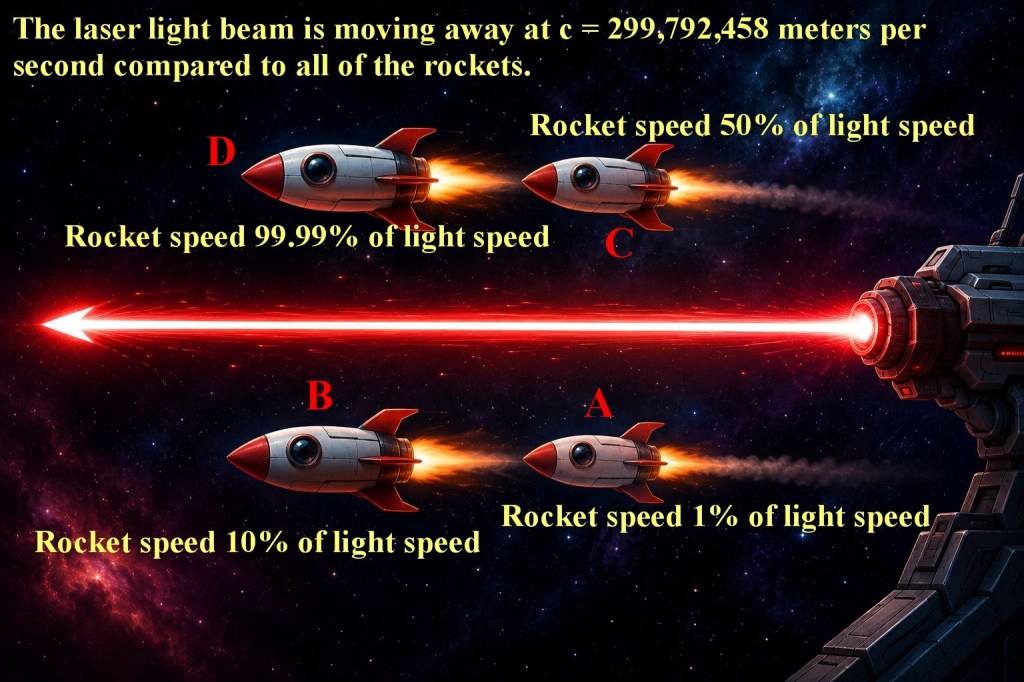
A spaceship on the right is shooting out a laser beam towards the left. Alongside the laser beam are four rockets trying to catch up with the light beam. | The speed of light is the speed of causality
Four rockets, A, B, C, and D, are traveling along a light (laser) beam. No matter how fast they travel along the light beam, the light beam will always travel c = 299,792,458 meters per second faster than they do. I generated this picture with the help of ChatGPT.

I am posting about the speed of light again because there are so many aspects of it that are mind blowing. For starters, “The Speed of (Light in Vacuum) Is a Universal Constant”. It is always c = 299,792,458 meters per second for everyone no matter at what speed they are travelling. If you try to catch up to a light beam by going faster and faster the light beam will still keep moving at c = 299,792,458 meters per second faster than you. No matter how much you accelerate you can never catch up. The beam will keep moving away from you at c = 299,792,458 meters per second. This is possible because time and space are relative, at least if viewed separately, like we do.
Clocks being sucked into a hole or possibly sped up into space.
Time is going to be different for me than for you. From shutterstock Illustration ID: 1055076638 by andrey_l

Photons and other massless particles will always move exactly at the speed of light c = 299,792,458 meters per second, whilst anything with mass could never travel at the speed of light. It will always move slower. In fact, when something with mass is approaching the speed of light, its mass will grow towards infinity, and it will require infinite energy to accelerate it to the speed of light. Basically, something with mass can never accelerate to reach the speed of light.
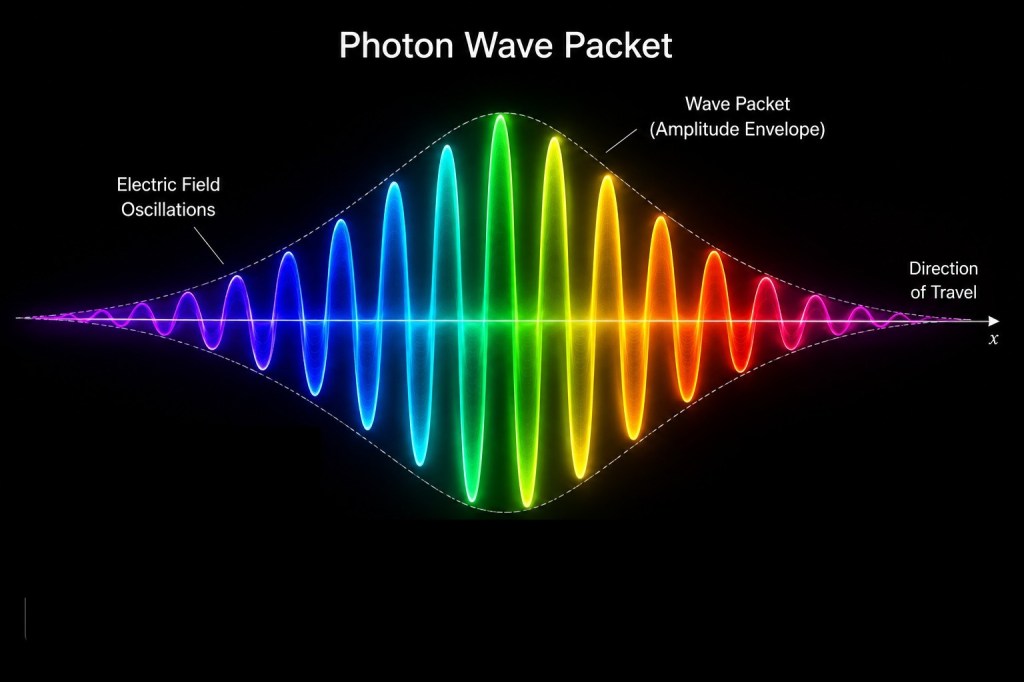
A colorful photon wave packet showing small amplitudes on the left, larger amplitudes in the middle and then small amplitudes on the right. | The speed of light is the speed of causality
A photon wave packet. It has no mass, travel at the maximum speed, the speed of causality, and time does not exist for the photon.

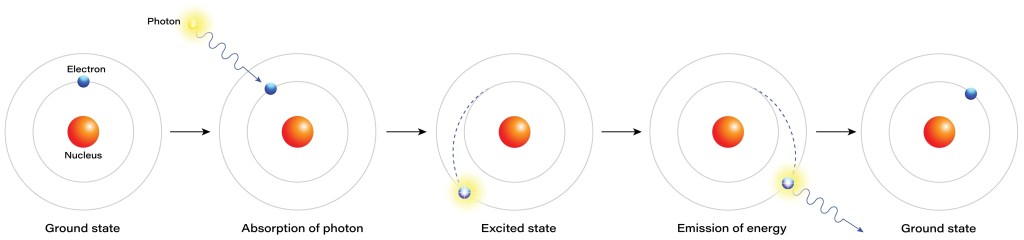
Note: In my first paragraph I wrote (Light in Vacuum) in parenthesis because light always travels at c = 299,792,458 meters per second, but it appears to be going slower in transparent matter. When light moves through matter it is being absorbed and emitted as it “travels” between the atoms in the material, and this absorption and emittance process takes time.
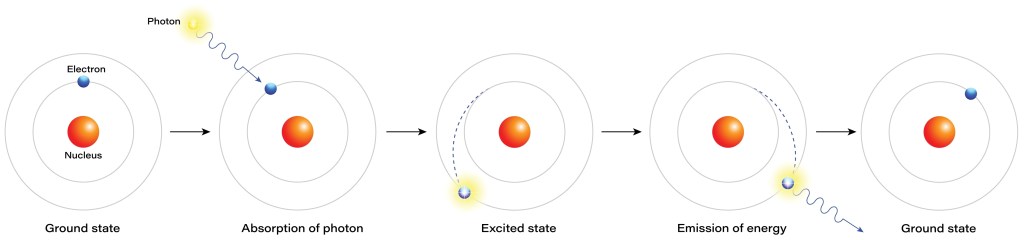
From left to right, an atom absorbs a photon, which excites an electron that jumps into a higher orbit. Then it emits a photon and the electron falls back to the ground state again.
From ground state to excited state, absorption and emission of a photon in an atom. Shutterstock asset id: 2180385419 by rktz.

As mentioned, the speed of light is a maximum speed limit for any action, signal, or information to travel from one place to another. Einstein’s theory of relativity shows that space and time are linked. The c = 299,792,458 meters per second acts as a conversion factor that binds space and time together. So, in a sense the speed of light is not even a speed in a regular sense, it is a property of time and space.
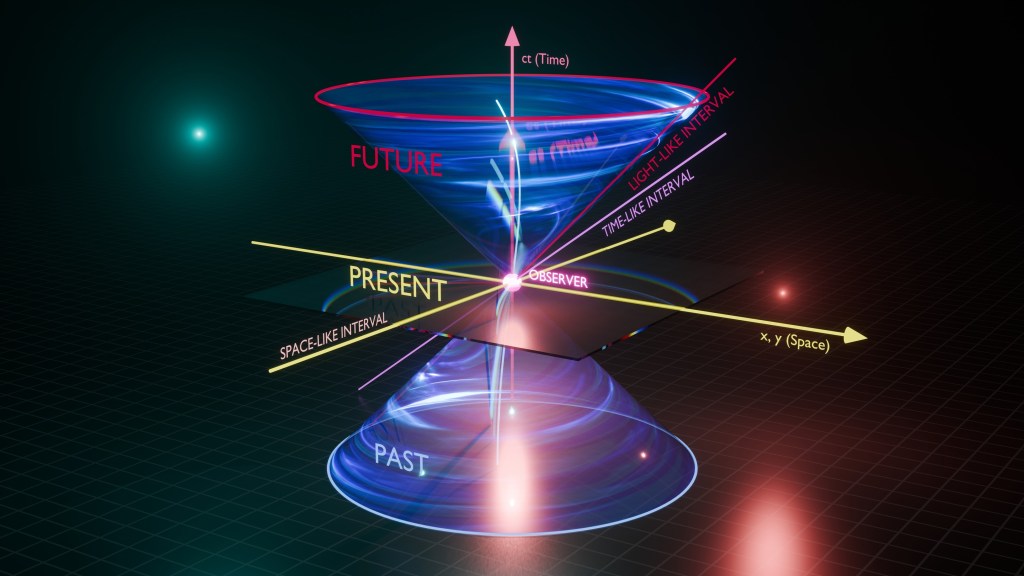
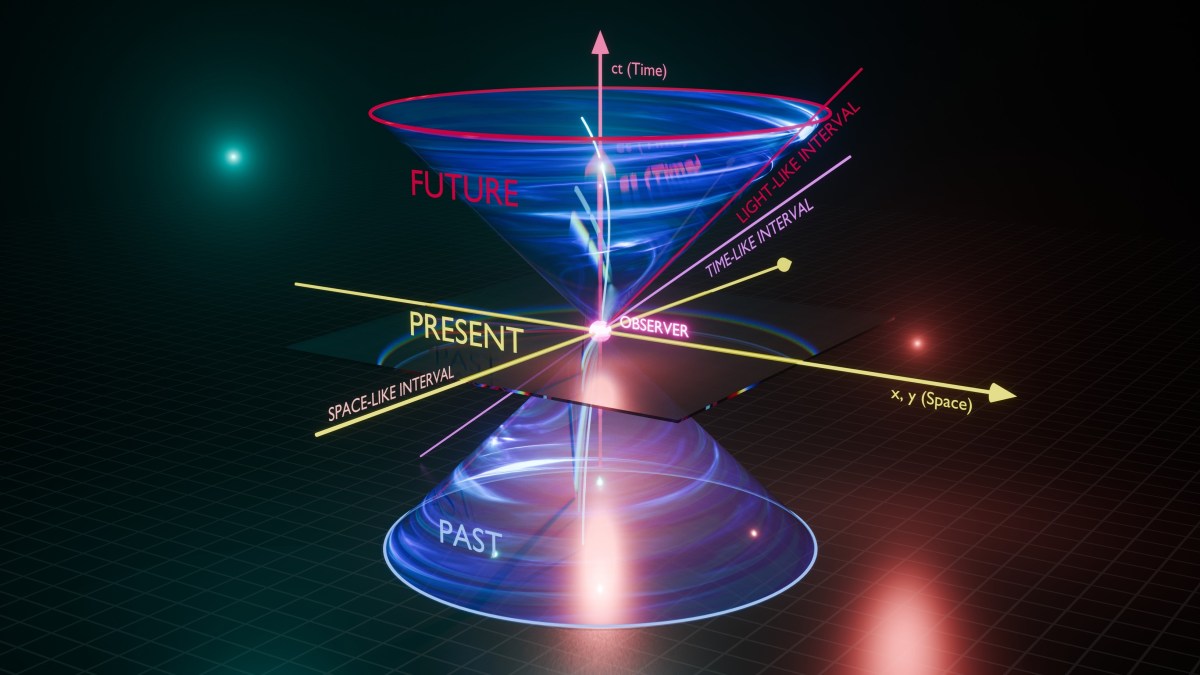
Scientific visualization of Minkowski light cone diagram demonstrating physics of special relativity theory and spacetime intervals, 3D rendering. 3D Illustration. | The speed of light is the speed of causality
In the light cone diagram above, an observer can only affect what is confined within the future cone above it. Shutterstock asset id: 2728984295 by atdigit

The cone diagram above is a coordinate system with time being the pink arrow going from the bottom and up. The yellow arrows represent the x and y axis representing space. The center is the observer (you).  The past cone below the center represents all the past events that could have affected you (the center). The future cone represents everything that you could possibly affect in the future. All light beams travel on the surface of the future cone. What is outside these cones are parts of the Universe you cannot affect and that cannot affect you. This is the non-observable part of the Universe.

That the speed of light is also the speed of causality, or the maximum speed of cause and effect is an important fact that is mind blowing, and therefore a super fact in my opinion.

Light is Beyond the Reach of Time

Since the speed of light is a conversion factor between time and space and not a speed in a real sense there is more to say about the speed of light that may come as a surprise, for example, that time does not exist for photons. This means that from the photon’s perspective there will be no time at all. A photon, or a light beam, will travel from Earth to a distant galaxy a billion light years away in an instant.

It will not take a billion years. It will not take one year. It will not take one second. It will not take one microsecond. It will not take a nanosecond, or a picosecond, or a trillionth of a picosecond. It will take zero seconds. The Big Bang and the end of the Universe (if there is one) happen at the same exact moment from the perspective of a photon. Time does not exist for a photon (or a gluon, or any other mass-less particle). This is explained in greater detail in my post “Light is Beyond the Reach of Time”.


What About Quantum Entanglement?

What about quantum entanglement? You may have heard about instantaneous action across vast distances due to quantum entanglement. Quantum entanglement is when pairs or groups of particles interact in ways such that the quantum state of each particle cannot be described independently of the others, even when the particles are separated by a vast distance. Therefore, measuring the state of one particle instantly determines the state of the other. Does that not violate the speed of light being the speed of causality? It turns out that it doesn’t.
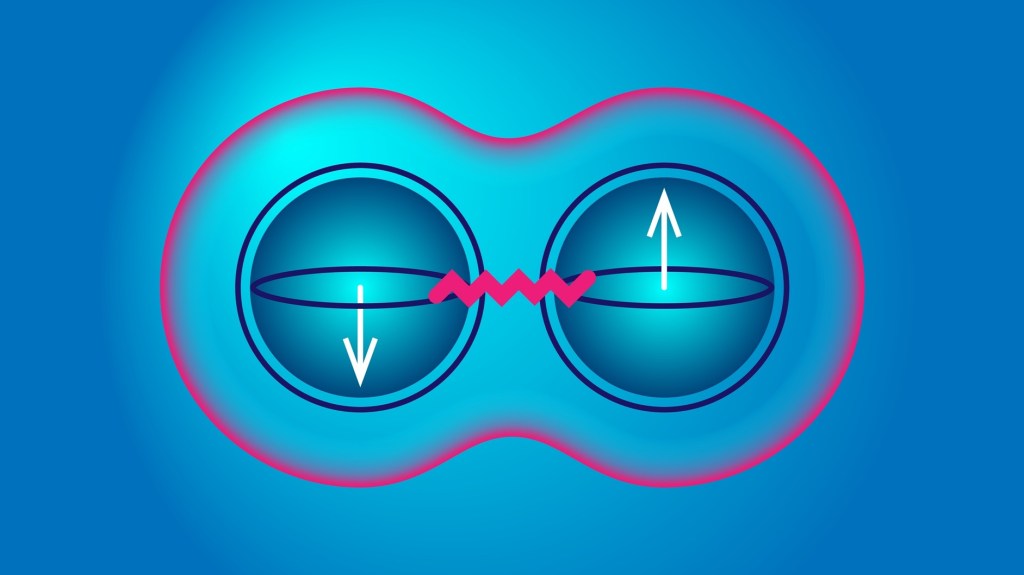
Entanglement of quantum qubits in superposition, schematic block spheres representation, two particles, one with spin up and one with spin down, measured state, visualization of concepts of quantum computing, vector illustration.
Two entangled particles, one with spin up and one with spin down. If you measure one the other one will manifest the opposite spin across any distance.

It can be understood the following way. Imagine two identical looking shoe boxes, one containing a left white shoe and the other containing a black right shoe. If you were to randomly scramble the two boxes so that you did not know in which box respective shoe was. Then you send one of the boxes to Mars. If you open the shoe box still on earth, you will instantly know the content of the box on Mars. The Martians don’t need to send a message to Earth.

The analogy is not perfect because unlike the shoe boxes the quantum case involves pure randomness. The content of the shoe boxes has been predetermined, and the randomness stem from the fact that we don’t know which box is which. But the shoes are there the whole time before you open any box. This corresponds to what you would call a hidden variable in physics. In the quantum case, the quantum state is not hidden or predetermined, there is no hidden variable, it does not even exist until you measure. It is true randomness. However, it is still similar in the sense that no signal, no message, and no information is being sent, and no message or information need to be sent.

The speed of light is the speed of causality
Two red boxes with a white left shoe and a black right shoe. I used ChatGPT to generate image.

What about Warp Drives ?

So, nothing with mass can travel at the speed of light, and nothing can exceed it. What about the warp drive in Star Trek? As I said, the speed of light is not really a speed but the conversion factor between time and space. It is a geometric fact of space-time. That is a pretty difficult reality to get around, just like it is pretty difficult to push Earth out of its orbit by pushing on the floor. However, there is a way to cheat and that is to stretch space-time itself. This is theoretically possible, but it requires colossal amounts of mass-energy and enormous amounts of negative energy. We don’t even know if negative energy exists on a macroscopic scale.

So, no one knows if a warp drive is possible, and if it isn’t, then we are stuck moving slower than the speed of light, which would make interstellar travel very difficult and inconvenient.

Other Super Facts Related to the Speed of Light


To see the Other Super Facts click here

Light is Beyond the Reach of Time
Superfact 116: Time and space do not exist for light particles (called photons) and not for other particles without mass either. All massless particles travel at the speed c = 299,792,458 meters per second compared to all other objects regardless of how fast those other objects are moving. Objects / particles that have mass will always travel slower than c = 299,792,458 meters per second. The speed of light, c, is not really a speed. It is a conversion factor between space and time. It is therefore a universal constant.

An eye with photons streaming into it. | Light is Beyond the Reach of Time
Billions of photons coming into the eye. Shutterstock asset id: 2629068895 by muratart.

Light does not travel through a medium, like a sound wave, or a water wave does. There is no medium for light to travel in. Photons are massless, which means that an extremely tiny force, an infinitesimal smallest possible force, could send a photon off at infinite speed. There is no mass to hold the photon back.

However, the conversion factor between space and time c = 299,792,458 meters per second will prevent that and the photon will travel at this “speed”. Since c is a conversion factor, a physical constant describing time and space, this is not motion, or movement, in a normal sense. Space and time won’t allow any physical event to have any effect faster, and no information of any kind can travel faster than c = 299,792,458 meters per second.

One of the effects of the speed of light being a universal constant is that different observers measure different distances and time durations, and even the order of events may be in different orders for different observers. As you travel ever closer to the speed of light the time it will take to travel between two points will shrink towards zero as you approach the speed of light. In addition, the distance between the two points will shrink. You can read Albert Einsteins original paper on the topic here, and about space-time here.

This means that from the photon’s perspective there will be no time at all. A photon, or a light beam, will travel from Earth to a distant galaxy a billion light years away in an instant. It will not take a billion years. It will not take one year. It will not take one second. It will not take one microsecond. It will not take a nanosecond, or a picosecond, or a trillionth of a picosecond. It will take zero seconds. The Big Bang and the end of the Universe (if there is one) happen at the same exact moment to a photon. Time does not exist for a photon (or a gluon, or any other mass-less particle).

This is a mind-blowing fact, and it is true and important to our understanding of the Universe. Therefore, I consider it a super fact.

What does the Speed of Light Being a Universal Constant Mean ?

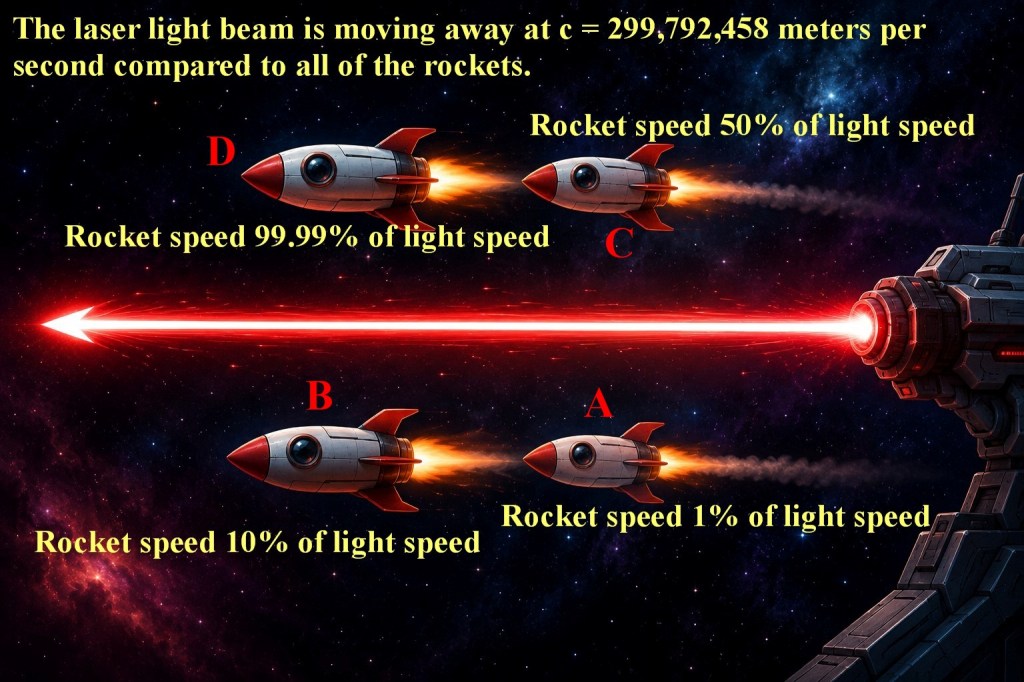
A spaceship on the right is shooting out a laser beam towards the left. Alongside the laser beam are four rockets trying to catch up with the light beam.
Four rockets, A, B, C, and D, are traveling along a light (laser) beam. No matter how fast they travel along the light beam, the light beam will always travel c = 299,792,458 meters per second faster than they do. I generated this picture with the help of ChatGPT.

The first thing to acknowledge about the speed of light (in vacuum) is that it is a universal constant as explained in my post “The Speed of Light in Vacuum Is a Universal Constant”. However, I am explaining this fact slightly differently in the next few paragraphs with the help of the picture above.

In the picture above we are emitting a light beam from our spaceship using our super laser. There are also four rockets that travel along the light beam. The rocket on the lower right (rocket A) travel at 1% of the speed of light v = 2,997,924.5 meters per second (or 2,998 miles per second). That is extremely fast, but much slower than light. You would think that the light beam would travel a little bit slower compared to this rocket at the relative speed c – v = 299,792,458 – 2,997,924.5 = 296,794,533.5 meters per second. But it doesn’t. The light beam is still speeding ahead of rocket A at exactly c = 299,792,458 meters per second.

What happens if you compare the beam with the rocket in the lower left (rocket B)? That rocket travels at 10% the speed of the light beam. Shouldn’t the light beam move 10% slower compared to that rocket? No, the light beam speeds ahead at exactly c = 299,792,458 meters per second compared to rocket B, once again.

Now take rocket C in the upper right corner. It also travels along the light beam but at half the speed of light. Shouldn’t the light beam travel at half of the speed of light compared to rocket C? No, it will stubbornly travel at exactly c = 299,792,458 meters per second compared to rocket C. Not less and not more.

The same is true for the rocket in the upper left, rocket D. It travels at 99.99% of the light speed compared to us in the spaceship, and yet the light beam will stubbornly travel at exactly c = 299,792,458 meters per second compared to rocket D. Not less and not more.

The universal speed c = 299,792,458 meters per second is not so much about light. As mentioned, it is a conversion factor between space and time. You take this conversion factor with you everywhere you go and regardless of how fast you move. That’s the way time and space works.

The fact that the speed of light is a universal constant that is exactly the same for all observers, no matter how fast they move, should tell you that it is not a speed in a normal sense. It is not really a “speed” at all. As mentioned, it is a conversion factor between space and time. Light isn’t really travelling super-fast. It is just conforming to the geometric reality of time and space, and to us it looks like it is travelling at the speed c = 299,792,458 meters per second.

The Space-Time Interval for Light is Zero

I mentioned that from the photons perspective time does not exist but that from our perspective light travel through space or seem to travel through space and that takes time. However, for us space and time are separate things. If you combine them and measure space-time intervals instead you get a more complete picture. In 3D space you get the distance between two points by adding the differences between the coordinates using Pythagoras theorem, s^{2}=x^{2}+y^{2}+z^{2}. (x, y, and z, are differences in the coordinates) As long as you are consistent with the units you will always get the same distance regardless of position and orientation of your coordinate system. You can read more here.

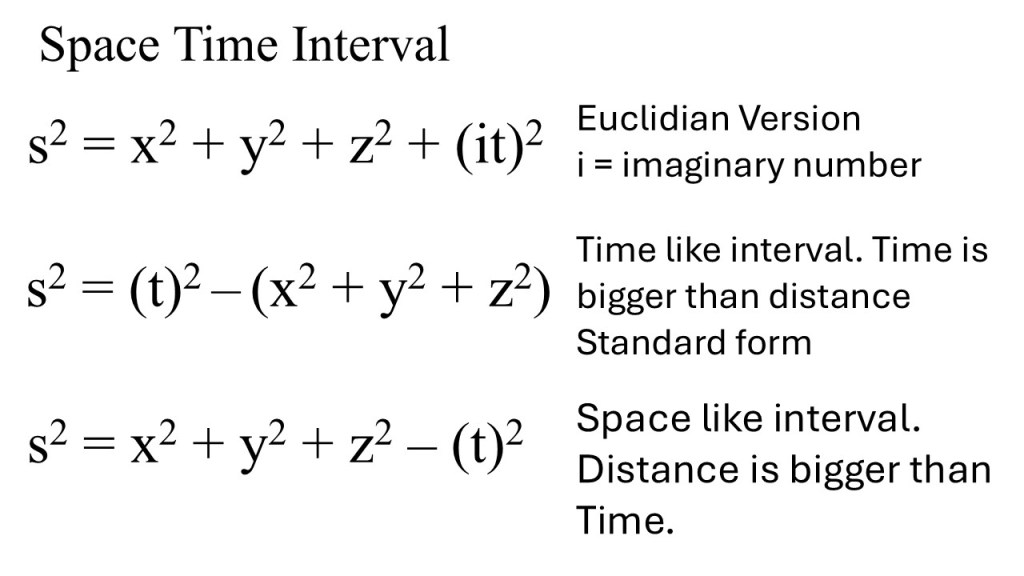
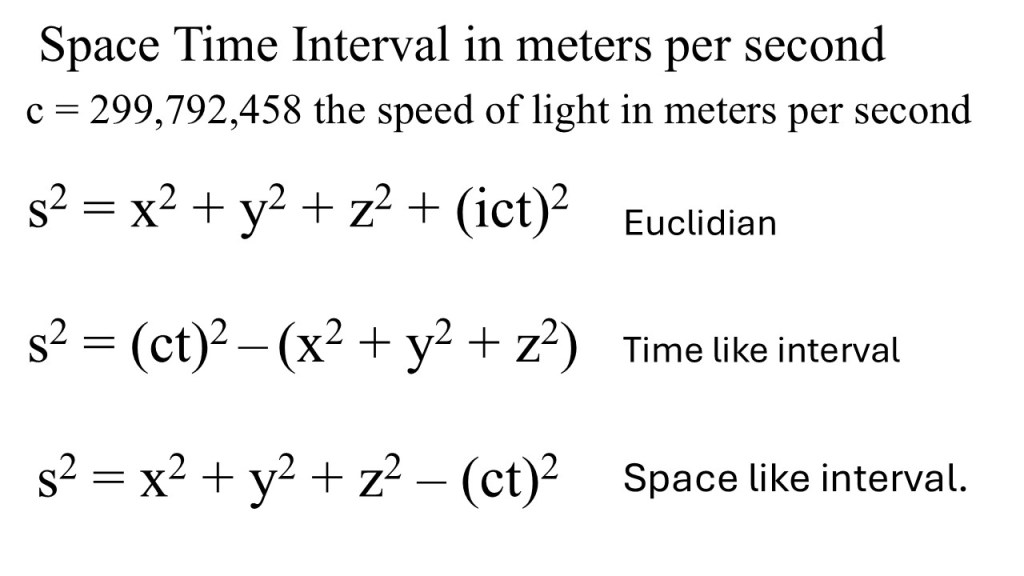
If you add time to Pythagoras theorem you will get the space-time interval, which interestingly enough is the same for all observers. There is no time dilation or length contraction in the interval. s^{2}=x^{2}+y^{2}+z^{2}+(it)^{2} As you might suspect, intervals involving light travelling from one event to another will always be zero for all observers, and not just from the photons perspective. And again, the same applies to all massless particles. Below are the Pythagoras formulas for different versions of the interval. In the top picture it is assumed that the conversion factor c = 299,792,458 meters per second has already been baked into to the time variable and in the bottom it has not. This is not any stranger than converting feet to meters.

The image shows three formulas for the spacetime interval Euclidian: “(s^{2}=x^{2}+y^{2}+z^{2}+(it)^{2}”.  For Time like intervals, the standard form: “(s^{2} = t^{2} – (x^{2}+y^{2}+z^{2}))”. For distance like intervals: “(s^{2} = ((x^{2}+y^{2}+z^{2}) – t^{2}))”. | Light is Beyond the Reach of Time
The three formulas for the spacetime interval above all assume that the unit used for time is the time it takes light in vacuum to travel the distance unit used. If that is meters, it would be the time it takes light to travel one meter. The top formula is the Euclidian form of spacetime. It contains only the ‘+’ operator at the expense of adding the imaginary number (square root of -1) in front of the time coordinate. The second form is typically used with time like intervals and considered the standard form. The third form is used when the distance between two events is larger than the time distance, or distance like intervals.
The image shows the formulas for the spacetime interval with the constant representing the speed of light in vacuum “(s^{2}=x^{2}+y^{2}+z^{2}+(ict)^{2}”,  “s^{2}= (ct)^{2} – (x^{2}+y^{2}+z^{2})” and “(s^{2}=x^{2}+y^{2}+z^{2}-(ct)^{2}”.
If you measure the space coordinates in meters and the time in seconds you must adjust the units to match by inserting the speed of light in vacuum c = 299,792,458. The three forms of the space interval now have the constant c attached to the time coordinate.

What about the speed of light in water ?

It is well known that the speed of light in transparent materials such as water and glass is slower than the speed of light in vacuum. The speed of light it water is about 75% of the speed in vacuum and about 70% or less in glass (depending of the type of glass) compared to the speed in vacuum. In some materials the speed of light can be much less than that. This seems to violate what I said above about the speed of light always moving at c = 299,792,458 meters per second for all observers regardless of their speed.

What is going on is that when light moves through matter it is being absorbed and emitted as it “travels” between the atoms in the material, and this absorption and emittance process takes time. This time is extremely short but long enough to be measurable. As the photons move in between the atoms they travel at the “speed”  c = 299,792,458 meters per second, the time to space conversion factor I’ve been talking about. See the illustration below.

From left to right, an atom absorbs a photon, which excites an electron that jumps into a higher orbit. Then it emits a photon and the electron falls back to the ground state again. | Light is Beyond the Reach of Time
From ground state to excited state, absorption and emission of a photon in an atom. Shutterstock asset id: 2180385419 by rktz.

More about the mass of a Photon

I’ve said photons have no mass. According to Einstein’s theory of special relativity, time does not pass (or effectively “exist”) from the perspective of a massless particle. However, this is the intrinsic mass or so called proper mass or invariant mass. It is the mass of an object as measured by an observer who is completely at rest relative to it. This intrinsic mass is the mass that a photon does not have.

The mass of an electron is 511 Kilo Electron Volts, which is  0.0000000000000000000000000009109 grams. That is the intrinsic mass of the electron. If an electron is sped up to close the speed of light its mass increases and goes toward infinity. If its speed is very close to the speed of light its mass could be much bigger than that of the entire Universe. That’s because as you are increasing the speed of the electron, you are increasing its kinetic energy and as you increase the total energy of the electron you also increase its total mass according to E = mc2.

As the electron’s speed approaches the speed of light the kinetic energy goes toward infinity. That is one reason why it is impossible to travel at exactly the speed of light for anything but massless particles. Infinite energy and infinite mass are not realistic. We, the objects that have mass, can move closer and closer to light speed but never get there.

However, the intrinsic mass for photons is zero and therefore the photon is travelling at exactly the speed of light, c = 299,792,458 meters per second. E = mc2 still applies to light but the mass is not the intrinsic mass, which is zero, but the total mass, and the total mass can pretty much take on any number.

What about Warp Drives ?

So, nothing with mass can travel at the speed of light, and nothing can exceed it. What about the warp drive in Star Trek? As I said, the speed of light is not really a speed but the conversion factor between time and space. It is a geometric fact of space-time. That is a pretty difficult reality to get around, just like it is pretty difficult to push Earth out of its orbit by pushing on the floor. However, there is a way to cheat and that is to stretch space-time itself. This is theoretically possible, but it requires colossal amounts of mass-energy and enormous amounts of negative energy. We don’t even know if negative energy exists on a macroscopic scale.

So, no one knows if a warp drive is possible, and if it isn’t, then we are stuck moving slower than the speed of light, which would make interstellar travel very difficult and inconvenient.

Richard Feyman’s Lecture on Why Light Is NOT Moving Through Space?

The YouTube video below is very long, 48 minutes. However, Richard Feyman, Nobel prize winner in physics, has a knack for explaining extremely abstract concepts so that they are easy to understand. If you are very interested in this topic and have some extra time, this is a fascinating lecture. He certainly explains this topic better than I can.

Other Super Facts Related to the Speed of Light

To see the Other Super Facts click here