The goal of this blog is to create a list of what I call super facts. Super facts are important and true facts that nevertheless are surprising to a lot of people, mind-blowing, or misunderstood or disputed among non-experts. They are special facts that we all can learn something important from. However, I also create posts that are not super facts but feature other interesting information, such as this book review and book recommendation. The book is:
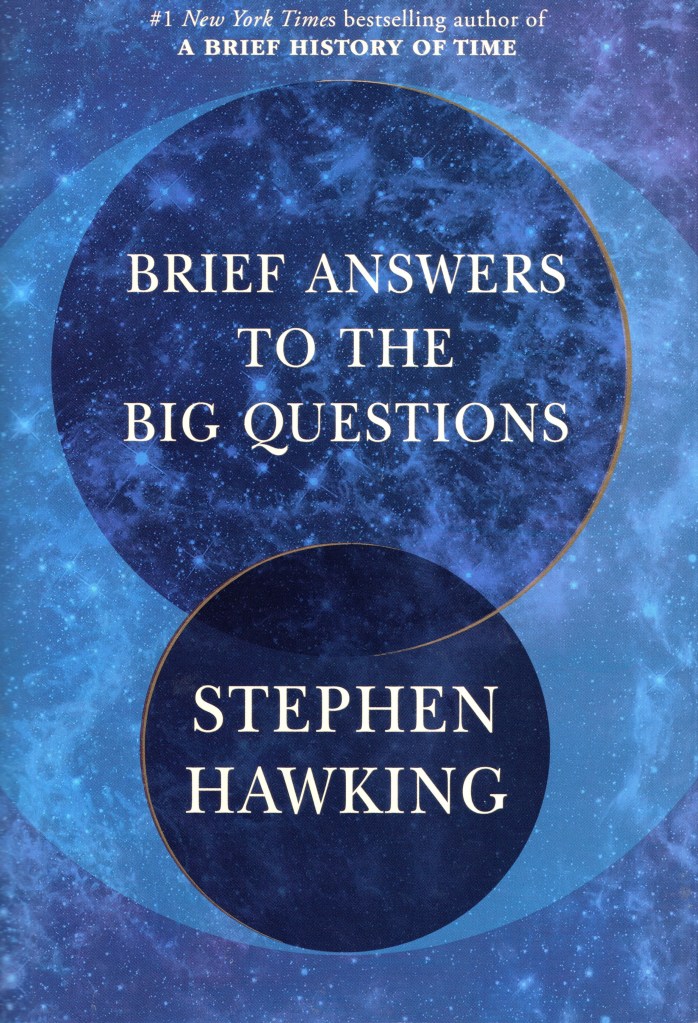
Brief Answers to the Big Questions by Stephen Hawking
Below I am listing the four editions of this book. I bought and read the hardback version.
- Hardback – Publisher : Bantam (October 16, 2018), ISBN-10 : 1984819194, ISBN-13 : 978-1984819192, 256 pages, item weight : 12.8 ounces, dimensions : 5.55 x 0.8 x 8.1 inches. It costs $11.58 on US Amazon. Click here to order it from Amazon.com.
- Paperback – Publisher : Random House Large Print (November 13, 2018), ISBN-10 : 1984887262, ISBN-13 : 978-1984887269, 352 pages, item weight : 10 ounces, dimensions : 5.3 x 0.82 x 7.8 inches. It costs $27.00 on US Amazon. Click here to order it from Amazon.com.
- Kindle – Publisher : Bantam (October 16, 2018), ASIN : B07D6BBGKL, ISBN-13 : 978-1984819208, 227 pages, it costs $5.99 on US Amazon. Click here to order it from Amazon.com.
- Audiobook – Publisher : Random House Audio (October 16, 2018), ASIN : B07FW4NT2X, Listening length : 4 hours and 51 minutes. $0.99 with membership. Click here to order it from Amazon.com.
Amazon’s Description of the Book
“Hawking’s parting gift to humanity . . . a book every thinking person worried about humanity’s future should read.”—NPR
NAMED ONE OF THE BEST BOOKS OF THE YEAR BY Forbes • The Guardian • Wired
Stephen Hawking was the most renowned scientist since Einstein, known both for his groundbreaking work in physics and cosmology and for his mischievous sense of humor. He educated millions of readers about the origins of the universe and the nature of black holes, and inspired millions more by defying a terrifying early prognosis of ALS, which originally gave him only two years to live. In later life he could communicate only by using a few facial muscles, but he continued to advance his field and serve as a revered voice on social and humanitarian issues.
Hawking not only unraveled some of the universe’s greatest mysteries but also believed science plays a critical role in fixing problems here on Earth. Now, as we face immense challenges on our planet—including climate change, the threat of nuclear war, and the development of artificial intelligence—he turns his attention to the most urgent issues facing us.
Will humanity survive? Should we colonize space? Does God exist? These are just a few of the questions Hawking addresses in this wide-ranging, passionately argued final book from one of the greatest minds in history.
Featuring a foreword by Eddie Redmayne, who won an Oscar playing Stephen Hawking, an introduction by Nobel Laureate Kip Thorne, and an afterword from Hawking’s daughter, Lucy, Brief Answers to the Big Questions is a brilliant last message to the world.
This is my five star review for the book Brief Answers to the Big Questions
Smart but Brief Answers to Some Big Questions
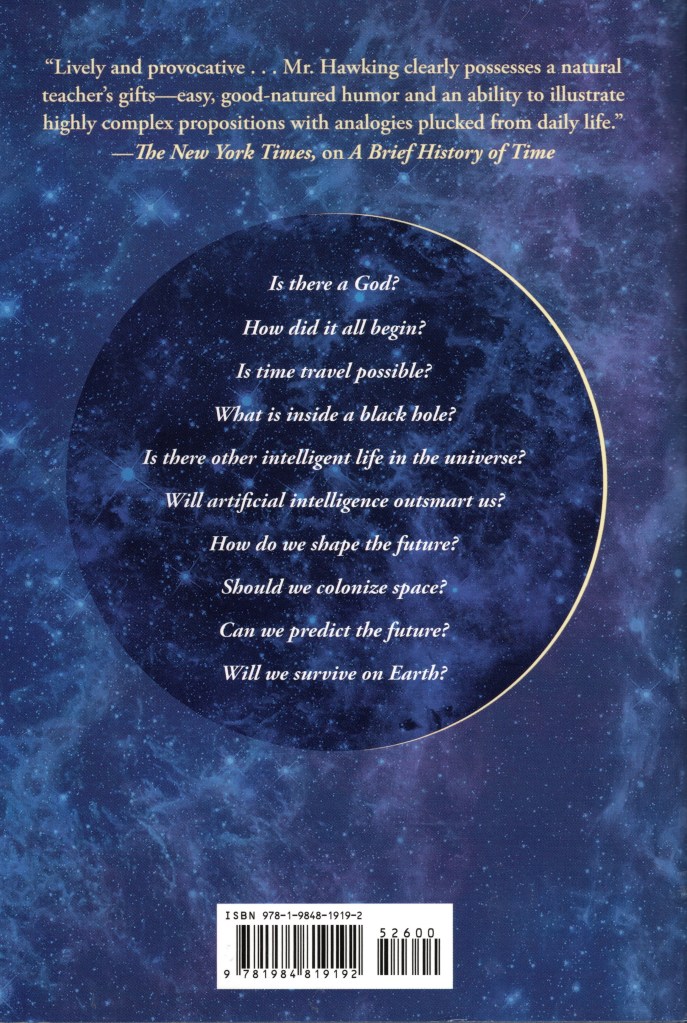
People want answers to the big questions. Is there a God? How did it all begin? Is time travel possible? Is there other intelligent life in the Universe? Will artificial intelligence outsmart us? Will we survive on Earth? Should we colonize space? That’s some of the questions that Stephen Hawking address in this book. Stephen Hawking is answering these questions as simply and as briefly as possible at the same time as he uses advanced scientific knowledge and his deep insights and intelligence to do it. However, to read this book you need to be curious and open to using scientific knowledge and logic. The book is for those who intentionally seek the truth and not confirmation of their existing beliefs. That does not mean that Stephen Hawking will arrive at conclusive answers “Yes” or “No” answers.
Take for example the question “Is there a God?” His answer is not “Yes” or “No”. His answer is to explain why the Universe does not need a creator and assuming that the cosmological viewpoint that time and space came into existence with the Big Bang, why the Universe cannot even have a creator. He is using modern physics and logic to deduct those answers, but they are not identical to a simple “No”. As to whether we will survive on Earth, he states that global warming, which is caused by us burning fossil fuels, is potentially a civilization destroying threat, which we may not survive during the next 1,000 years. He says the same thing about nuclear weapons, which do not seem to go away and instead more countries want to adapt. At some point during the next 1,000 years something could go very wrong, whether it is a total nuclear war or runaway global warming. He is also concerned that malevolent Artificial Intelligence could one day outsmart us. He talks about the doomsday clock. These are all well informed opinions but not definite answers.
Along the way we learn about a lot of concepts from science, especially physics. We learn about quantum physics, special and general relativity, black holes, gravitational collapse, the big bang, inflation (the cosmological kind), multiverses, the strong and weak anthropic principle, the information paradox, hawking radiation, antiparticles, virtual particles, supertranslations, cosmic strings, the Higgs Boson, the Large Hadron Collider, vacuum fluctuations, the Casimir effect, the chronology protection conjecture, nuclear fusion, nanocrafts, the technological singularity, etc. He does not explore these concepts in depth but explains them well enough to be useful for answering the big questions for laymen. He is obviously an admirer of Albert Einstein, and I think for good reason I should add.
This book is written for laymen, people who are not physicists, and not experts on these matters. It is well written and relatively easy to understand. Not everyone will like all of the answers but as a reader make sure you understand the arguments and facts before you reject an answer because you don’t like it. Stephen Hawkings was an amazing scientist and he is certainly missed. I highly recommend this book to everyone.