
The goal of this blog is to create a list of what I call super facts. Super facts are important and true facts that nevertheless are surprising to a lot of people, mind-blowing, or misunderstood or disputed among non-experts. They are special facts that we all can learn something important from.
However, I also make posts that are not super facts but feature other interesting information, such as this book review and book recommendation. The book is:
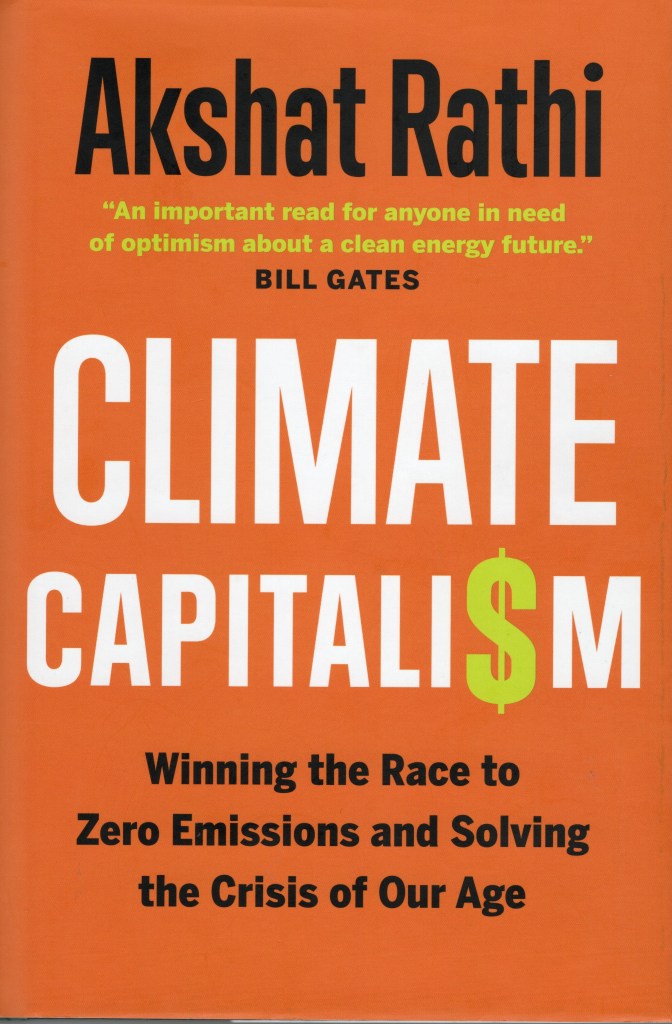
Climate Capitalism: Winning the Race to Zero Emissions and Solving the Crisis of Our Age by Akshat Rathi
I should say that I am part of a book club and we recently read two books “This Changes Everything: Capitalism vs. The Climate by Naomi Klein” as well as “Climate Capitalism: Winning the Race to Zero Emissions and Solving the Crisis of Our Age by Akshat Rathi”. They were supposed to be contrasts.
Naomi Klein’s book was anti-capitalism and Akshat Rathi’s book was pro-capitalism, or rather pro-climate-capitalism, meaning a type of capitalism that takes into consideration that polluting the atmosphere for everyone should not be without any type of cost to the polluter. I liked Akshat Rathi’s book, but I had a hard time with Naomi Klein’s book because I found it to be very ideological, filled with strong opinions I could not agree with, a lot of misinformation, and it was very pessimistic and negative. I gave it two stars and wrote a detailed review on Amazon as to why. However, I am not publishing that review here. You can read my Amazon review for Naomi Klein’s book This Changes Everything by clicking here.
The book I am reviewing here is Climate Capitalism: Winning the Race to Zero Emissions and Solving the Crisis of Our Age by Akshat Rathi.
Below I am listing the four versions of this book. I bought the hardback version.
- Hardback – Publisher : Greystone Books (March 12, 2024), ISBN-10 : 1778401856, ISBN-13 : 978-1778401855, 272 pages, item weight : 1.05 pounds, dimensions : 6 x 0.9 x 9 inches. It costs $13.84 on US Amazon. Click here to order it from Amazon.com.
- Paperback – Publisher : John Murray (June 20, 2024), ISBN-10 : 1529329949, ISBN-13 : 978-1529329940, 272 pages, item weight : 6.8 ounces, dimensions : 5.04 x 1.1 x 7.72 inches. It costs $ 12.69 on US Amazon. Click here to order it from Amazon.com.
- Kindle – Publisher : Greystone Books (March 12, 2024), ASIN : B0CHH9KQ23, 253 pages, it costs $13.15 on US Amazon. Click here to order it from Amazon.com.
- Audiobook – Publisher : Tantor Media (April 16, 2024), ASIN : B0CZYVNYDC, Listening length : 7 hours and 50 minutes. $0.00 with membership. Click here to order it from Amazon.com.
Amazon’s Description of the Book
“An important read for anyone in need of optimism about our ability to build a clean energy future.”—BILL GATES
“Illuminating, incisive, and deeply reported.”—DAVID WALLACE-WELLS, New York Times-bestselling author of The Uninhabitable Earth
Our age will be defined by the climate emergency. Contrary to the doomist narrative that’s taken hold about the climate emergency, the world has already begun deploying the solutions needed to deal with it. On a journey across five continents, Climate Capitalism tracks the unlikely heroes driving the fight against climate change. From the Chinese bureaucrat who did more to make electric cars a reality than Elon Musk, to the Danish students who helped to build the world’s longest-operating wind turbine, or the American oil executive building the technology that can reverse climate damages, we meet the people working to scale technologies that are finally able to bend the emissions curve.
Through stories that bring people, policy and technology together, Akshat Rathi reveals how the green economy is not only possible, but profitable. This inspiring blend of business, science, and history provides the framework for ensuring that future generations can live in prosperity and that the wheels of progress don’t falter.
This is my five star review for the book Climate Capitalism
Climate Capitalism
Blaming capitalism for climate change is simplistic. Capitalism and the “free market” work within a framework of laws. If there were no laws and everyone could just steal and kill each other, you would have miserable anarchy not a free market. However, the market could be framed by different kinds of laws and regulation. In other words, it can come in different flavors.
The book talks about “economic externalities”. A negative externality is when economic activity harms society. An example is pollution and climate change. Is the free market really “free” or “functional” if people are harmed by the economic activity of others? However, you can correct climate change related market failures, for example, by putting a price on carbon. Innovation and technological developments have been crucial in taking us in the right direction toward solving the climate change problem, and so have markets of scale, competition in the market, good policy and the right type of regulated capitalism. This book argues for what the author calls climate capitalism.
The book features a lot of enlightening and inspirational stories about innovators and business leaders who have accomplished amazing feats that are bringing us closer to solving the climate crisis. Wan Gang, a Chinese inventor, business leader, and official who got the Chinese Electric Vehicle revolution going, like Elon Musk did in the West. Sinha, the Indian entrepreneur and the success of solar power. Birol, the Turkish politicians fighting for clean energy and thereby addressing the two biggest challenges of the century: climate change and access to energy for all.
He tells us about Bill Gates efforts to use business and philanthropy to address climate change. He discusses the promise (and disappointments) of carbon capture and storage. The amazing success of a Danish fossil fuel company evolving into a renewable energy company. He tells us about Capitalists buying and selling shares in a smart way to direct the actions of companies, and he explains why plain divestment strategies does not do much to hurt companies fundamental business. There is also a chapter on campaigners and activists. The author states that democracy can be the biggest way to rein in the excesses of capitalism.
He also tells us about fossil fuel companies that behaved very badly. The oil industry knew about the link between fossil fuel burning and global warming as far back as 1959 but chose to hide it and spread misinformation about climate change. In 1989 the fossil fuel industry formed the Global Climate Coalition, GCC, only a few months after the UN had established the Intergovernmental Panel on Climate Change (IPCC).
The five leading oil companies in the GCC, ExxonMobil, BP, Chevron, Shell, and ConocoPhillips publicly spent at least 3.6 billion dollars on advertising and 2 billion dollars on government lobbying (in reality a lot more). Even though all oil companies have since accepted the overwhelming science of climate change and the role fossil fuels play in it, many haven’t quite accepted the changes that will be needed to truly tackle the problem. And the misinformation they spread still lives on.
In summary, the book contains a lot of interesting information that is both frustrating and hopeful. A lot of things have gone wrong, and a lot of things are going wrong, but we are beginning to turn things around. The recent astonishing worldwide success of renewable energy and EVs and the fact that a lot of countries, especially developed countries, have succeeded in significantly lowering their emissions while growing their economies, is a sign of that. The book is also captivating and easy to read, and it is well organized. Akshat Rathi is clearly a great author. I highly recommend this interesting, optimistic and fun read.
To see the Super Facts click here


Thanks for your review of this book, Thomas. Definitely an interesting read.
LikeLiked by 1 person
Thank you so much for your kind words Esther
LikeLiked by 1 person
That’s a nice review. I hope we’re not too late to turn things around.
LikeLiked by 1 person
Thank you so much Anneli. It is already too late to avoid some damage, but it is never too late to avoid much worse damage. I like to compare it with our national deficit. We should not have let it go to 40 trillion (the current) but 80 trillion is much worse on our kids and grandkids than 40 trillion. The sooner the better but never too late to start correcting.
LikeLiked by 1 person
Good attitude!
LikeLiked by 1 person
Thank you Anneli
LikeLiked by 1 person
Thomas, this is a solid, thoughtful take. I like how you keep it clear and grounded.
LikeLiked by 1 person
Thank you so much for your kind words Kymber
LikeLiked by 1 person
Thank you for this intelligent, balanced review. Good to know this is a fun, easy to read book. Innovators and business leaders bringing us closer to solving the climate crisis sounds hopeful. Still, there seem to be plenty business leaders doing damage. I’d like to support the companies working to protect our planet.
LikeLiked by 1 person
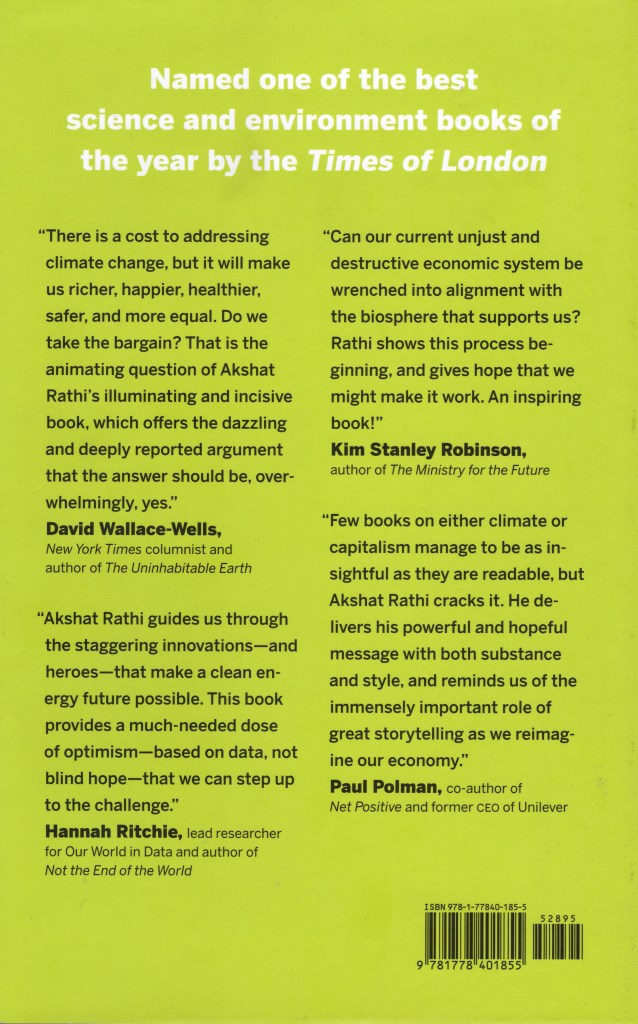
Thank you so much JoAnna. Yes it is not black and white. If you look at the back of the book one former CEO of a major corporation (Unilever) is very much supporting this book and so is Bill Gates of course. Some corporations and their leadership are trying to help solve the problem. Know which companies are fighting action on climate and which are trying to solve the climate crisis is difficult but a good help once you know.
LikeLiked by 1 person
Thanks for the great review. I like what you say about this book’s approach to showing how a pro-climate approach can also be good for innovative businesses. I think that kind of positive attitude is going to be necessary to improve the climate situation we find ourselves in.
I was also impressed to see that one of the quotes on the cover is from Kim Stanley Robinson. I was on a panel with him at a WorldCon a few years ago and I was impressed by how knowledgeable he was.
LikeLiked by 1 person
Yes I agree with you David. I liked his practical and pro-innovation and good-business (not the bad businesses) approach, with not so much ideology. I’ve read a few of Kim Stanley Robinson’s books. He is a great author. It is very cool that you were on a panel with him at WorldCon. Two great authors on the same panel.
LikeLiked by 1 person
This sounds like a useful and sensible book. Outside of gross greed, one of the biggest issues facing addressing climate change is the cost and the impact on jobs and economies. This author sounds like he is giving solid snd well thought out advice that is a realistic solution.
LikeLiked by 2 people
Thank you so much Robbie. Yes that is why I liked his book. It was practical and not so ideological.
LikeLike
Great review, Thomas. Thank you for diving in and sharing your impressions. Bravo…we need some hope.
LikeLiked by 2 people
Thank you so much for your kind words Gwen. Yes this book was more optimistic.
LikeLiked by 1 person
Thank you! This sounds up my alley!
LikeLiked by 2 people
Thank you so much Resa
LikeLiked by 1 person
Pleasure is mine!
LikeLiked by 1 person
Very interesting and concerned about climate capitalism as awaking campaign.
LikeLiked by 2 people
Thank you knowok
LikeLike
I’m currently at the point in Ministry for the Future where the central banks and other institutions are using carbon-linked cryptocurrency and other carrot/stick approaches to try to get capitalism and the financial industry to fix the climate problems that capitalism and the financial industry helped create. It’s a really interesting read despite my skepticism that the entities involved could be persuaded to act that way rather than continuing to mine all the short-term profit they possibly can lol
LikeLiked by 2 people
Oh yeah I remember that part. I remember thinking round about the same way you did. However, there are other approaches.
LikeLiked by 1 person
Java Bean: “Ayyy, we’re glad to hear that at least some people are trying to address the problem! Maybe that Kim Stanley Robinson was on to something after all!”
LikeLiked by 1 person
You are right Java Bean, that is comforting, and you are also right about Kim Stanley Robinson too, he was on to something after all!
LikeLike
Thank you for an impartial review of the two books. The book by Akshat Rathi sounds very interesting and timely, as awareness about renewable energy and greenhouse gas emissions has increased even in developing countries like India, which has set different targets to achieve.
LikeLiked by 1 person
Thank you so muc Kaushal for your kind words. I really liked the book by Akshat Rathi. He packed in a lot of interesting information in around 200 pages. He was not verbose. It was interesting to learn about the various entrepeneaurs in the renewable industy such as Sinha, the Indian entrepreneur. We don’t hear enough about them in the West. North America and Europe got their industrialization started using lots of fossil fuels but based on how things are going it looks like countries like India and China might be able to bypass the heavy use of fossil fuels and use more renewables instead.
LikeLiked by 1 person
Truly my pleasure, Thomas. Thank you for sharing additional information. You’re right, solar energy is being used very widely in independent houses and housing societies. If the government is responsive, there will be more positive developments. Akshat Rathi ‘s book is now in my TBR list. His name suggests he is of Indian origin.
LikeLiked by 1 person
Wow that is cool. Thank you Kaushal. It is a great book.
LikeLiked by 1 person
Yes, looks really interesting. I am interested in regenerative economics, where the cost of doing business or extraction as in fishing means we ask and commit to regeneration of the natural world- so extraction limited in one year and minimum damage to habitat may create more future proofed ecosystems and future food. I think the profit motive has driven a lot of damage and false sustainability. How do we leave the ocean more productive for the future.
LikeLiked by 1 person
That sounds like a very interesting topic and I certainly would like to learn more about it. It is great that you are doing that kind of research. You are learning and uncovering very important information.
LikeLiked by 1 person
This sounds like a fascinating and hopeful book. I especially like the focus on practical solutions, innovation, and the role of good policies in tackling climate change. Thanks for sharing your five-star review!
LikeLiked by 1 person
Yes I liked this book and it is hopeful, and I agree. I also like the focus on practical solutions, innovation, and the role of good policies in tackling climate change. Thank you for your kind words Anowar.
LikeLiked by 1 person
My pleasure 😊❤️
LikeLiked by 1 person
Un análisis muy constructivo y claro sobre What is Climate Capitalism. Destaca aspectos clave esenciales para entender el tema.
LikeLike