The goal of this blog is to create a list of super facts. Important facts that are true with very high certainty and yet surprising, misunderstood, or disputed by many. This blog aims to be challenging, educational, and fun, without it being clickbait. I determine veracity using evidence, data from reputable sources and longstanding scientific consensus. Prepare to be challenged (I am). Intentionally seek the truth not confirmation of your belief.
Author: thomasstigwikman
My name is Thomas Wikman. I am a software/robotics engineer with a background in physics. I am currently retired. I took early retirement. I am a dog lover, and especially a Leonberger lover, a home brewer, craft beer enthusiast, I’m learning French, and I am an avid reader. I live in Dallas, Texas, but I am originally from Sweden. I am married to Claudia, and we have three children. I have two blogs. The first feature the crazy adventures of our Leonberger Le Bronco von der Löwenhöhle as well as information on Leonbergers. The second blog, superfactful, feature information and facts I think are very interesting. With this blog I would like to create a list of facts that are accepted as true among the experts of the field and yet disputed amongst the public or highly surprising. These facts are special and in lieu of a better word I call them super-facts.
Super fact 71 : Based on the fossil record today’s extinction rate is hundreds, or even thousands, of times higher than the natural baseline rate.
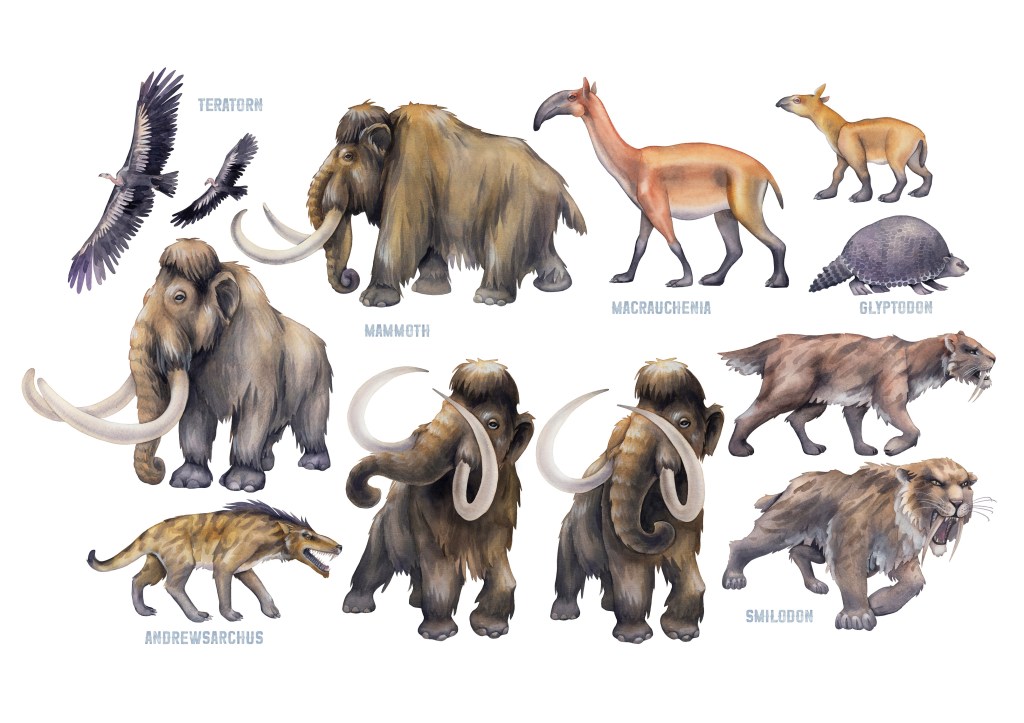
Collection of watercolor prehistoric and now extinct animals isolated on a white background. Hand painted illustration of Ice Age. Asset id: 2169205593 by Ekaterina Glazkova
Estimating the extinction rate is a complicated task that requires some assumptions and estimations. This article from the National Library of Medicine use what it claims to be conservative estimates, which would tend to minimize evidence of an emerging mass extinction. Despite that fact the average rate of vertebrate species loss over the last century is up to 100 times higher than the extinction rate without/before humans (background rate). Other sources claim an extinction rate that is 1,000 or even 10,000 the background rate.
To put some specific numbers on what a high extinction rate means, scientists count 881 animal species are known to have gone extinct since around 1500. If we include animal species that scientists suspect might be extinct, that number shoots up to 1,473. You can read more on the issue here or here or here.
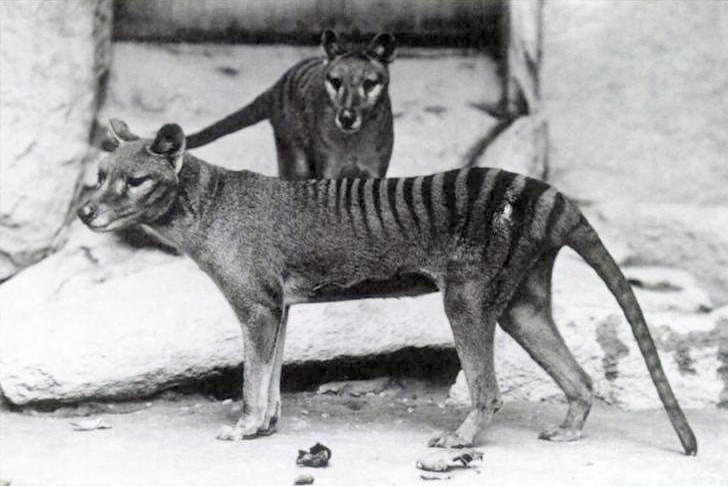
Two Tasmanian Tigers. The Tasmanian Tiger or Thylacine was hunted to extinction. Benjamin, the last Tasmanian Tiger, died in 1936 in the Beaumaris Zoo in Tasmania. Baker; E.J. Keller., Public domain, via Wikimedia Commons
What is clear is that the current extinction rate is much higher than what is typical and we humans are the cause. This came as a shock to me the first time I found out about it, and it is certainly an important topic, and therefore a super fact. It is true, surprising to many, and important.
Those who want to minimize the problem with the ongoing extinctions often point out that extinctions are a natural part of evolution and that throughout Earth’s history up to around 98% of all species that have ever existed are now extinct. In my opinion, that argument fails to consider the enormity of Earth’s four billion year natural history. A lot of evolution happened during that time.
Modern humans have only been around 300,000 years, or 0.0075% of that time, a tiny blip in time. Human civilization has only been around for 12,000 years, or 0.0003% of that time, an even tinier blip in time. Like comparing an ant head to a mile. Us having a large negative impact on the natural world in such an extremely short time is quite notable.
By considering the extinction rate you get a better idea of the scope of the problem. The fact that the extinction rate today is significantly higher than the expected natural rate and that the primary cause of modern extinctions is human impact as opposed to natural phenomena, makes it a case for concern. To read about a related issue, “The Wild Mammal Biomass Has Substantially Declined”, click here.
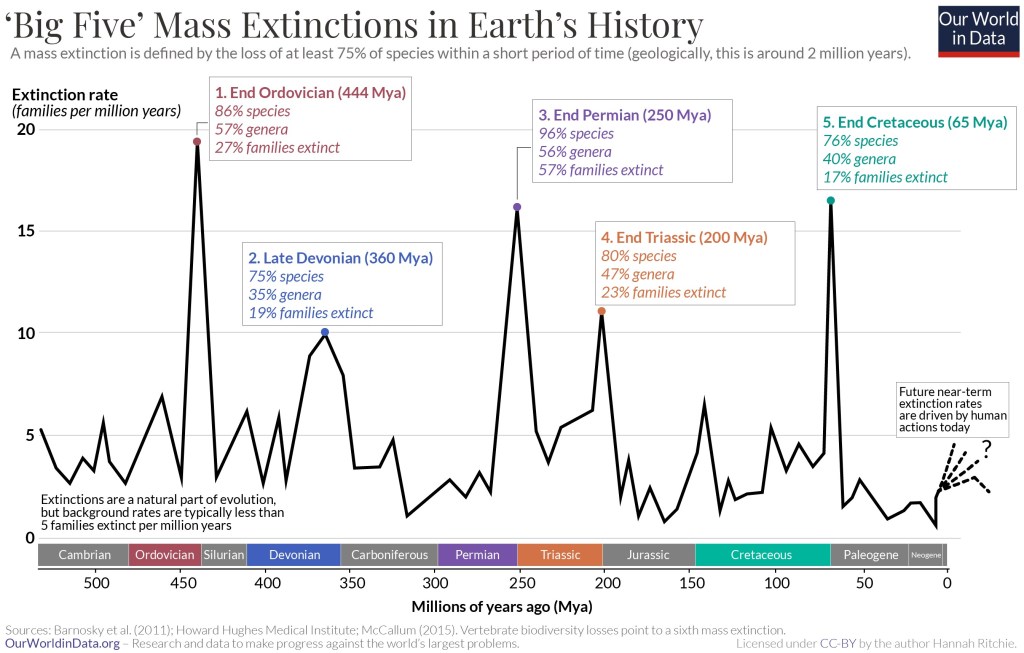
Over the last 440 million years life on Earth has experienced five so called mass extinctions. A mass extinction event is when at least 75% of the world’s species are lost during a short period of time – geologically speaking. This period is not clearly defined but often defined to be two million years. Two million years may seem like a long time, but geologically speaking, it is a short time.
Extinction of the dinosaurs when a large asteroid hits earth 66 million years ago. It was the last mass extinction event. Asset id: 2196200279 by funstarts33
End Cretaceous (65 mya) – the event that killed off the dinosaurs.
Below is an overview of the five big mass extinctions in Earth’s history. The graph is from Our World in Data.
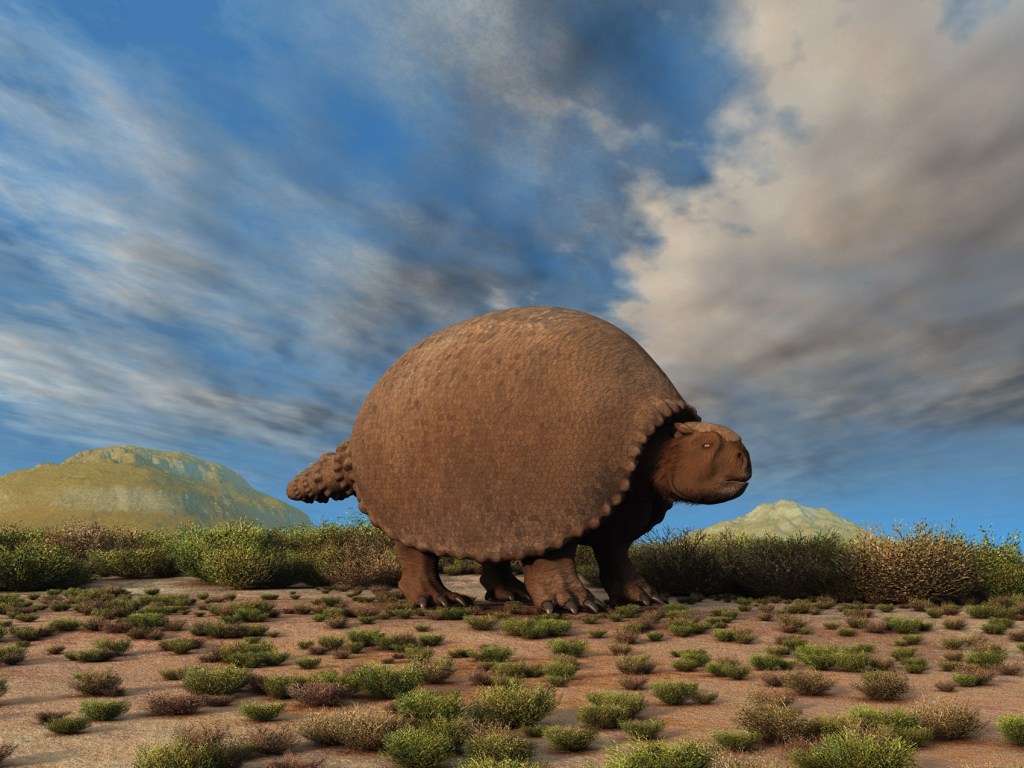
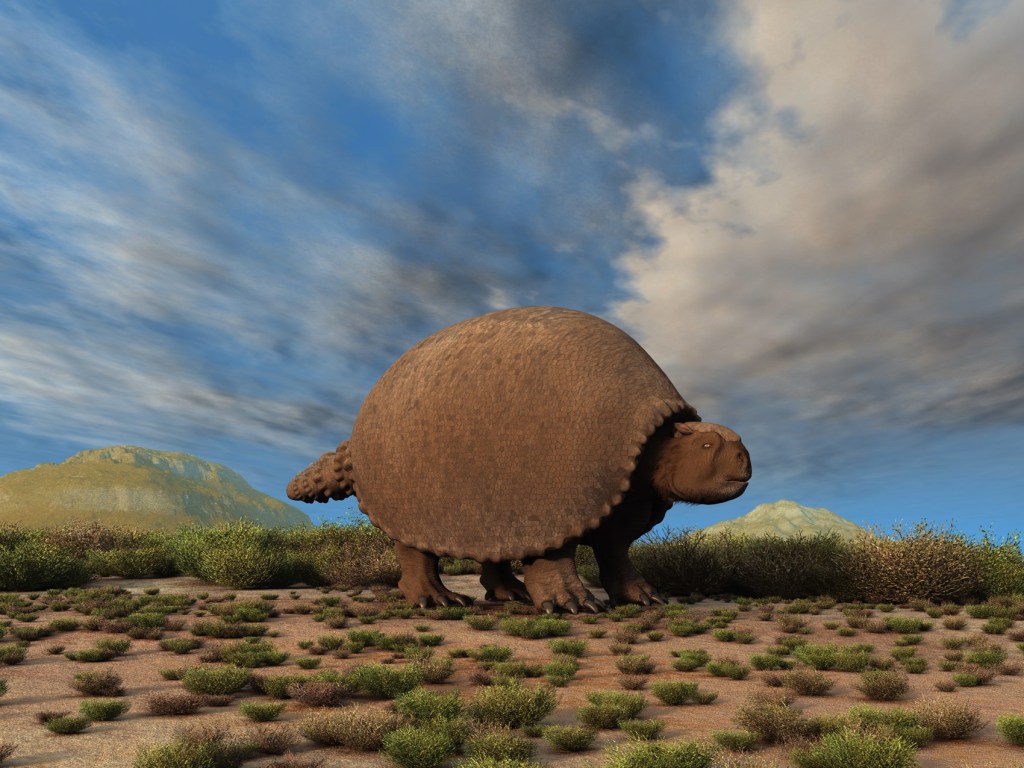
The Big Five Mass Extinctions in Earth’s History. A mass extinction is defined by the loss of at least 75% of species within a short period of time (geologically, this is around 2 million years). Extinctions are a natural part of evolution, but background rates are typically less than 5 families extinct per million years. Sources Barnosky et al (2011). Howard Hughes Medical Institute: McCallum (2015). Vertebrate biodiversity losses point to a sixth mass extinction. From Our World in Data.Are We in the Middle of a Sixth Mass Extinction ?3D illustration of a Glyptodon, also extinct, Asset id: 495169627
Biodiversity experts have estimated that about 30% (uncertainty range: 16–50%) of species have been globally threatened or driven to extinction since the year 1500. 30% globally threatened or extinct is not 75% that are actually extinct, but in just 500 years that looks like a quick start on a mass extinction. It should be noted that 500 years is just 0.025% of two million years. Issues such as deforestation, chiefly the result of replacing forests with agriculture, overexploitation, and global warming / climate change are driving extinctions and represent big biodiversity threats in the near future.
The Northern white rhino subspecies, the second-largest land mammal after elephants, has no hope of recovery after the last male died in 2018. Only a female and her daughter are left. The photo is of Angalifu, a male northern white rhinoceros at the San Diego Zoo Safari Park. Angalifu died of natural causes at the age of 44 on 14 December 2014. Sheep81, Public domain, via Wikimedia Commons.
Posting this on Thanksgiving Day may seem awkward. However, whether there will be a human caused sixth mass extinction or not depends on us, and it looks like more people want to protect our natural world. Many animals, such as the giant panda, bald eagle, the sea otter, black footed ferret, the Peregrine falcon, the blue whale, Rodrigues fruit bat, the Island night lizard, and the California condor, have been saved from extinction through conservation efforts like habitat restoration, anti-poaching laws, captive breeding programs, and reintroduction to the wild. Perhaps we are turning things around. We should give thanks to all who care.
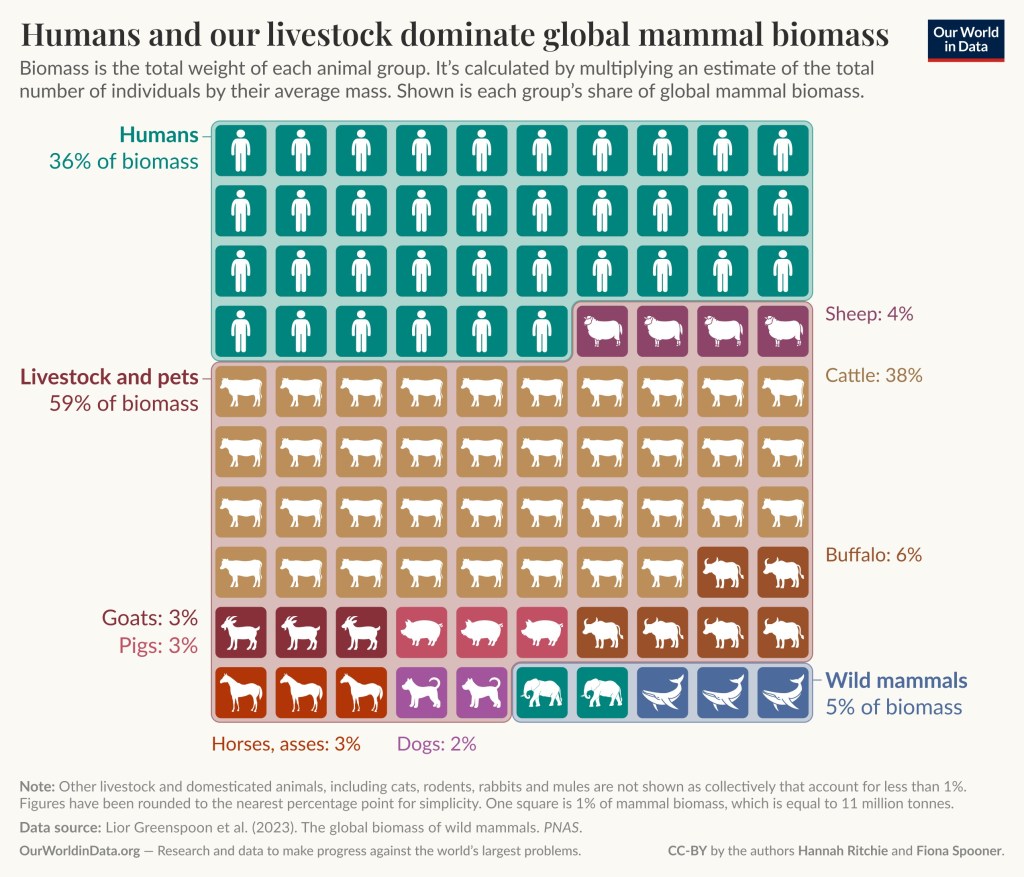
Super fact 70 : Wild mammals have declined by 85% since the rise of humans even as the total mammal biomass has nearly tripled. The result is that only 4-5% of the total biomass of mammals are wild animals. The rest are humans and livestock.
Livestock, mostly cattle and pigs, corresponds to 60% of the mammal biomass, humans are 36%, and wild mammals are 4%. The data is taken from this article.
Humans and our livestock dominate global mammal biomass. Biomass is the total weight of each animal group. It’s calculated by multiplying an estimate of the total number of individuals by their average mass. Shown is each group’s share of global mammal biomass. This graph is taken from Our World In Data.
I think this is a super fact because we know it is true, and this huge and extremely rapid change of Earth’s fauna (from a geological timescale) is certainly important, and yet I think it comes as a surprise to many people. I often see the argument that humans have been great for animals because there are many more of them and the mammal biomass has tripled. That argument leaves out the part about the increase in mammal biomass coming from domesticated animals while wild animals have been disappearing. One question that comes to mind is whether life at the cramped factory farm is better than the life as a wild animal.
Wild Mammal Biomass Data
Below are a couple of graphs displaying some additional information on wild mammal biomass.
The distribution of the world’s wild land mammal biomass. The graph is taken from Our World in Data.
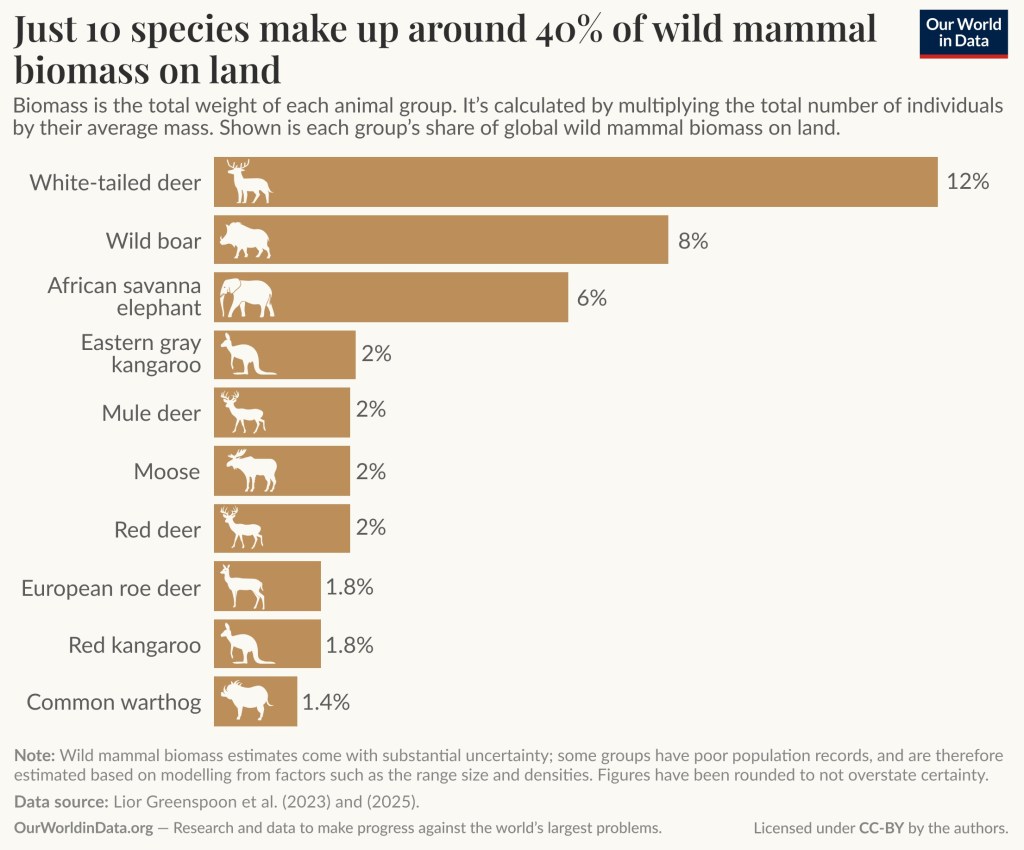
Another thing to note is that the wild animal biomass is very concentrated to just a few species. Considering that there are between 6,500 and 6,800 recognized mammal species in the world, it is quite remarkable that only 10 species make up 40% of the mammal biomass.
Just 10 species make up around 40% of wild mammal biomass on land. The graph is taken from Our World in Data.
Reasons for Decline of Wild Animal Biomass
This decline of wild mammal biomass is primarily caused by human activity, including hunting, habitat loss and degradation from agriculture and urbanization, climate change, and pollution. This human-driven extinction event is the result of a rapidly growing human population and its increased consumption of natural resources, leading to widespread disruption of ecosystems and dramatic declines in wild mammal populations. It should be mentioned that the extinction of large mammals such as mammoths, American mastodon, giant ground sloths and glyptodonts was likely aided by human hunting in prehistoric times. The largest mammals have always been at the greatest risk for extinction and that is still true today.
Woolly mammoth, now extinct, Asset id: 2571557381 by Wirestock Creators.3D illustration of a Glyptodon, also extinct, Asset id: 495169627
Super fact 69 : Polar nights happen in the regions north of the Arctic Circle and south of the Antarctic Circle. Together the two polar regions cover an area double as large as the United States, and it includes a population of millions of people. During a polar night the sun does not rise for days, or months, up to six months. The polar nights are special, not just for the daytime darkness, but for the spectacular aurora borealis, the starlit skies, the extremely clear air, and the fact that people often lose track of time during polar nights.
It should be noted that even though the sun never rises during the polar night it may not be totally dark during the entire polar night. Part of the time you may get some light in the middle of the day, what is called polar twilight (nautical twilight or astronomical twilight). Nautical twilight tends to be bluish as shown in the photo below.
When our kids were young, we visited the Ice Hotel in Jukkasjärvi in northern Sweden. We went in March, during the American spring break, which was not during the polar night, so we did not experience it then. The polar night in Jukkasjärvi will begin December 5, 2025, or December 10, 2025, depending on how you count, and end at the beginning of January. However, the Ice Hotel was a fun way to experience a polar region. When I did my Swedish army service I spent the winter in the forest around that area, and even further north, and I experienced the Polar Night firsthand,
The lobby of the ice hotel. Our kids are sitting around a table of ice. A chandelier of ice is hanging above the table. The light is from fiber optics, so the ice won’t melt.
During my army service we stayed in tents in the forest far away from villages and cities and we often did not use any lights. The result was that it was incredibly dark most of the time. It was so dark that I could not see my own hand if I held it right in front of my face. The upside was that the sky was filled with thousands of stars on a clear night. It is estimated that you can see between 2,500 to 5,000, even 10,000, stars in the sky with the naked eye if you have good vision and it is completely dark. You could also see the Milky Way Galaxy very clearly and easily, as well as the Andromeda Galaxy, meteors, comets, satellites, not to mention the most spectacular aurora borealis that you can see anywhere on earth. That certainly beats the 14 stars and 3 planets that you can see with the naked eye on a clear night here in Dallas, Texas, where I live now.
Milky way sky on dark background, and a lot of stars. Asset id: 2524020369 by MR.PRAWET THADTHIAM
On one occasion I was standing guard outside the camp. We were pretending that we were at war with the Soviet Union. It was minus 40 degrees, and they forgot about me. I stood there alone in the darkness and the extreme cold for more than three hours. This was considered dangerous. The rule was no more than one hour out in the cold at a time. Once they discovered that I had been there for more than three hours they came to get me, and they apologized profusely. They were happy that I was not hurt. However, I did not mind, because my night sky view was spectacular. The night sky was so spectacular, it was to die for.
If it is cloudy and you are far from any civilization it may be pitch black in the afternoon. Even if it is not cloudy but the moon is not out it will be pitch black later in the afternoon. In addition, the air is very clear during the polar night, because the cold sunless Arctic air often contains almost no moisture and the visibility stretches for 100 miles. If you want to remain unseen in this situation it is very important to understand that even the tiniest light will be very visible, far away. Our platoon did an experiment. Someone lit a cigarette about one mile away and we could very easily see the bright cigarette even through the forest. The lesson was, No Cigarettes, and No lights!
Aurora Borealis are often spectacular in the polar regions, especially during the polar night. Asset id: 2499746583 by HappyVibeArt
I consider this a super fact because the polar night is a surprising phenomenon to those who do not know much about the arctic and my claims above are true and important since the polar regions are large and under threat from climate change / global warming. The polar regions and thereby the polar night also cover an area that is not small, and four million people live there.
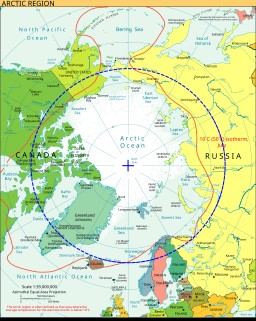
The Arctic Circle, at roughly 66.5° north, is a commonly-accepted boundary of the Arctic waters and lands. CIA World Fact Book, Public domain, via Wikimedia Commons.
The Midnight Sun
I can add that in the summer (northern hemisphere) you have the opposite phenomenon with the midnight sun. Just like the polar night can cause people to lose track of time so can the midnight sun. When we visited northern Sweden with our niece Jessica for my brother’s wedding, we had what is called midnight sun. Jessica was nine years old at the time. A couple of hours after we had gone to sleep Jessica woke me up “wake up Thomas, it is time to go out and play”. I protested, no it is not, it is one a clock at night and we are going to sleep. Jessica protested, she said, “No the sun is up, it is morning it is time to play”.
So, I said “Jessica, let me explain something to you. This is northern Sweden in June and here the sun is up in the middle of the night, and we are not going outside to play in the middle of the night.” After that my wife went out to play with Jessica, but I refused to go out and play at one o clock at night.
Ice Hotel Photos
Finally, I just wanted to include a few of my photos from the Ice Hotel, just for fun.
Our son David with one of the kick sleds called “spark”.This is a photo of the ice instruments standing on the ice stage.We are going on a dogsled tour. The ice theater is in the background, and you can see part of the ice hotel on the right.You can see ten dogs and the sled with us on top of it. On the left is a kåta, a movable Sami structure (indigenous arctic Scandinavian people). It is like a Tipi.
This is not a super fact but a collection of interesting facts about Fish. They are not very important facts but amazing facts.
Minnows Asset id: 1182854671 by Rostislav Stefanek
Most Fresh Water Fish would die from dehydration if put in Sea Water
Most freshwater fish would die from dehydration if placed in seawater due to a process called osmosis. The same is true for saltwater fish placed in freshwater. There are a few exceptions. So called euryhaline species are able to more or less handle both freshwater and seawater, an example is salmon. It is also why freshwater fish native to oceanic islands like Hawaii are euryhaline species. Freshwater fish that are not euryhaline species cannot travel to oceanic islands.
What is a Fish?
A fish is a vertebra (has a backbone and a brain protected by a braincase) that is aquatic, lives in water, has gills, fins, scales and is cold blooded. Dolphins, whales, jellyfish, and starfish are not fish.
Some fish have both gills and lungs
Lungfish have both gills and lungs. Their unique respiratory system allows them to breathe underwater with their gills and also breathe air from the surface with their lungs. Some species of lung fish can survive on land for several months.
Fish raining from the sky. Picture generated with the help of ChatGPT
Mudskippers the land dwelling fish
Mudskippers are fish that spend most of their time on land. It can walk on land, jump, and climb trees, by using their strong pectoral fins like legs and their tails as a lever. They breathe air through their skin and gill chambers. Below is a four minute video featuring mudskippers.
Fish the First Vertebra on Earth
Fish appeared more than 500 million years ago during the Cambrian period. They are believed to be the first vertebrates on Earth. They lay the foundation for the diverse array of vertebrate life that has since populated the planet’s ecosystems.
Some Fish can make Light
Anglerfish are deep sea fish that produce their own light using bacteria. The dangling glowing light attracts prey. Some species of angler fish live only 200 meters down in the sea while other species live as far down as 3,300 meters (11,000 feet).
Angler fish on background realistic illustration isolate. Scary deep-sea fish predator. Deep sea fish monster. Asset id: 2134226987 by Konstantin G
Some Fish know how to use Tools
Wrasse are fish that use rocks as anvils to crack shells. They grab hard-shelled prey like crabs and mollusks, swim to a rock or coral, and repeatedly strike the prey against the hard surface to break it open. This is a form of tool use.
The largest fish that has ever lived is likely the extinct shark Megalodon, estimated to have reached lengths of up to 70 feet and weighing 50-70 tons. The Megalodon was a giant shark believed to have gone extinct 2.6 million years ago, just in time for the appearance of our ancestors Australopithecus and Homo Habilis. They made a horror movie about a Megalodon that survived until modern times. It is called “The Meg”.
Surströmming (Fermented Baltic Herring) a North Swedish Delicatessen
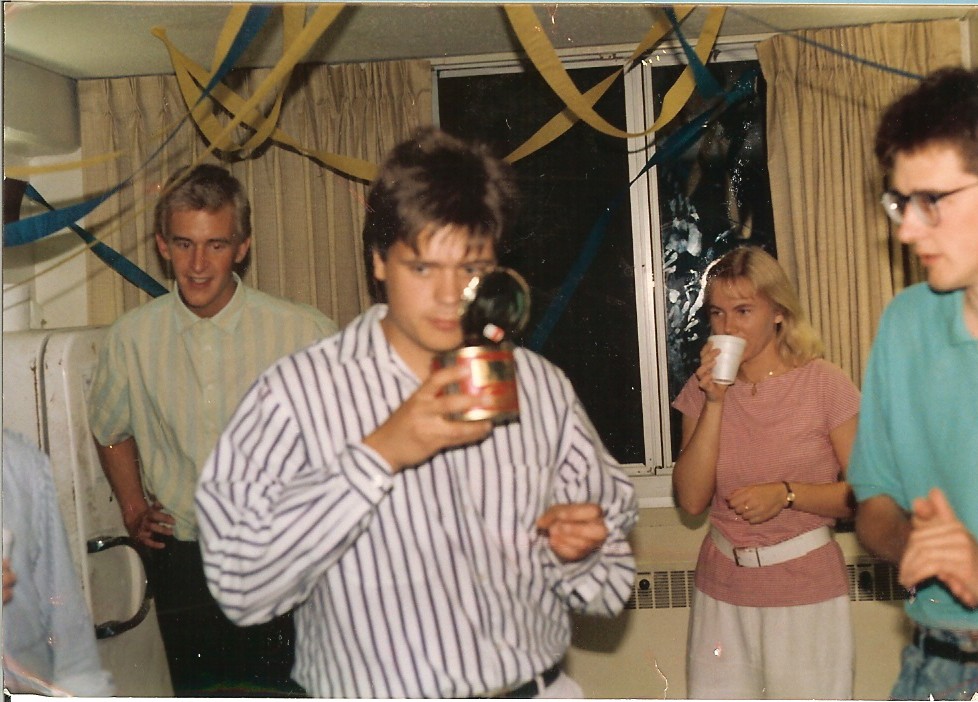
In 1987 I was selected by my University, Uppsala University in Sweden, to be part of a university level exchange student program. The exchange program was between Uppsala University and Case Western Reserve University in Cleveland, Ohio. In total we were six Swedes (two from Uppsala). I was studying Engineering Physics in Sweden. In the US, I would continue studying Electrical Engineering because the Swedish Engineering Physics program was very similar to the Electrical Engineering program at CWRU. One day we invited the other students to a Surströmming party. When we opened the cans, the American students headed for the windows and opened them. I should say there were other things to eat.
The fermented herring Surströmming from Sweden is often considered as one of the most unappetizing foods in the world. Just ask Google AI or ChatGPT this question, “what is the most unappetizing food in the world”, and you’ll see. The three top unappetizing food according to ChatGPT are Hákarl (Fermented Greenland Shark) – Iceland, Surströmming (Fermented Baltic Herring) – Sweden, and Casu Marzu (Maggot Cheese) – Sardinia.
I grew up with this food, and I don’t think it is unappetizing. It might not be beef bourguignon or trout almondine, but it isn’t bad. The problem is that the smell of Surströmming is not very pleasant and it is strong. However, it tastes quite different from the smell. It tastes like pickled herring with the addition of something sour like lemon. The taste is much better than the smell, which is why you should open the cans outside and then bring them in once the smell has settled. We did not do that because our party was partially a prank. Well, if you don’t like pickled herring, then you won’t like this either.
Four Swedes inviting Americans to a fermented herring party. Fermented herring is a north Swedish specialty. Unfortunately, all the Americans experienced a culture shock from the fermented herring. I am the guy smelling the fermented herring can.
The Greatest Intellectual Achievement of the human race is arguably the Standard Model of Elementary Particles. The Standard Model consists of Special Relativity, Quantum Physics, Noether’s theorem and gauge theories, Quantum Electrodynamics, Quantum Chromodynamics, and a framework for all elementary particles, and more. It is a towering achievement of physics that was created by thousands of geniuses over a period of several decades. It is the theory of almost everything.
Despite that fact it is not getting a lot of respect. Everyone is just trying to find something wrong with it. The reason is that as soon as it was created people realized that something was wrong with it. It could not be reconciled with General Relativity. Something was missing. So, finding out what is wrong with it or what is missing has been a top priority for physics for several decades. The book “The Theory of Almost Everything” by Robert Oerter is a very interesting book covering the standard model, its components, its history, and what could be missing. It contains a few formulas but other than that it is mostly readable to laymen.
Book Formats for The Theory of Almost Everything
The Theory of Almost Everything: The Standard Model, the Unsung Triumph of Modern Physics by Robert Oerter comes in three formats. I bought the hardback format.
Hardcover – Pi Press (July 22, 2005), ISBN-10 : 0132366789, ISBN-13 : 978-0132366786, 336 pages, item weight : 1.2 pounds, dimensions : 6.37 x 1.11 x 9.3 inches, it costs $35.08 on US Amazon. Click here to order it from Amazon.com.
Paperback – Penguin Publishing Group (September 26, 2006), ISBN-10 : 0452287863, ISBN-13 : 978-0452287860, 336 pages, item weight : 10.8 ounces, dimensions : 5.51 x 0.81 x 8.34 inches, it costs $16.99 on US Amazon. Click here to order it from Amazon.com.
Kindle – Publisher : Plume (September 26, 2006), ASIN : B002LLCHV6, ISBN-13 : 978-1101126745, 348 pages, it costs $6.99 on US Amazon. Click here to order it from Amazon.com.
Front cover of The Theory of Almost Everything: The Standard Model, the Unsung Triumph of Modern Physics by Robert Oerter. Click on the image to go to the Amazon page for the hardcover version of the book.
Amazon’s Description of The Theory of Almost Everything
There are two scientific theories that, taken together, explain the entire universe. The first, which describes the force of gravity, is widely known: Einstein’s General Theory of Relativity. But the theory that explains everything else—the Standard Model of Elementary Particles—is virtually unknown among the general public.
In The Theory of Almost Everything, Robert Oerter shows how what were once thought to be separate forces of nature were combined into a single theory by some of the most brilliant minds of the twentieth century. Rich with accessible analogies and lucid prose, The Theory of Almost Everything celebrates a heretofore unsung achievement in human knowledge—and reveals the sublime structure that underlies the world as we know it.
Below is my full length giant review of The Theory of Almost Everything. Unless you are really interested, I suggest you read the somewhat shorter Amazon version by clicking the link above.
An introduction to the greatest intellectual achievement of the Human Race
The public has to a large extent missed the greatest scientific revolution in the history of the human race because mainstream media has largely ignored this breakthrough, despite the fact that the Nobel Prize committee has been raining Nobel Prizes over it. In the 1970’s a theory that explained, at the deepest level, nearly all of the phenomena that rule our daily lives came into existence. The theory called “The Standard Model of Elementary Particles” is a set of “Relativistic Quantum Field Theories” that explains how elementary particles behave, which elementary particles there are, and why they have the properties they have, for example, isospin, spin, charge, color charge, flavor, even mass, or mass relations in many cases.
The theory explains how all of the fundamental forces in nature work except gravity. The theory describes how the elementary particles interact; decay, how long they are expected to exist, and how they combine into other subatomic particles. The theory uses only 18 adjustable parameters to accomplish all of this.
Close up illustration of atomic particle for nuclear energy imagery. From iStock photos.
In the extension the theory thus explains how nucleons and atoms are formed and what properties the atoms will have, and how molecules will form and what properties molecules will have, their chemical reactions, and what elasticity, electric conductivity, heat conductivity, color, hardness, texture, etc. any material will possess. In the extension it explains why mass and matter exist, how the sun and the stars work, and the theory is therefore the ultimate basis of all other science. It also provides a formula, or an equation of almost everything.
Best of all it has been thoroughly verified experimentally, in fact the predictions the theory has made have been confirmed with such stunning accuracy and precision that it could be considered the most successful scientific theory ever. A theory that successfully unites all physics and basically all of human knowledge of the Universe into one single theory has never before existed.
However, “The Standard Model” does not incorporate gravity and the general theory of relativity, and cannot explain dark energy, dark matter and why neutrinos have mass. Therefore, almost as soon as the theory came into existence physicists started looking for the next theory that would finish what the “The Standard Model” did not finish.
Example of such theories are GUT theories, SO(5), SO(10), string theories (abandoned), super string theories, and M-theories. Even though those new theories are extremely interesting they have not been verified or able to predict anything. In comparison with the “Standard Model”; super string theories, grand unified theories, chaos theories, you name it, are essentially nothing, but are still better known. Hopefully this will change in the future, either because the Standard Model gets the respect it deserves, or because a more complete theory can be verified.
About the book
This book explains to the layman what the “Standard Model” is and how it came into existence. The book is by no means a perfect book. I think there are several problems with the book. However, I decided not to take off any star because there are very few books written for science interested non-physicists that explain the “Standard Model of Elementary Particles”. Dr. Oerter deserves five stars just for his decent attempt at doing so. I find Dr. Oerter to be a good writer and popularizer. I don’t think he is as good as Isaac Asimov, or Carl Sagan, but close, and he is writing on a much more complex topic then, for example, Carl Sagan did.
I studied physics as an engineering student, and I could understand most of text (but not every detail regarding everything). However, I believe anyone who is somewhat familiar with science, especially physics and math, can understand most of this book. For me more diagrams and more equations would have helped. For readers without much background in physics more and better diagrams would definitely have helped. Dr. Oerter came close to writing a good book for the layman, but the book was still lacking in certain aspects. In the remainder of the review, I will give a brief synopsis for each chapter and present my opinions and reflections on each chapter. In a sense I have written a short review for every chapter. My intent is to both tell you what the book is about and give my opinions on the different sections of the book.
Chapter 1: The first unifications
In Chapter one Oerter gives an interesting overview of the history of physics. Physics has typically been divided up into many fields. New discoveries have led to either new sub disciplines or the merging of existing sub disciplines (unifications). Nineteenth century physics was divided into many sub disciplines.
Dynamics (the laws of motion)
Thermodynamics (the laws of temperature, heat and energy)
Waves (oscillations in water, air, and solids)
Optics
Electricity
Magnetism
However, because of the atomic hypothesis, thermodynamics and wave mechanics were swallowed up by dynamics. For example, temperature and heat were now explained in terms of atomic and molecular motion. The theory of electromagnetic fields subsumed optics, electricity, and magnetism (light is an electromagnetic wave). All of physics, it seemed, could be explained in terms of particles (atoms) and fields. New discoveries would alter the picture once again and the old field theories had to be abandoned, and the laws of classical mechanics (dynamics) had to be altered.
Finally, the physicists were able to come up with a unified theory that explained almost all of physics and in the extension all of science, the standard model of elementary particles. This chapter was very basic and not difficult to understand. I think his approach to give an overview of physics was both unique and enlightening. His description of how physics and our understanding of the Universe went through periods when our knowledge expanded and gave rise to new fields and due to new discoveries, that led to a deeper understanding resulted in the merging of these fields. So, in summary more knowledge lead to more fields, then deeper understanding united them. This went back and forth a few times. Finally, we have a unified theory of almost everything, the Standard Model (if we exclude the General theory of relativity).
Chapter 2: Einstein’s relativity and Noether’s theorem
Even though the book is a Physics book, I think it is also a book on Philosophy. The way I see it Physics is in a sense both Science and Philosophy, the kind of Philosophy that can be falsified, verified and proven wrong or correct. Let me explain what I mean by telling you about Noether’s theorem. Noether’s theorem states that whenever a theory is invariant under a continuous symmetry, there will be a conserved quantity. As an example of what a continuous symmetry is, is the following: any physical experiment that is performed at a certain time will have the same result if it is performed exactly the same way a certain time later. That seemingly self-evident observation means that Energy is conserved.
Another example is any physical experiment that is performed at a certain place will have the same result if it is performed exactly the same way somewhere else. That seemingly self-evident observation means that momentum is conserved. Let me add that “exactly the same way” really means that! Gravity, other forces, differences in light, or anything else cannot be different in the second experiment. The only thing allowed to be different is the position “x” (if that is our symmetry variable). That is what a continuous symmetry means, changing just one thing, and everything stays the same.
Noether’s theorem has been the guiding principle behind the standard model, and it is used to find conservation laws where symmetries are found, and it is used to find symmetries where conservation laws are found. It is a spontaneous symmetry brake that allows the Higgs Boson to give all other particles their mass (excepting mass less particles). This is the reason that matter and everything in our Universe exists. The Higgs Boson is also called the God particle. So, Noether’s theorem is both very useful in a practical sense and deeply philosophical at the same time. In addition to Noether’s theorem the standard model is built upon the special theory of relativity and a modern formulation of quantum mechanics (Quantum field theory), QED, QCD, as well as some discoveries regarding elementary particles. I can add that Noether’s theorem was formulated by a Jewish woman, Emmily Noether, who could not get a job in academia because she was a woman. This theorem is one of those very important but mostly unknown discoveries, like the invention of paper by the Chinese Tsai Lun.
Oerter does not attempt to explain the special theory of relativity; however, he tries to give the reader an idea of what it is. The problem with his approach is that he gives the reader just enough information to enable the observant reader to come up with the apparent paradoxes within the special theory of relativity, but not enough information to help the reader to easily resolve them. He also confuses the reader by not distinguishing between rest mass and relativistic mass. The observant reader will think that he is contradicting himself. The term relativistic mass is the total mass and the total quantity of energy in a body. The rest-mass is the mass of the body when it is not moving. The formula E = mc^2 is always true, when it refers to relativistic mass, which is why we talk about an energy/mass equivalence. The other more complex formula Oerter presents refers to rest mass. There is no such thing as an energy/rest mass equivalence (except at speed 0) but that is what the reader who is not already familiar with the subject will end up believing.
Another mistake Oerter does is in regard to the fact that the speed of clocks will be measured differently in different reference frames. On page 35 last paragraph Oerter writes “Here, we have an apparent paradox: If each reference frame sees the other as slowed down, whose clock will be ahead when the passengers leave the train?” Then he implies that the paradox has to be solved by incorporating the General theory of relativity. Even though that may be how it was first solved, you can solve this form of the so called “Twin Paradox” and other similar paradoxes from within the framework of the special theory of relativity itself. So even though I enjoyed reading about Nother’s theorem and still think this chapter could use some improvement.
Chapter 3: (The End of the World as we know it) + Chapter 4: (Improbabilities)
Oerter explains Quantum Physics in a very typical manner, and he mostly avoids making it look weirder than it actually is which he should be commended for (that is not true for every author). However, there is one thing that all Physicists seem to do when they explain Quantum Physics to the layman which annoys me greatly. The matter waves (or quantum fields) in Quantum Physics are quite strange entities. The reason they are so strange is because they do not exist in a real sense, they are more correctly stated mathematical abstractions. Oerter states this clearly, which is good.
However, he then goes on to mention De Witts’ idea about multiple Universes without acknowledging that these “bizarre solutions” to various Quantum Wave conundrums are completely unnecessary. So, to some extent he is still making Quantum Physics appear weirder then it is (but I have seen worse). Well, OK, Quantum Physics is weird, but we don’t need to make it seem even weirder.
After giving a background to the special theory of relativity and Quantum Physics, Oerter continues explaining relativistic Quantum Physics including the fantastic prediction you get when you combine the special theory of relativity with Quantum Physics; that for every particle there is a twin particle with exactly the same mass, and spin, but opposite charge and isospin. These particles were called anti-particles and until they were actually found physicists tried to get rid of them from the theory. However, the combination of the special theory of relativity and Quantum Physics would lead not only to much better explanation for such things as the radiation and light spectrum and the properties of atoms, it would also lead to new discoveries. This is what is referred to as Relativistic Quantum Mechanics.
Chapter 5: The Bizarre Reality of QED
Richard Feynman came up with a new representation of relativistic quantum physics for electrons that did not use waves, called Quantum Electro Dynamics (QED). This was one of the first steps towards the standard model. Instead of viewing electrons as particles governed by waves, Feynman viewed electrons as particles guided by fields consisting of all possible paths and their probabilities. He used the two-slit experiment as a guide when formulating the equations for the probabilities of the paths for the electrons (and in the extension may other particles). When he summed up all the possible paths and compared with the old Quantum Mechanics (Wave Mechanics) he got the same answer as Quantum Mechanics in every case. In fact, his new approach was able to explain and calculate phenomena’s like the electrons spin and the fine structure constant that Quantum Mechanics (Wave Mechanics) could not explain properly, and his approach also would prove crucial for the development of Relativistic Quantum Field Theory.
So, in summary, first came Quantum Mechanics, then Relativistic Quantum Mechanics, and then QED and Relativistic Quantum Field Theory. I can add that this chapter also explains Feynman diagrams and an infinity problem that cropped up. The three infinities that cropped up corresponded to the electron’s mass, the photon’s mass, and the electron’s charge. However, the problems with these infinitives were solved using a normalization process that is also explained in this chapter. I can add that I think QED probably seems less strange to laymen then Wave Mechanics because it is easier to visualize the probabilities of possible paths as compared to waves that do not even exist, even though their “amplitude squares” represents something real. This chapter was probably one of the harder chapters to understand (for those who know nothing about QED). This chapter could really have been made better by using many more diagrams and figures. Again, I am not going to knock a star for that because the book is overall so unique and important.
Chapter 6: Feynman Particles, Schwinger Fields
Chapter 6 was a short but interesting chapter. Julian Schwinger took a different approach to QED than Feynman; he sorts of invented a new wave mechanics, in which a quantum field can be pictured as a quantum harmonic oscillator at each point in space. Even though the two approaches used different models Freeman Dyson proved in 1949 that Schwinger’s field theory point of view and Feynman’s sum-over-all-paths approach were in practice identical. However, the two approaches are useful for different things and form the basis of Quantum Field Theory. QED and Quantum Field Theory eliminate the distinction of particle and field and in a sense removed the conundrum of the particle and wave duality. In the nineteenth century light was an electromagnetic wave (well it still is) and in the old Quantum Physics it was both a wave and a particle, however, in Relativistic Quantum Field Theory it is something completely new-a quantum field, neither a particle nor a wave, but an entity with the aspects of both.
Chapter 7: Welcome to the Subatomic Zoo
In this chapter Oerter describes the history of the “strong nuclear force” and the “weak nuclear force” and the subatomic zoo that later emerged. There are four fundamental forces of nature, electromagnetism, gravity, and the “strong nuclear force” and the “weak nuclear force”. The two latter fundamental forces were not known until the 1930’s. The studies of these two new forces led to the predictions and discoveries of new elementary particles. One of these was the pion, however, when the physicists looked for this particle in the cosmic background radiation, they found an elementary particle that was similar to the pion but had the wrong mass.
After some confusion it became clear that it was not a pion but a new never foreseen particle that was named the meson. This was a problem because it was a new entity which the existing physics theories could not explain. However, it got worse. More elementary particles were discovered in the 1940’s 1950’s and the 1960’s. Our Universe turned out to be a lot stranger than people thought, and people started talking about the subatomic zoo. These newly discovered elementary would remain big mysteries until the event of the Standard Model in 1974. This chapter was pretty straight forward and easy to understand. Oerter does an excellent job in making this history interesting and entertaining to the reader and the chapter also contains some humor.
Chapter 8: The Color of Quarks
In the 1960’s physics had become ugly because of the subatomic zoo. Murray Gell-Mann and Yuval Neeman suggested a periodic table for elementary particles (like there is a periodic table for the elements). This periodic table was referred to the eightfold way. The eightfold way was also referred to as the SU(3) theory. It led to the discovery of an elementary particle that was even more fundamental than the known elementary particles, the Quark. It was soon established that there were two kinds of fundamental elementary particles: leptons and Quarks, in addition to the Bosons. Let me explain the details. There are elementary particles with whole number spin, and they are called Boson’s, and there are elementary particles with half number spin called Fermions.
The Pauli Exclusion Principle (that no two particles can occupy the same state) applies to Fermions but not to Bosons and therefore the two different types of particles behave very differently and follow different kinds of statistical rules (Bose-Einstein statistics versus Fermi-Dirac statistics). All force carriers are Boson’s while some Fermions are used to build “normal matter”. Examples of Bosons are the photon, gluons, W and Z Boson, mesons, the Higgs Boson (the God particle). The Fermions come in three families, each with four particles and their anti-particle.
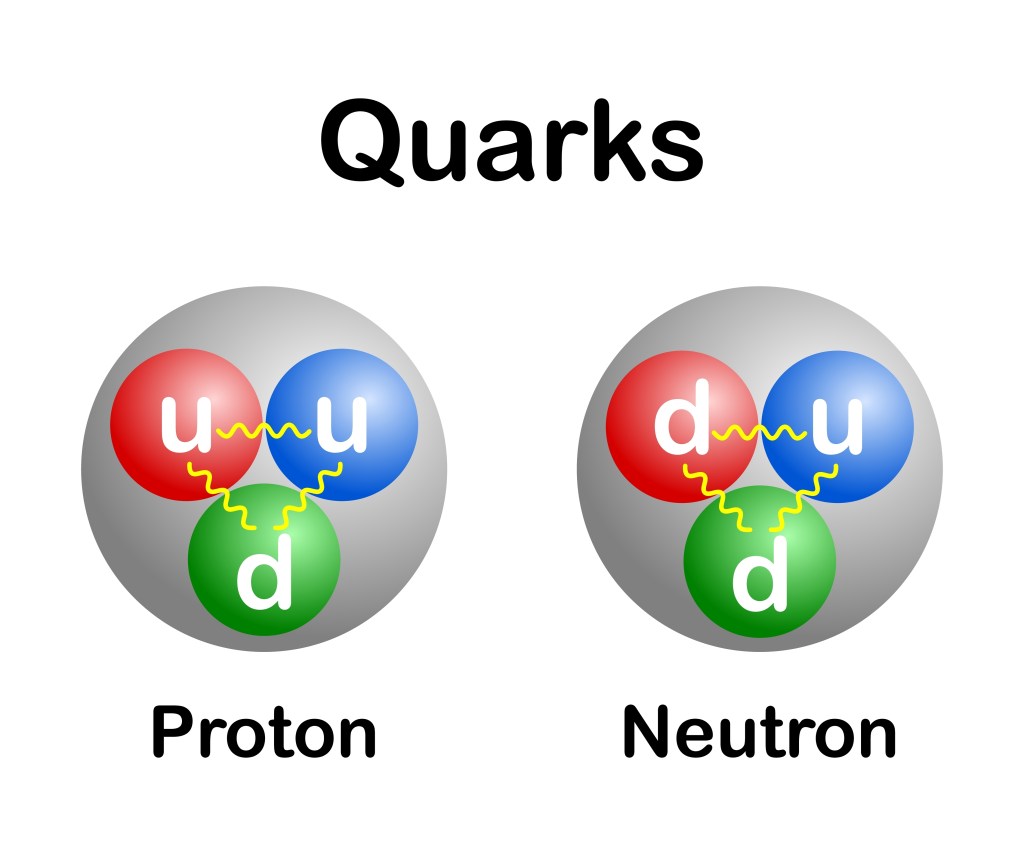
The proton and neutron each consist of three quarks. Protons consist of two up quarks and one down quark. Neutrons consist of two down quarks and one up quark. Both protons and neutrons have a net white charge. The yellow squiggly lines are gluons transporting color charge between the quarks. Asset id: 2333679305 by KRPD.
Electron / positron
Neutrino / anti-neutrino
Up quark / anti up quark
Down quark / anti down quark
muon / anti-muon
Mu Neutrino / anti-mu-neutrino
Charm quark / anti charm quark
Strange quark / anti strange quark
tau / anti-tau
Tau Neutrino / anti-tau-neutrino
Top quark / anti top quark
Bottom quark / anti bottom quark
The quarks can be used to build other particles, but leptons cannot. For example, a quark and an anti-quark pair form a particle called a meson (there are many kinds of mesons). A triplet of quarks is called a Baryon. An example of a baryon is the proton which consists of two up quarks and one down quark. Another example is the neutron which consists of one up quark and two down quarks. So just like electrons, protons and neutrons build atoms; the quarks build other elementary particles, for example, protons. As mentioned, the six flavors of Quarks are up, down, strange, charm, top and bottom.
However, the Quarks also have colors (well they are not real colors), red, blue and green which sort of correspond to the three kinds of charges for the strong nuclear force. Based on this new model a new Quantum Field Theory called Quantum-Chromodynamics (QCD) was created which together with QED would form the basis of “The Standard Model of Elementary Particles”. This was also a very straight forward chapter that was both interesting and not very difficult to understand. Again, Oerter makes the story interesting and captivating. This is perhaps the most interesting chapter in the book.
To learn more about Protons, Neutrons, Quarks, Gluons, Color Charges, and Quantum Chromodynamics you can watch this 10 minute video below.
Chapter 9: The Weakest Link
Despite the eightfold way, the Quarks, QED and QCD, all was still not well. The Weak Nuclear force was still not fully understood. Martinus Veltman, Steven Weinberg, Abdus Salam, and Sheldon Glashow were the people chiefly responsible for developing a theory for the weak nuclear force. It involved W+, W- and Z0 Bosons and something called spontaneous symmetry breaking.
These theories in turn led to something called the Higgs field and the so called Higgs particle or Higgs Boson (named after Peter Higgs who first introduced the concept of spontaneous symmetry breaking in elementary particle theory). The Higgs particle provided the physics community with a very nice surprise. The Higgs particle gives electrons (and other leptons) and the Quarks their mass. Unexpectedly we thus got an explanation as to why many elementary particles have mass and therefore why matter exists. This is why the Higgs Boson is often referred to as the God particle. It just showed up because of the theories explaining the weak force and turned out to be what created our Universe by giving the elementary particles their mass.
There was just one problem. The Higgs Boson had not yet been found when this book was written. Once the Large Hadron Collider (LHC) came online it became possible to find the Higgs Boson. This final touch to the Standard Model was the one that was the most difficult to grasp. I had a hard time understanding what spontaneous symmetry break really was, and the Mexican hat potential, etc. I think that Oerter needs to look over this chapter and find a different approach to explaining spontaneous symmetry break. I think that Oerter actually sorts of “gave up” at this point. This topic is too abstract for the layman so instead of making a good effort explaining spontaneous symmetry.
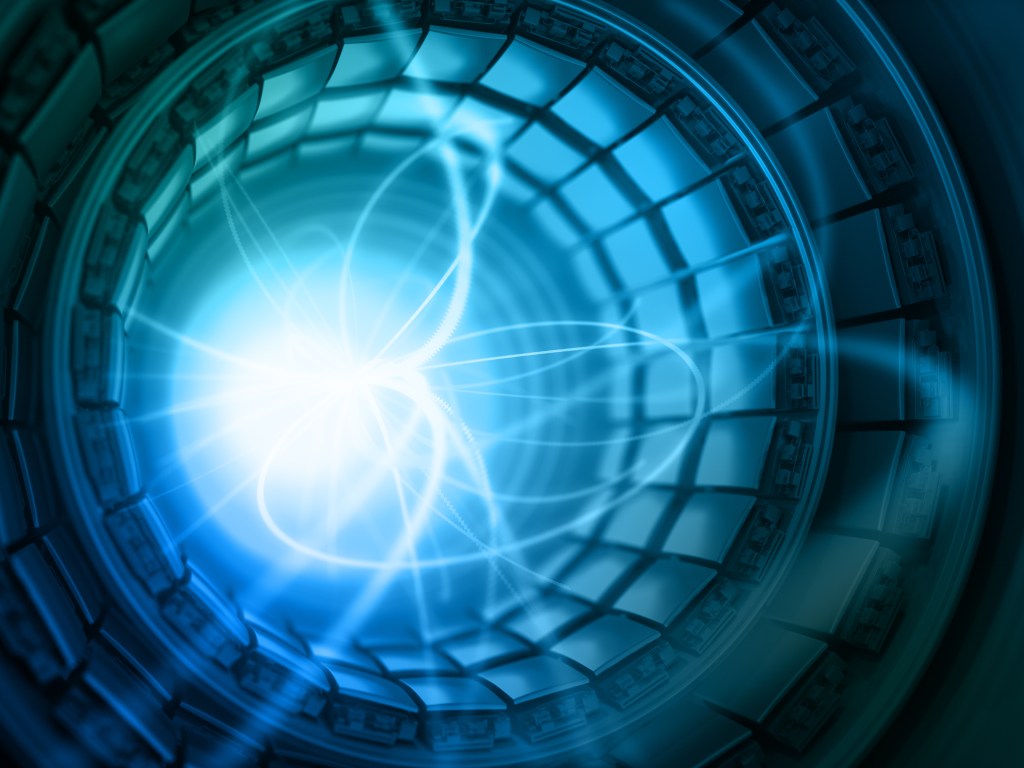
Collision of Particles in the Abstract Collider. From iStock photos.
Chapter 10: The Standard Model at Last
The standard model is built from relativistic quantum field theory, specifically QED and QCD. In chapter 9 QED was incorporated into electroweak theory which led to the Higgs Boson etc. QED is interwoven together with QCD to create a single theory whose essential elements can be written in a single equation.
Yes, that is right; an equation of everything, or almost everything. This equation is stated on 207 in this chapter. The equation over all equations that there ever was. You should buy this book just to look at it.
The Langrangian function that summarizes all of the propagators and interactions in the standard model.
The equation of everything is not as complicated as you may think. It is a Lagrangian function that summarizes all propagators and interactions, and it contains 18 adjustable numerical parameters. I admit that I don’t understand the equation fully, but Oerter explains the parameters and as mentioned it is just a big Lagrange function. As Oerter states “this equation is the simplicity at the bottom of it all, the ultimate source of all complex behavior that we see in the physical world; atoms, molecules, solids, liquids, gases, rocks, plants and animals”.
Oerter also discusses the birth of the Universe in the context of the Standard Model. In my opinion this was a very cool chapter, and Oerter does a good job at exciting the reader in this chapter. Naturally the equation of everything is a little bit difficult to understand and if you don’t know what a differential equation is you can forget about it. However, understanding the equation of everything is not important. The main point of this chapter is that there is such an equation.
Chapter 11: The Edge of Physics, Chapter 12: New Dimensions
As Oerter states in chapter 11 “The standard model is by far the most successful scientific theory ever. Not only have some of its predictions been confirmed to spectacular precision, one part in 10 billion for the electron magnetic moment, but the range of application of the theory is unparalleled. From the behavior of quarks inside the proton to the behavior of galactic magnetic fields, the Standard Model works across the entire range of human experience. Accomplishing this with merely 18 adjustable parameters is an unprecedented accomplishment, making the Standard Model truly a capstone of twentieth-century science.” However, this is not the end of physics. Gravity is explained by the General Theory of Relativity but is not incorporated into the Standard Model.
There is also dark matter and dark energy which is not part of the Standard Model. The neutrinos seem to have mass; however, they are predicted to have no mass in the Standard Model. In addition, it would be nicer to have fewer adjustable parameters than 18. Is there may be a better theory? In chapter 12 Oerter is discussing Grand Unified Theories (GUT), or SO(5) and SO(10) theories as well as super string theories, and M-theories. These are theories that might be able to do everything the Standard Model can do plus what it cannot do. However, none of these theories have ever predicted anything, so unlike the Standard Model they are speculation. There is some controversy regarding these issues, and I think Oerter might have been a tiny bit biased against super string theory here. However, he still explains what super string theory is about pretty well.
Final Conclusion and Recommendation
I highly recommend this book for anyone who wants to understand something about our world and the Universe. However, don’t expect to understand everything, it is not written so that you can. I wish Physicists would become a little better at explaining these matters to the layman using nice descriptive pictures and a little bit of math too (don’t assume math is always bad). I once read a 30 page long Swedish book on the special theory of relativity that successfully explained the kinematics, dynamics, and magnetism in relativity to your average high school kid. The Lorenz transforms, formulas for acceleration, E = mc² and magnetism were derived using simple algebra and a tiny bit of calculus at one point. That is the way these kinds of books should be written, but I have seen this only once in my life. Excluding this single example (the Swedish book), Oerter’s book is one of the best books on Physics for the layman that I have ever read.
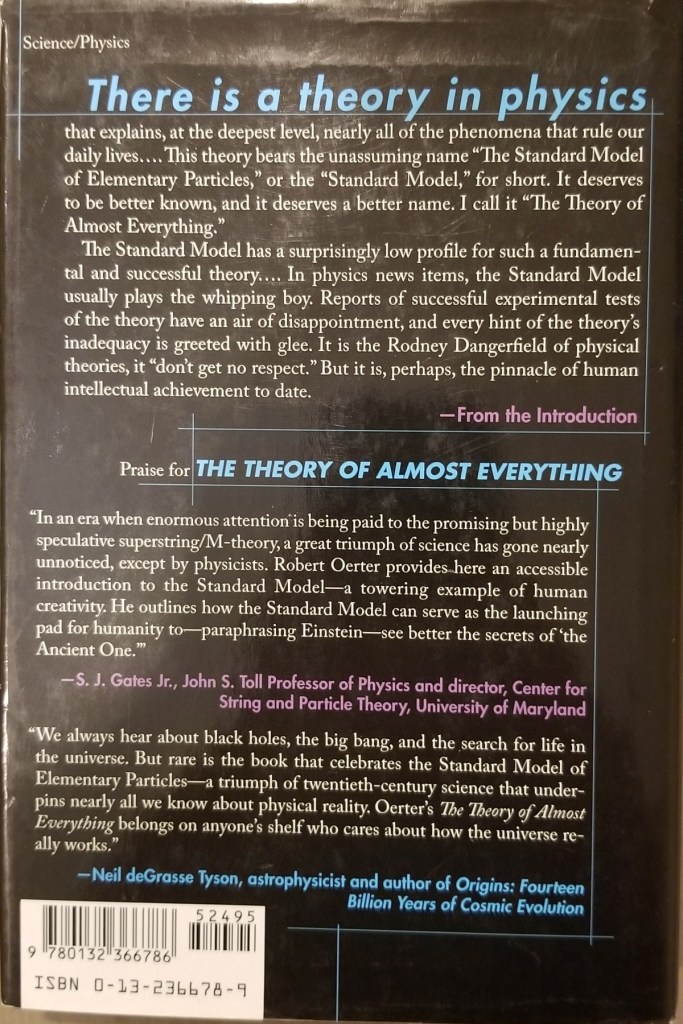
Back cover of The Theory of Almost Everything: The Standard Model, the Unsung Triumph of Modern Physics by Robert Oerter. Click on the image to go to the Amazon page for the paperback version of the book.
Here are some other posts that are related to the content of this book.