Marsupial Planet

Image above by Kevin from The Beginning at Last

An illustration of a kangaroo jumping across the grassland. There are a few trees in the background | Marsupial Planet
This picture reminded me of our trip to Australia and all the kangaroos and other marsupials we encountered. This is a submission for Kevin’s No Theme Thursday.

There Are Three Types of Mammals

Placentals, Monotremes, and Marsupials

All mammals are warm-blooded, have fur, and produce milk. However, there are three main types of mammals, placentals, monotremes, and marsupials, distinguished by how they give birth. Placentals give birth to well-developed young, and they nourish their young in the uterus through the placenta. Examples include gorillas, humans, whales, rodents, tigers, and bats. Monotremes lay soft-shelled eggs. Examples include the platypus and the echidna.

Then we have Marsupials, which give birth to small and underdeveloped young. Most female marsupials have pouches. Examples include kangaroos, wallabies, wombats, possum, opossum, Tasmanian devils, and koalas. Below is a kid friendly overview of the three types of mammals.

Marsupials on Three Continents

Close to 70% of the 334 extant marsupial species are concentrated on the Australian continent, including mainland Australia, Tasmania, New Guinea, and nearby islands. The remaining 30% are distributed across the Americas, primarily in South America. The Virginia opossum is the only marsupial native to the United States, but it is quite common. For example, we have lots of them in our neighborhood in Dallas. It should also be noted that there are a lot of marsupial fossils in Antarctica, which means that marsupials once lived there.
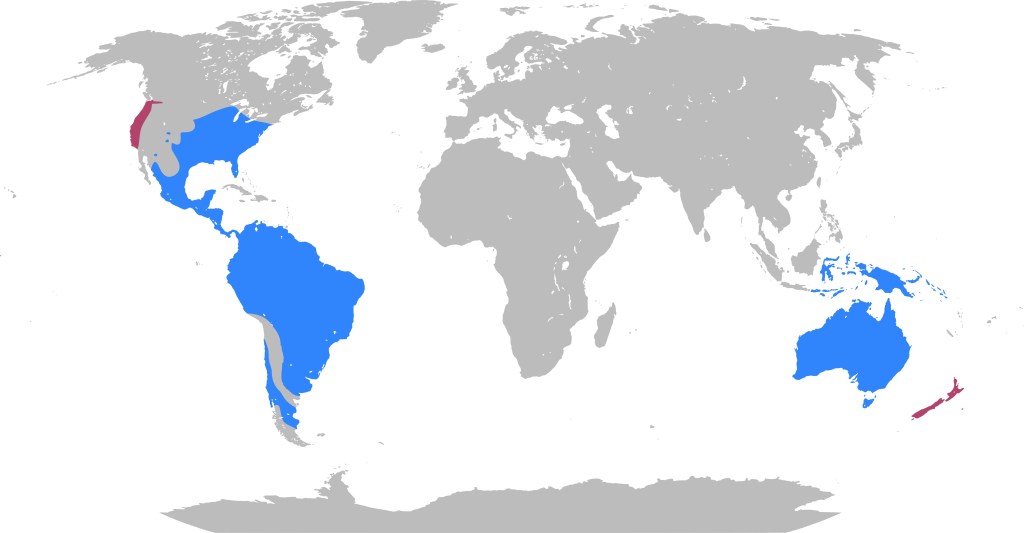
The image shows the distribution of marsupials being Australia, south America and parts of North America.
This map shows the distribution of marsupials. Blue indicates places in which marsupials are native and purple where they have been introduced. The image is from Wikipedia commons created by Michal Klajban under https://creativecommons.org/licenses/by/4.0/.

DNA evidence supports a South American origin for marsupials, with Australian marsupials arising from a single Gondwanan migration of marsupials from South America, across Antarctica, to Australia. These continents were connected and part of the supercontinent Gondwana back then. The ancestors of the marsupials, the metatherians split from placentals around 100 million to 120 million years ago during dinosaur times.

Bamboozled by an Opossum

We’ve found opossums in our house, behind our laundry machine. We’ve seen them along the street, on lawns in the neighborhood and we’ve seen them climb trees. They are pretty common in our neighborhood. It should be noted that they are not possums even though they are sometimes called that. Possums is an Australian relative to the Opossum.

An Opossum sitting on top of a fence looking down at the photographer.
A photo of an Opossum. Author Sergey Yarmolyuk. From  Wikimedia commons https://creativecommons.org/licenses/by-sa/4.0/

One day when my wife and I were out walking the dogs we saw an opossum lying on the alleyway behind our house. He looked dead. However, when I checked, he was warm and appeared to be alive even though he was unconscious. We put him in a box containing a soft blanket and took him to the veterinary. We were willing to pay for any treatment or surgeries needed. At the veterinarian he woke up and they later placed him in a nature sanctuary. We did not need to pay anything.

Later on, we learned that when an opossum is threatened or harmed, they will “play possum“. They mimic the appearance and smell of a dead animal. This response is involuntary, like fainting, and not a conscious act. That might have been what was going on. So, I might have been bamboozled by an opossum. Bamboozlement seems to be the story of my life. Luckily, he was a male and the veterinary said it looked like he had been hit by a car, so us taking him to the veterinary probably did not do much harm. However, the “playing possum” thing is something to keep in mind with these animals.

Australia and our Photos of Marsupials

When our kids were young, we traveled to Australia where we encountered a lot of marsupials in the wild, in nature preserves and at zoos We encountered a lot of kangaroos but also wombats, koalas, and Tasmanian Devils. I can add that checking out kangaroos and other marsupials was not the only thing we did in Australia. We also spent a week in Great Barrier Reef where we did snorkel and scuba diving.

The first picture below was from our visit to the Blue Mountains. We stopped to have lunch, and I decided to go and take a leak. As I approached a bush, I heard some noise and when I looked behind the bush, I saw that there was a kangaroo behind it. What you see in the picture below is what I saw. The kangaroo was just two yards away. He seemed to be as startled as I was, and we stared at each other for a few seconds. I had my camera hanging around my neck, so I decided to take a photo. Then he hopped away. I am so glad I did not pee on his lunch.
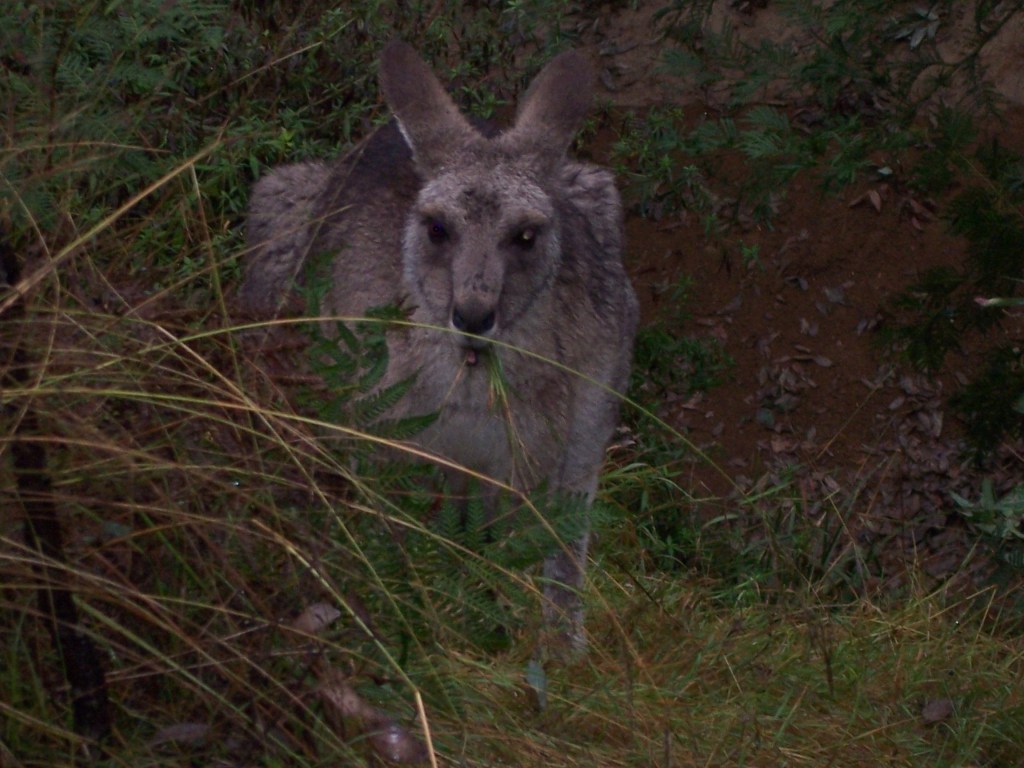
A kangaroo standing behind a bush munching on foliage while staring into the camera | Marsupial Planet
A surprise encounter with a kangaroo in the wild. I am so glad I did not pee on his lunch.
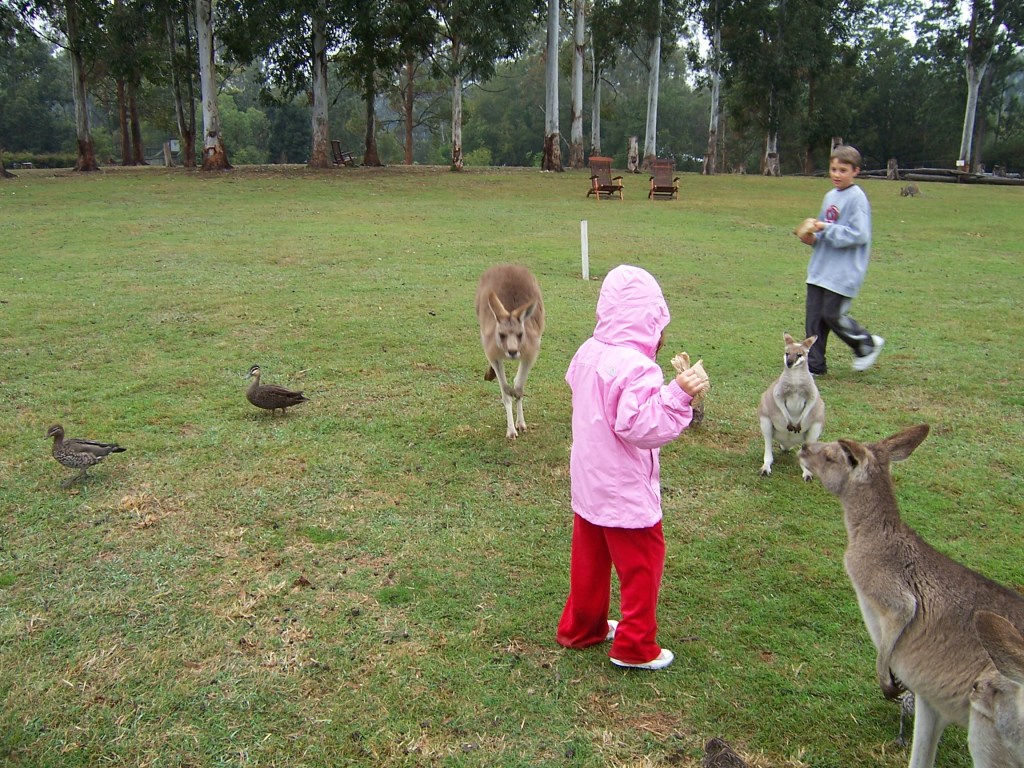
Our son in a blue shirt and our daughter in a pink rain jacket surrounded by three kangaroos.
Our oldest son and daughter feeding small kangaroos (or wallabies) at a nature preserve outside Brisbane, Australia.
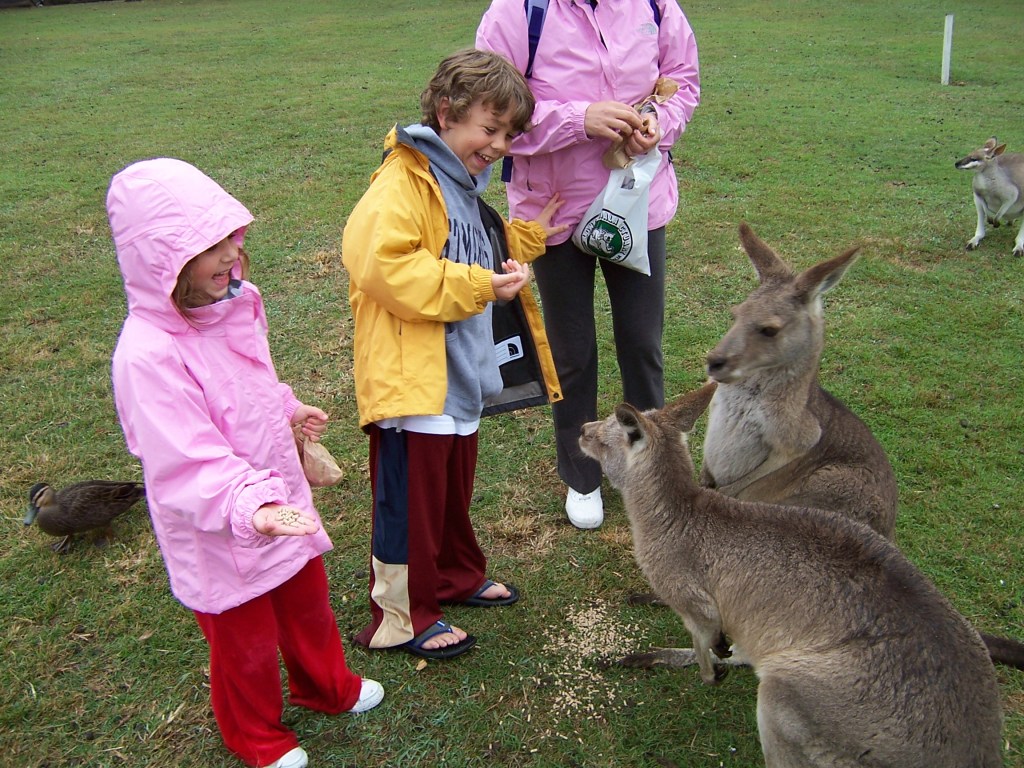
My wife and younger son in yellow rain jackets and our daughter in a pink rain jacket surrounded by three kangaroos that are close up.
Our younger son and daughter feeding small kangaroos at a nature preserve outside Brisbane, Australia. They are laughing because one of the kangaroos grabbed the entire bag of food and then spilled it.
The kangaroo is putting his face straight into the camera, very close | Marsupial Planet
A small kangaroo/wallaby is sniffing my camera (at the same nature preserve).
Note : Koalas are often called Koala bears, but they are not bears.

A koala is sitting in a tree branch curled up with its eyelids shut.
A Koala sleeping in a tree at Brisbane Zoo.
Our six-year-old daughter is sitting in a chair and holding a koala.
Our daughter holding a Koala at Brisbane Zoo.
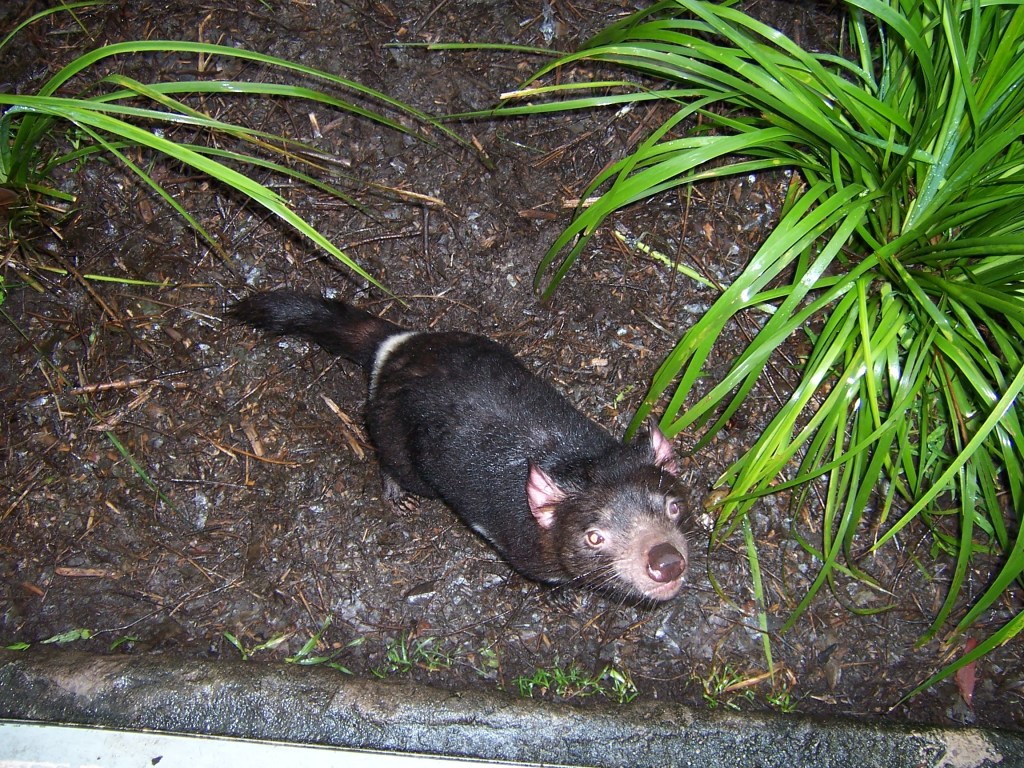
The Tasmanian Devil is behind a fence, and he is looking up to the camera | Marsupial Planet
A Tasmanian Devil at the Brisbane Zoo.
A wombat in a cage eating straw | Marsupial Planet
Wombat at Brisbane Zoo

One interesting fact about Wombats is that they produce cubic shaped poop. This makes the poop stackable, and the wombats use it to mark their territory and attract mates.

To see the Super Facts click here

Environmental Benefits of Recycling Are Overestimated

Super fact 32: The common perception that recycling is one of the best things you can do for the environment is an exaggeration. Its impact is often not very large and if not done properly it can be counterproductive.

In general recycling is beneficial, because you conserve natural resources, reduce climate change, save energy and reduce waste and pollution. Battery recycling is particularly important since it reduces toxic waste and reduces the risk of a future shortage of certain minerals. Recycling is often viewed as a very important activity that everyone should participate in, and neighbors often shame those who fail to comply.

The shocking news is that even though recycling in general is good for the environment it may not be as beneficial as it is assumed. It turns out to be complicated. As you will see later, most people think that recycling is the most impactful action you can take as an individual to reduce carbon emissions, when in fact it is of very marginal importance. This is what made me consider this a super fact.

A company where a big green hand is depicted to symbolize the protection of the environment, where climate-friendly topics are also depicted, such as wind turbines or recycling | Environmental Benefits of Recycling Are Overestimated
This content was generated by an Artificial Intelligence (AI) system. Asset id: 2531547331

Recycling and Greenhouse Gases

According to EPA recycling saves 193 million metric tons of carbon emissions, which sounds a lot until you consider that the US emit 6,343 million metric tons per year according to EPA making it 3%. According to this website consumers can save 732 kilograms of CO2 assuming they do the recycling correctly. This should be compared to the average carbon footprint for an American (US), which is 16 metric tons, making the savings for good recyclers 4.6%.

According to our World in Data (Not the End of the World page 114), based on this research, giving up an average SUV for a sedan would save 3.6 metric ton, or 22.5%. Switching to a plant-based diet would save 2.2 metric ton per person, or 13.8%. Actions saving more greenhouse gases than recycling that we as consumers can take, are for example: give up SUV, go car free, have a plant-based diet, avoid transatlantic flights, buy green energy, switch to electric car, switch from electric car to no car, avoid medium flights, laundry in cold water, and hand dry clothing.

Surveys across 21,000 adults in 30 countries showed that the two actions that people believed saved the most greenhouse gases were recycling (59%) and upgrading lightbulbs (36%). Upgrading lightbulbs have an even smaller effect than recycling. It is of course still a good action to take.

However, what this data demonstrates is that we are bad at guessing which actions are impactful. We need to get better informed and not make assumptions. It should be noted that the efficiency of the recycling efforts varies from country to country. Among the 32 developed countries for which there is data the United States ranks 25.

Recycling and Plastic Waste

Greenhouse gas emissions is certainly not the only issue to consider. What about plastic waste? As it turns out plastic is very difficult to recycle (depending on the kind of plastic) and according to the EPA less than 9% of plastic is recycled. According to Our World in Data and the book “Not the End of the World” by Hannah Ritchie the US and Europe have well managed landfills and good waste management systems that make our plastic problem less of an issue. That’s good news.

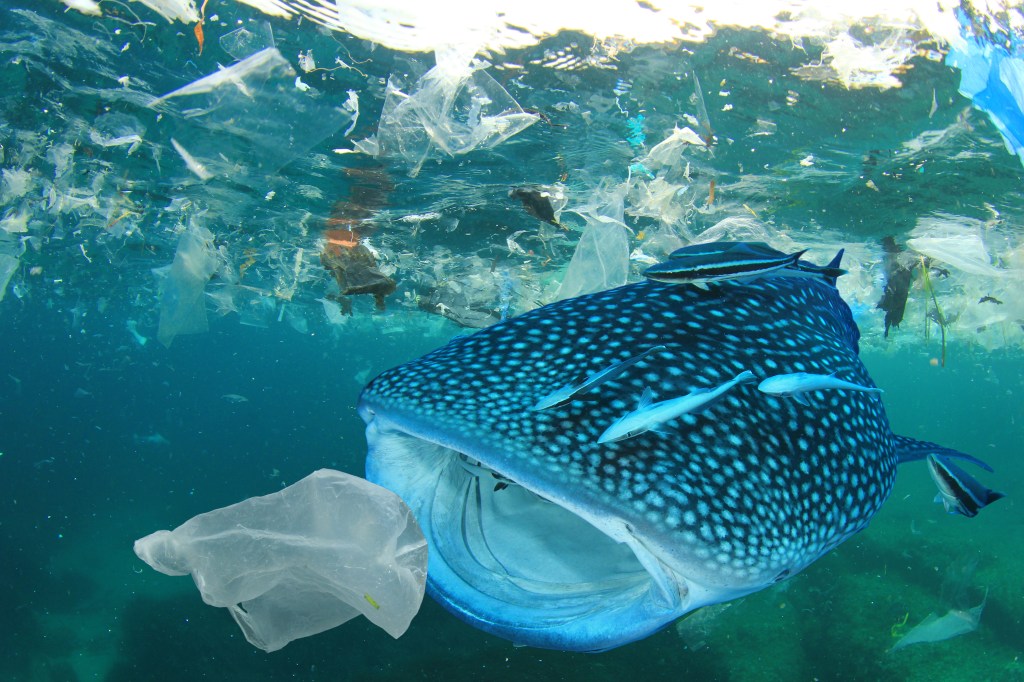
But what about the awful problem with plastic in the ocean? Plastic ending up in the ocean is indeed a bad problem. However, 81% of all plastic in the ocean come from Asia, and the rest mostly comes from Latin America. Only 1% come from the United States and 1% from Europe and Oceania. According to Scientific American 93% of plastic in ocean come from just 10 rivers. Eight of them are in Asia: the Yangtze; Indus; Yellow; Hai He; Ganges; Pearl; Amur; Mekong. Two are in Africa – the Nile and the Niger.

None of them are in North America or Europe. Therefore, if we in the developed world greatly improve our recycling of plastic, it would not make much of a difference with respect to the problem of plastic in the ocean. What we need to do is assist China, India and southeast Asia with improving their waste management systems.

Whale Shark swimming in the ocean about to swallow a plastic bag.
Plastic Ocean pollution. Whale Shark filter feeds in polluted ocean, ingesting plastic. Asset id: 1120768061 by Rich Carey

Another issue to keep in mind is that uneducated consumers can do a lot of damage to the recycling process. For example, throwing a greasy pizza box into the recycling bin can ruin the entire batch. You are not just recycling incorrectly you are ruining the recycling efforts of your neighbors too. There are many ways to ruin the recycling process, by throwing items in the recycling that don’t belong there. Recycling requires consumers to pay attention to the instructions. It should also be noted that some companies have been found to ignore the recycling process and throw all recycled items in with the trash. There are also neighborhoods that don’t have recycling.

Conclusion

In summary, recycling may not be as great as it is often made out to be. You should still do it if you care about the environment. Just be aware that there are actions that you can take and that your government can take that are much more impactful.

One of the conclusions you can draw from this discussion is that if you are driving a big SUV or eating red meat every day you should probably abstain from shaming your neighbor for not recycling.

To see the other Super Facts click here

Freedom to Roam and Concentric Circles

Image above by Kevin from The Beginning at Last

Water surrounded by trees, what looks like coniferous forest. There are circular ripples on the water with drops falling into the lake in the middle | Freedom to Roam and Concentric Circles
This picture reminded me of the Swedish lakes I used to swim in. This is a submission for Kevin’s No Theme Thursday

Freedom to Roam Everywhere

When I was a kid, I used to roam around a lot, in the forest and on the mountains, and I liked to swim and fish in the rivers and the famous deep lakes in the Swedish countryside. Sweden has 97,500 lakes larger than 2 acres and many of them are deep lakes with clean and clear water surrounded by forests, typically coniferous forests. A small deep clean forest lake is referred to as a “tjärn”. I can add that there are no alligators or venomous water snakes in Swedish lakes.

Sweden offers a type of freedom that is rare in the world, and it does not exist in the United States and certainly not in Texas where I live. It is the freedom to roam or more specifically allemansrätten. Whether the land is public or private you have the right to roam, to hike, to camp, to swim, to pick wild berries, to pick wild mushrooms, to fish, and no one can stop you. Landowners are not allowed to tell you to get off their land and they cannot put up fences to stop you or animals from roaming on their land. Everyone has the right to roam and swim everywhere. It is a freedom Swedes love, and if you one day come to experience it you will know why.

My son letting of a swing tire. There are ripples on the lake beneath him. You can see trees on the other side of the lake.
My son is jumping off a tire swing and into a “tjärn” in northern Sweden.

Allemansrätten

The Swedish freedom to roam or allemansrätten, is a right for all people to travel over private land in nature, to temporarily stay there and, for example, pick wild berries, mushrooms, flowers and certain other plants. It is important to point out that you must respect the landowner’s property. You can pick wild berries but not anything the landowner is growing. You cannot destroy or break things or start fires, use ATVs, cut branches off trees, etc. You also need to stay 70 meters or 230 feet away from any dwelling.

As a landowner in Sweden, you can buy land and use it for farming and forestry, and you have the right to prevent people from damaging or stealing your crops. You can buy land for mining, and you have the right to your proceeds and the right to prevent people from stealing from your mines. In addition, people don’t have the right to get close to your house. However, you do not have the right to prevent anyone from roaming on your land.

Other countries with similar laws are Norway, Finland and Iceland. Limited forms of allemansrätten exist in Austria, Germany, Estonia, France, the Czeck Republic, and Switzerland. In the United States, where  allemansrätten does not exist, 63% of all land is private and in Texas 93% of all land is private. Since there is no law in the US protecting your freedom to roam there is noticeably something missing, especially if you are an outdoors person.

Concentric Circles

In addition to evoking my memories of Swedish lakes and allemansrätten, Kevin’s picture tickles my mathematical sense, specifically regarding concentric circles. Concentric circles are beautiful, dreamy, and interesting mathematical phenomena. I could watch concentric circles in the water all day long.

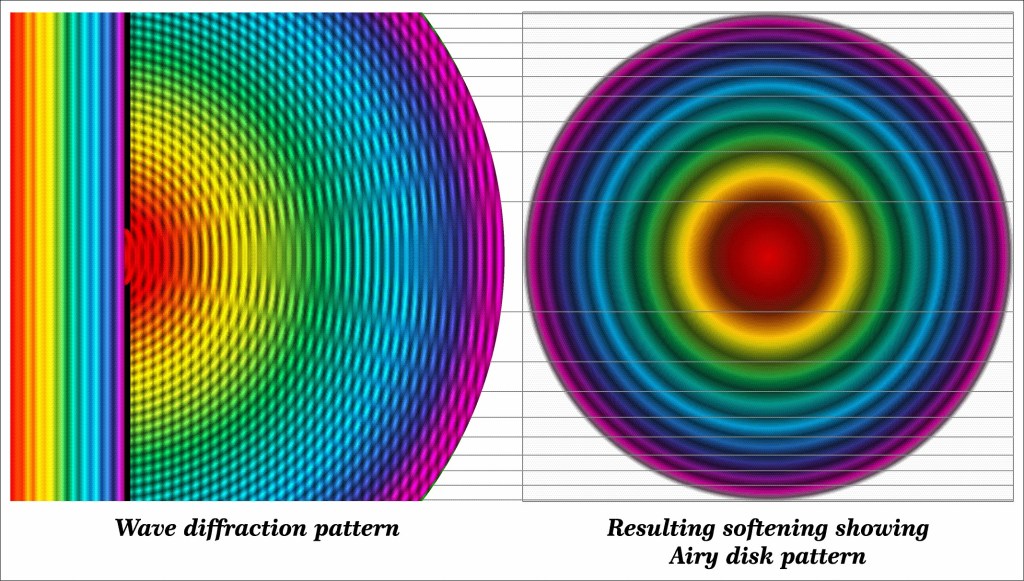
When you jump and play in a lake, when raindrops fall on a lake or a pond you’ll see concentric circles. You see concentric circles on a tree stumps, when you cut an onion, some flower petals, spiderwebs, etc. Concentric circles are everywhere in nature. Light can create concentric circles due to diffraction called an airy disk. Gravitational waves originating from, for example, two black holes colliding create 3D gravitational concentric circles/spheres traveling at the speed of light through space.

Concentric circles are very common in nature. You can see them in Kevin’s picture above. You can see them below my son as he falls into the Swedish lake, and you can see them in the pictures of light below. Whenever waves originate at a point and spread outward you get concentric circles.

There are many kinds of waves, water waves, sound waves, surface waves, seismic waves (earthquakes), mechanical waves, light are waves, electromagnetic waves, matter is both particles and waves, gravitational waves, and they can all make concentric circles. If the waves are moving outward with the same velocity in all directions, you will get equidistant concentric circles.

A real Airy disk created by passing a red laser beam through a 90-micrometre pinhole aperture with 27 orders of diffraction | Freedom to Roam and Concentric Circles
A real Airy disk created by passing a red laser beam through a 90-micrometre pinhole aperture with 27 orders of diffraction. Bautsch, CC0, via Wikimedia Commons
A computer generated an Airy disk from diffracted white light. The colorful light circles come from the hole in the left wall | Freedom to Roam and Concentric Circles
A computer generated an Airy disk from diffracted white light. The colorful light circles come from the hole in the left wall. Asset id: 1973771255 by Fouad A. Saad.
To see the Super Facts click here

Eating Locally is not Necessarily Ecological

Super fact 30: Eating locally is often promoted as an environmentally friendly choice, but that is not always the case.

Whether the food you eat is sustainable and environmentally friendly or not depends on a lot of factors including agricultural methods, whether greenhouse farming or monocropping was used, and whether the crop is natural to its environment. In addition, inefficient local transportation can result in higher emissions than faraway transport by ships and trains. If a crop is grown locally in greenhouses, the extra energy that is needed, and the resulting extra carbon emissions are often much larger than the emissions from the transport.

Cargo ship at sunset. Emissions from the transport of produce is not the main factor for emissions.
Photo by aries nha on Pexels.com

I consider this a super fact because it is often assumed that buying locally is the best choice for the environment. After all, transporting something across the world causes a lot of emissions, right? It turns out not to be that simple.

Articles on Transportation of Food in my French Book

The first time this issue was brought to my attention was in my French class. I am learning French, just as a hobby. There was an article in our French book on the transportation of food around the world “Notre planète ne tourne pas rond!”.

We read that cashews were grown in the Ivory Coast in Africa and then sent for peeling and cleaning in Brazil and then sent to France to be sold. The cashews travelled 10,000 kilometers or 6.250 miles. We read about cod that was caught in Norway then sent to China to be cut into filets and then sent to France to be sold. That cod travelled 15,000 kilometers. We all thought it was crazy, and very bad for the environment, so much unnecessary emissions from transportation. But we all learned a few new French words.

Then at our next class, we turned the page “Consommer local, vraiment bon pour la planète?” / “Consuming locally, really good for the planet?”. Wait what? The next article confused us since it stated that in many cases eating locally was bad for the environment, not good for the environment. Transporting the food around the globe might be good for the environment.

Incidentally, at the time I was reading “Not the End of the World, How we can be the first generation to build a sustainable planet” by Hannah Richie, the research director for “Our World in Data”. “Our World in Data” is a highly regarded free and open-source website that collects and analysis vetted statistics on a large range of topics. In that book she stated that the data showed that tomatoes imported to Sweden from Spain caused less carbon emission than tomatoes grown locally in Sweden.

The Problem with Locally Grown Tomatoes

This article from University of Southern Denmark claim that importing tomatoes from warm countries are better for the environment than buying locally. The reason being that when tomatoes are grown in an open field, the production emits an average of 80 kg CO2 per ton, but if the tomatoes are grown in a greenhouse, they emit up to 700 kg CO2 per ton. In northern countries it is common to grow tomatoes in greenhouses, especially when they are out of season. The long transport of the tomatoes causes much less emissions than that.

This scientific article analyses the issue a bit deeper and concludes that “that the distance travelled by the tomatoes is not the most important environmental burden”. Whether the tomatoes were grown in greenhouses or not matters a lot, but there are many other factors. In short, it is complicated.

Lots of fresh red tomatoes | Eating Locally is not Necessarily Ecological
Photo by Julia Nagy on Pexels.com

This study of local vs. imported tomato production in Canada concludes that locally grown tomatoes grown in greenhouses on average cause 1,070 grams of carbon emissions per kilo of tomatoes grown and tomatoes grown open field in Mexico cause 775 grams of carbon emissions per kilo of tomatoes, despite the 3,800-kilometer journey from Mexico to Ontario, Canada. The reason for the higher emissions for locally grown tomatoes is again that greenhouses use a lot of energy.

Naturally, this would change if you grew the tomatoes in season without using greenhouses. The article also notes that carbon emissions are not the only issue for sustainability. Water usage is another important factor.

The Problem with Locally Grown Vegetables and Fruits

Tomatoes are just one example. The same hold true for cucumbers, lettuce and salad greens, potatoes, bell peppers, hot peppers, green beans and other bean varieties, berries, pineapples, bananas, mangoes, other tropical fruits. In addition, some of these crops can deplete the soil and require large amounts of water, which can be bad if they are being cultivated in areas where water resources are already scarce such as growing avocados in California. In general, growing vegetables and fruits in their natural environment tends to be the most sustainable.

Fresh yellow bananas | Eating Locally is not Necessarily Ecological
Photo by Dom J on Pexels.com

The Problem with Locally Grown Apples

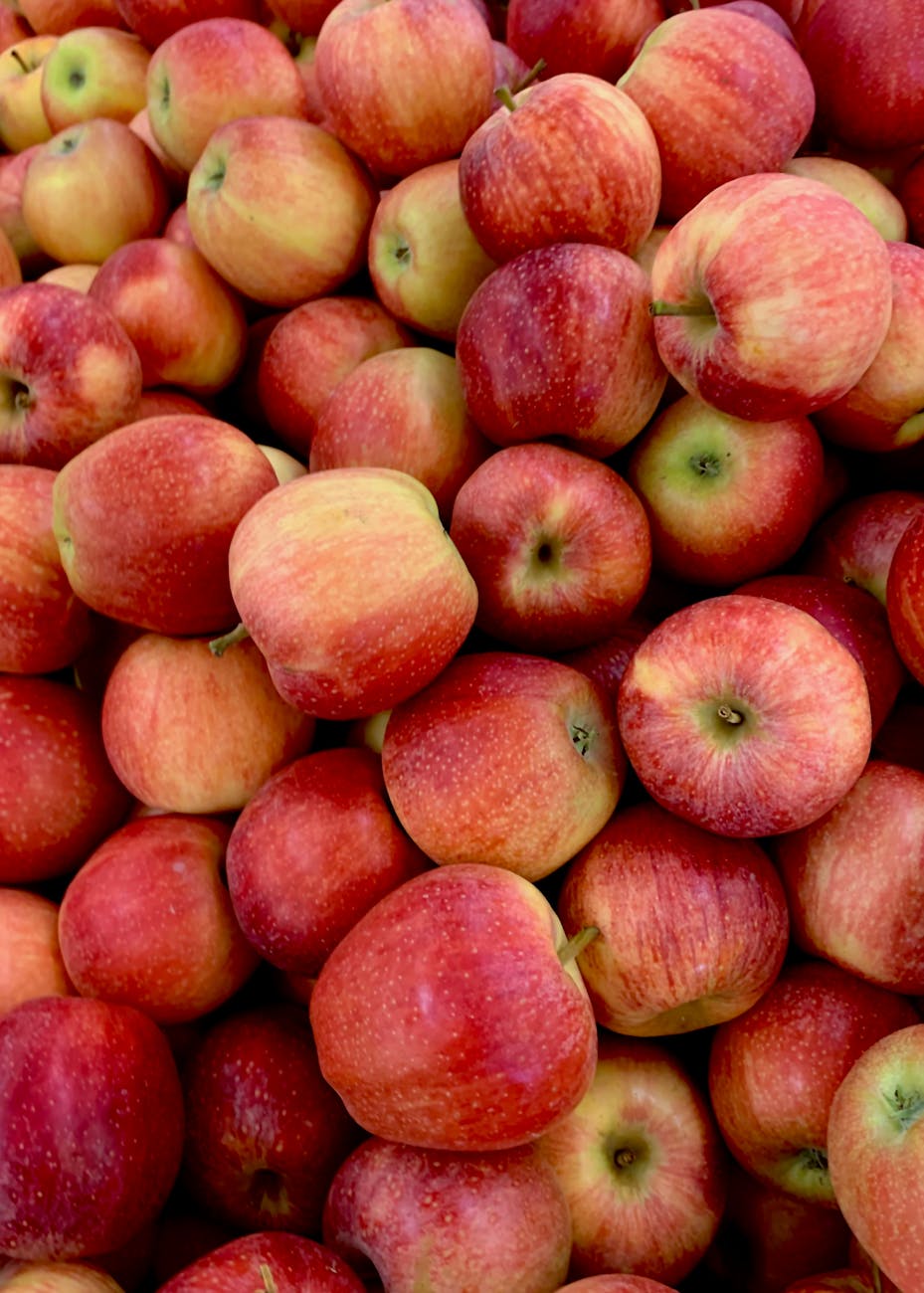
The problem with apples tends to be the opposite, geography wise. In warmer areas, they might require significant water resources or chemical inputs to thrive. Apples from cooler climates need less water and fewer chemicals, reducing their ecological impact.

Lots of apples | Eating Locally is not Necessarily Ecological
Photo by Pierpaolo Riondato on Pexels.com

Local versus Imported It’s Complicated

I should point out that growing locally sometimes being worse for the environment than importing does not mean that importing produce is better for the environment. It just means that it is complicated and that you need to make that determination on a case-by-case basis. The environment is also not the only concern. Another consideration is the protection of local farmers and the local economy.

My opinion is, instead of worrying a lot about local versus imported produce, it is better to focus on things that we know cause a lot of emissions. A dirty grid, coal power stations, a non-hybrid SUV with an internal combustion engine, unnecessary business trips, eating a lot of red meat, basically start with the low hanging fruit.

Eating Locally is not Necessarily Ecological
Photo by Janusz Walczak on Pexels.com
To see the other Super Facts click here

EV Cars Indeed Emit Less Carbon Pollution

Super fact 29: EV Cars emit less pollution than Internal Combustion Engine Cars, even considering manufacturing, disposal and EV Cars being charged by dirty grids.

EV Cars emitting less carbon pollution is a Super Fact

At least here in Texas it is quite common to hear people say that EV cars do not reduce emissions. After all EV cars use electricity from the dirty grid. It is also frequently implied that environmentalists and people who care about fossil fuel emissions do not understand that the electricity for EV cars typically comes from the dirty grid. However, the environmentalists I know do know that. In fact, they typically know more and have sometimes done the math. This is why I consider it a super fact. We know that it is true that EV Cars emit less carbon pollution. This is a fact that matters, it is not trivia, and yet this fact is frequently disputed, argued over, or surprising to people.

EV Cars are more efficient than Internal Combustion Engines

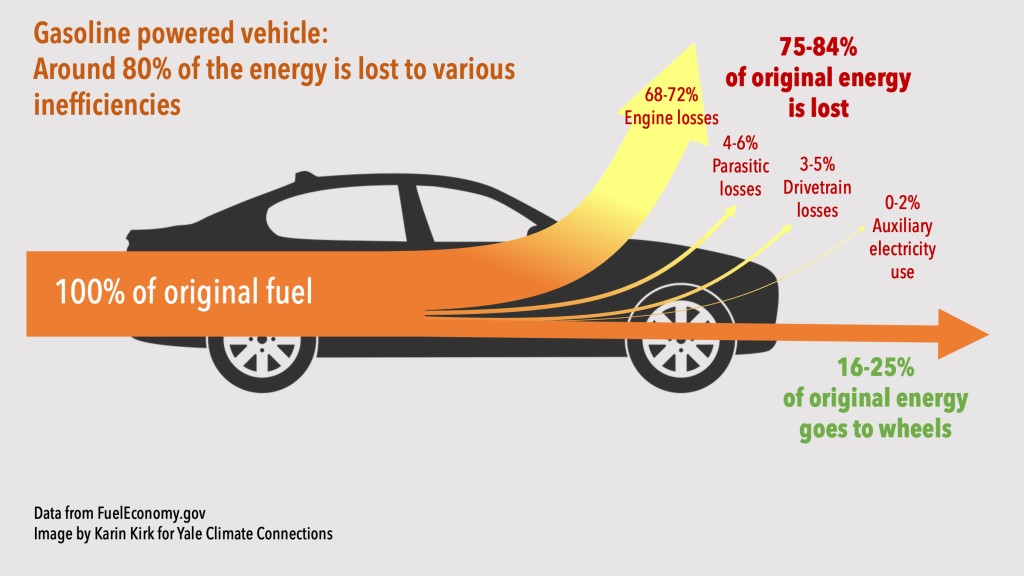
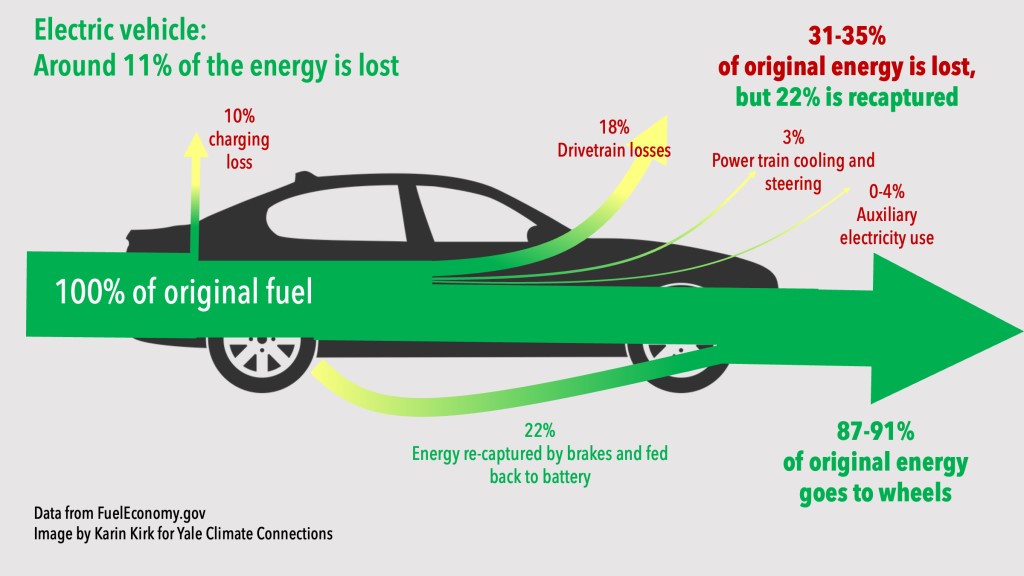
For starters, EV cars are much more efficient than Internal Combustion Engine cars, or ICE, and even a coal-fired power plant is less wasteful than a car engine. The net result is that the emissions caused by EVs via the electrical grid are significantly less per mile. The miles per gallon equivalent (MPGe) for electric vehicles (EVs) varies by state/grid and depends on the model of the car but in general it is much better than for an ICE . Replacing gasoline-powered cars with EVs saves energy, regardless of the energy source used to recharge the EVs. For an ICE 16-25% of the original energy goes to the wheels whereas for an EV 87-91% of the original energy goes to the wheels.

Image showing an ICE car and its various carbon losses | EV Cars Indeed Emit Less Carbon Pollution
16-25% of original energy goes to the wheels. Data from FuelEconomy.gov, Image by Karin Kirk for Yale Connections.
Image showing an EV car and its various carbon losses | EV Cars Indeed Emit Less Carbon Pollution
87-91% of original energy goes to the wheels. Data from FuelEconomy.gov, Image by Karin Kirk for Yale Connections.

The Manufacture and Disposal of EV Cars

It takes more energy to manufacture an EV battery for an EV car than it does to produce a combustion engine. So, the production of an electric vehicle does emit more carbon than a petrol car. However, the lower emissions resulting from driving an EV means that an electric car quickly pays back that debt, so to speak. It is typically paid back within two years, according to Hannah Richie, the research director at Our World in Data. The statistics show that switching from an average ICE to an equally sized EV will save 1.2 tons of carbon emissions per person and year. That is a lot considering that the average carbon footprint per year is 4 tons worldwide and 14.4 tons per year for an American.

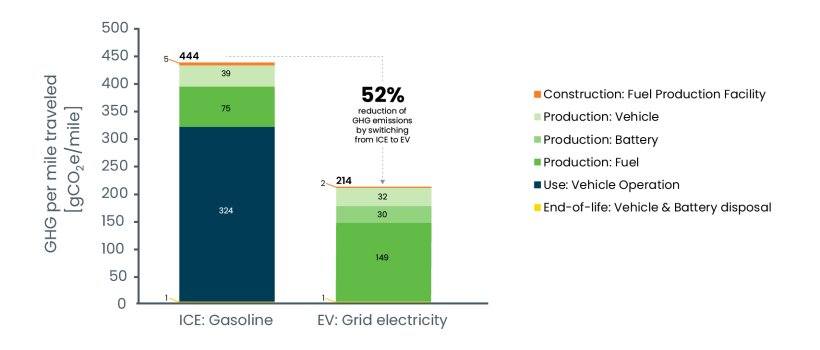
So, are electric vehicles definitely better for the climate than gas-powered cars? This article from MIT answers the question in the affirmative. The graph below includes construction of facilities, manufacturing of vehicle and battery, production of fuel, vehicle operation as well as disposal. It  is taken from this government website and this article also answers the question above in the affirmative. This is an article from the Department of Energy is stating the same thing.

The histogram graph show that if you consider construction of facilities, manufacturing of vehicle and battery, production of fuel, vehicle operation as well as disposal the total average greenhouse gas emissions from EV cars is 52% less.
Lifecycle greenhouse gas emissions comparison of average gasoline car and average EV.

Hannah Richie at Our World in Data also states that other environmental damages related to EVs such as mining for minerals are less than the damage from mining and extraction for fossil fuel cars, and she claims that the price of lithium-ion batteries has fallen by 98% over the last three decades. It should be noted that EVs are becoming increasingly common. According to Our World in Data in 2022, 88% of all cars sold in Norway were EVs and 54% of all cars in Sweden were EVs.

EV Cars Indeed Emit Less Carbon Pollution
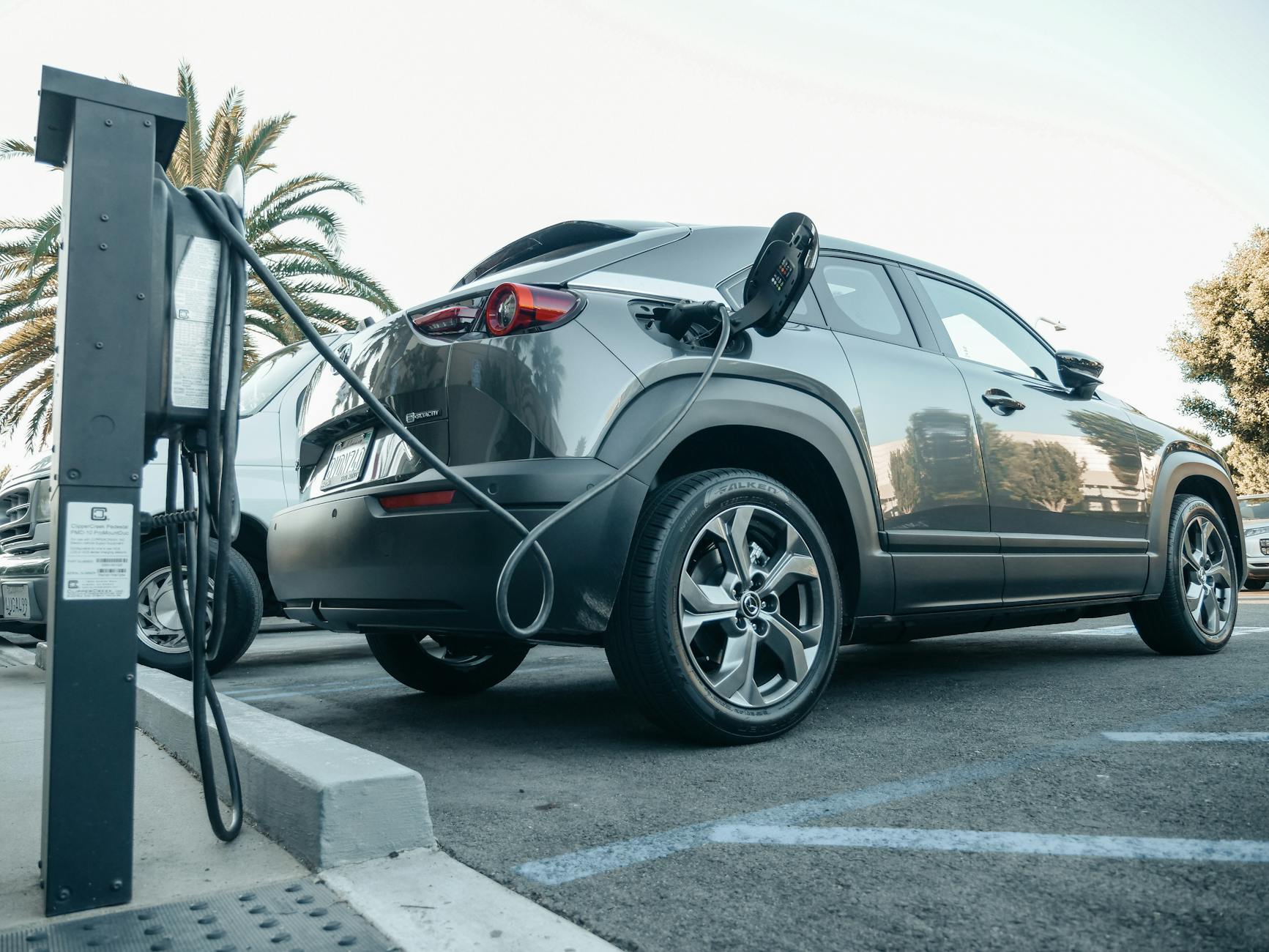
Photo by Kindel Media on Pexels.com

Other EV Myths

There are other EV myths that you may want to have debunked, such as Electric vehicle batteries are unreliable and need to be replaced every few years. In 2011 battery failures were common, 7.5%, but in 2023 battery failures were 0.1%. See this article for details and other myth debunking. A related post is my post on electrification.

I should add that there are some drawbacks with EVs such as the easy with which you can charge them, depending on your location. This post is not a promotion of EVs, and I do not drive an EV for various reasons. This post, like most posts in this blog, is about correcting misinformation and getting the facts correct.

To see the other Super Facts click here