The goal of this blog is to create a list of what I call super facts. Super facts are important true facts that nevertheless are surprising to a lot of people, mind blowing, misunderstood or disputed among non-experts. They are challenging facts that sometimes are inconvenient truths or truths that contradict our beliefs. However, I also make posts that are not super facts but feature other interesting information, such as this book review and book recommendation. This book explains how trees communicate, protect each other, form communities, help weaker members, how they remember, and can live for thousands of years. The book is:
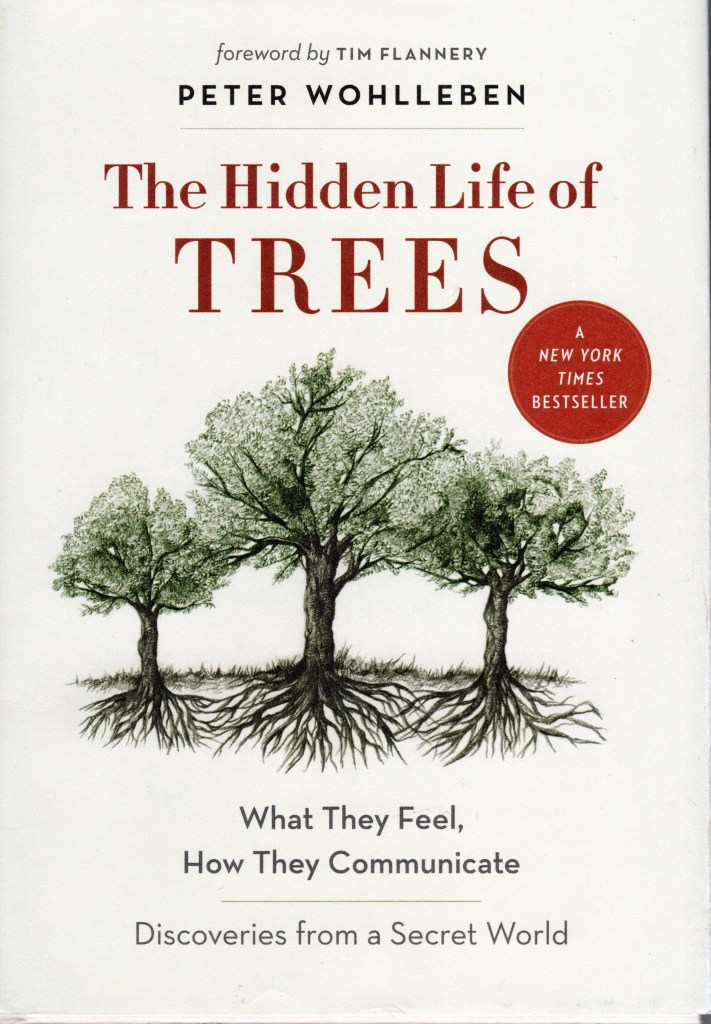
The Hidden Life of Trees: What They Feel, How They Communicate―Discoveries from A Secret World (The Mysteries of Nature, 1) by Peter Wohlleben (Author), Jane Billinghurst (Translator), Suzanne Simard (Afterword), Tim Flannery (Foreword)
Below I am listing the three editions on Amazon of this book. I bought the hardback version.
- Hardback – Publisher : Greystone Books (September 13, 2016), ISBN-10 : 1771642483, ISBN-13 : 978-1771642484, item weight : 2.31 pounds. dimensions : 5.3 x 1.1 x 7.6 inches, pages 288. It costs $14.34 on US Amazon. Click here to order it from Amazon.com.
- Paperback – Publisher : Greystone Books (May 5, 2026), ISBN-10 : 1771643773, ISBN-13 : 978-1771643771, 288 pages, item weight : 10.4 ounces, dimensions : 5.25 x 2 x 7.5 inches. It costs $13.83 on US Amazon. Click here to order it from Amazon.com.
- Publisher : Random House Audio (January 1, 2035), ISBN-10 : 1524708593, ISBN-13 : 978-1524708597, Currently not available.
Amazon’s Description of the Book
A NEW YORK TIMES, WASHINGTON POST, AND WALL STREET JOURNAL BESTSELLER • One of the most beloved books of our time: an illuminating account of the forest, and the science that shows us how trees communicate, feel, and live in social networks. After reading this book, a walk in the woods will never be the same again.
“Breaks entirely new ground … [Peter Wohlleben] has listened to trees and decoded their language. Now he speaks for them.”—The New York Review of Books
NAMED ONE OF THE BEST BOOKS OF THE YEAR BY BRAINPICKINGS • HONORABLE MENTION: SEJ Rachel Carson Environment Book Award • Shortlisted: Audible International Book of the Year Award • Books For a Better Life Award • Indie Choice Award—Nonfiction Book of the Year
Are trees social beings? In The Hidden Life of Trees forester and author Peter Wohlleben convincingly makes the case that, yes, the forest is a social network. He draws on groundbreaking scientific discoveries to describe how trees are like human families: tree parents live together with their children, communicate with them, support them as they grow, share nutrients with those who are sick or struggling, and even warn each other of impending dangers. Wohlleben also shares his deep love of woods and forests, explaining the amazing processes of life, death, and regeneration that he has observed in his woodland.
“A declaration of love and an engrossing primer on trees, brimming with facts and an unashamed awe for nature.”—Washington Post
“Heavily dusted with the glitter of wonderment.”—The New Yorker
Includes a Note From a Forest Scientist by Dr.Suzanne Simard
Published in Partnership with the David Suzuki Institute
This is my five star review for the book The Hidden Life of Trees
What Do You Know About the Wood Wide Web?
There are certainly a lot of things about trees that I did not know that I now know after reading this book. Trees are not just immobile, inert and passive life. They communicate, form communities and help each other. They form friendships, they learn, employ clever survival tactics, and they live for hundreds of years and even thousands of years, and they are incredibly important for our survival and the survival of most creatures on Earth.
This eye opening and fascinating book drawing on scientific discoveries about trees make you wonder whether trees might be conscious beings with feelings, like animals. You can always wonder. The author describes himself as a forester who belatedly became aware of how amazing trees are, especially trees in old growth forest that has not been managed by humans. Planted trees are not as healthy and capable as trees in old growth forests and planted trees don’t form friendships. Plantation monocultures managed using heavy machinery are especially unhealthy and damaging to ecosystems.
Trees communicate with each other in various ways. They send electrical signals via their root systems, and they use fungus for communicating and they send chemical signals traveling through the air. Some trees also use sound to communicate. One type of tree generates a crackling sound at 220 Hz, and the related seedlings direct their tips in that direction. They assist each other by supplying nutrients to weaker members, even tree stumps, that can go on living for many hundreds of years after being cut down thanks to the nutrients supplied by neighboring trees. If you try to help certain trees by getting rid of the competition you hurt them because they depend on their community. Because of the recent discoveries of tree behaviors researchers coined the term the Wood Wide Web.
Trees have amazing ways of protecting themselves from predators. When certain insects start eating their leaves, they release pheromones into the air that attracts the predators of those insects. The trees can often accurately identify which type of insect it is. When giraffes begin eating an acacia tree the acacia tree creates bitter and poisonous chemicals in its leaves within minutes as well as releasing chemicals into the air to warn other trees, which in turn do the same before any giraffes have gotten to their leaves. The giraffes get the message and move on.
Trees are also very important for our survival and the survival of most other species in the way they impact weather. Water vapor and clouds would not penetrate as easily into the interior of continents without trees. The trees within a distance of 500 miles from the coast are especially important. Without trees the interior of continents would be significantly drier.
A few of the fascinating facts that you learn about trees from this book is, for example, that there is a spruce in Sweden that is more than 9,500 years old. Well, its root system is that old and according to the author the root system is the most important part of a tree. Trees create eco systems that moderate temperature extremes and provide humidity. Slow growth when a tree is young is a prerequisite if a tree is to live to a ripe old age. Trees stockpile water during winter. You will learn about how trees transport water. You learn that forest air is the epitome of healthy air.
You will also learn about the different species of trees and their differences, beech trees, oak trees, spruce, fir, pine, birch trees, willow trees, yew, alder, hornbeam, hazels, poplar, redwood trees, etc. You will learn about the harm that our tree management and tree planting for the sake of the logging industry does and the damage and threat from climate change. You will learn how trees can help fight climate change (you need to let them grow old). You will learn how fossil fuels are formed and that burning wood is not carbon neutral, and about the effects of hoarfrost. You will learn about how beavers regulate water supplies, the terrible bark beetle and Asian long-horned beetle, and how damaging our interference with eco systems can be.
From this book I learned a lot about trees, forests and ecosystems and the damage we do to ecosystems. The information is presented in an accessible and captivating way. It is well written and interesting and does not contain complicated academic language. You will have a hard time putting the book down as you start reading it. It is a book that I highly recommend to anyone interested in understanding a bit more about our world and its forests and ecosystems.