The goal of this blog is to create a list of super facts. Important facts that are true with very high certainty and yet surprising, misunderstood, or disputed by many. This blog aims to be challenging, educational, and fun, without it being clickbait. I determine veracity using evidence, data from reputable sources and longstanding scientific consensus. Prepare to be challenged (I am). Intentionally seek the truth not confirmation of your belief.
Category: Surprising and Important Fact
This is a fact that is important for our understanding of the world and yet many people fo not know it and it comes as a surprise to many.
Super fact 137 : Child mortality has sharply declined in all world regions. Despite that fact, five million children die every year. Most of these deaths are preventable.
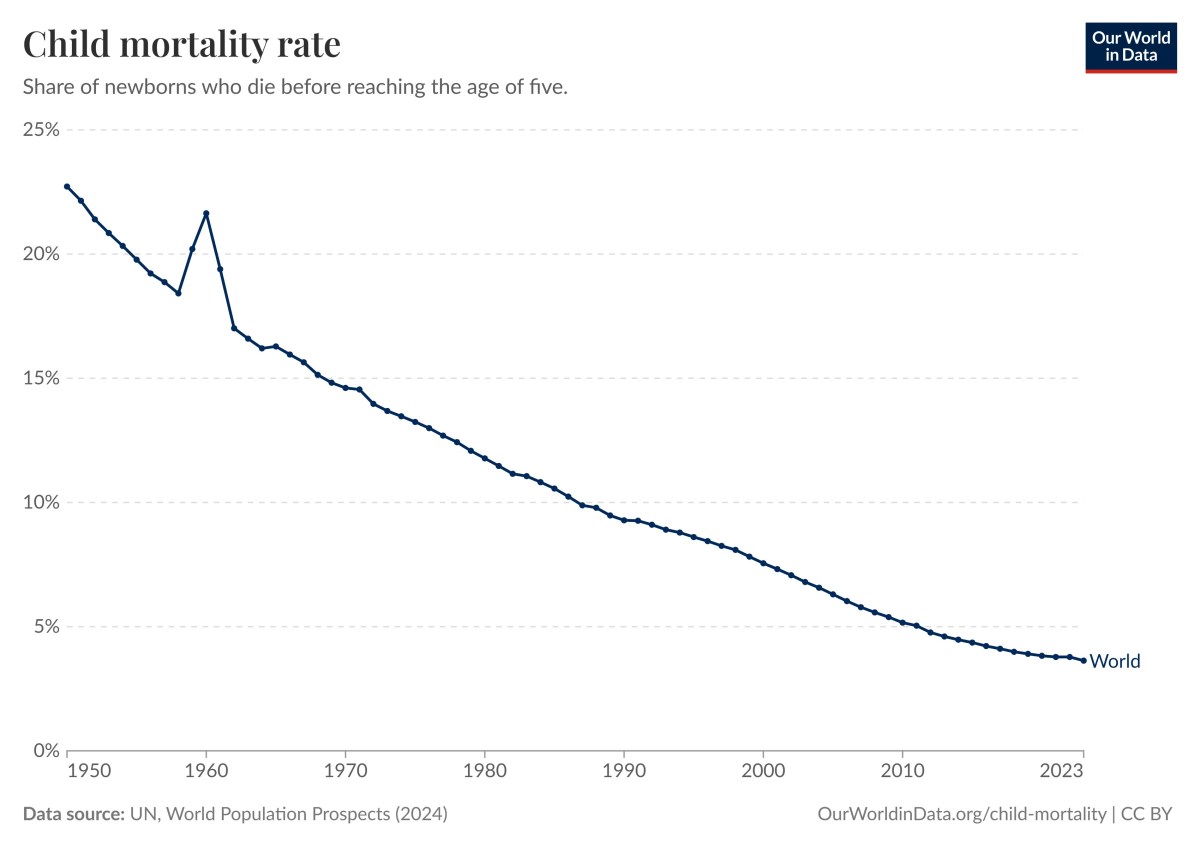
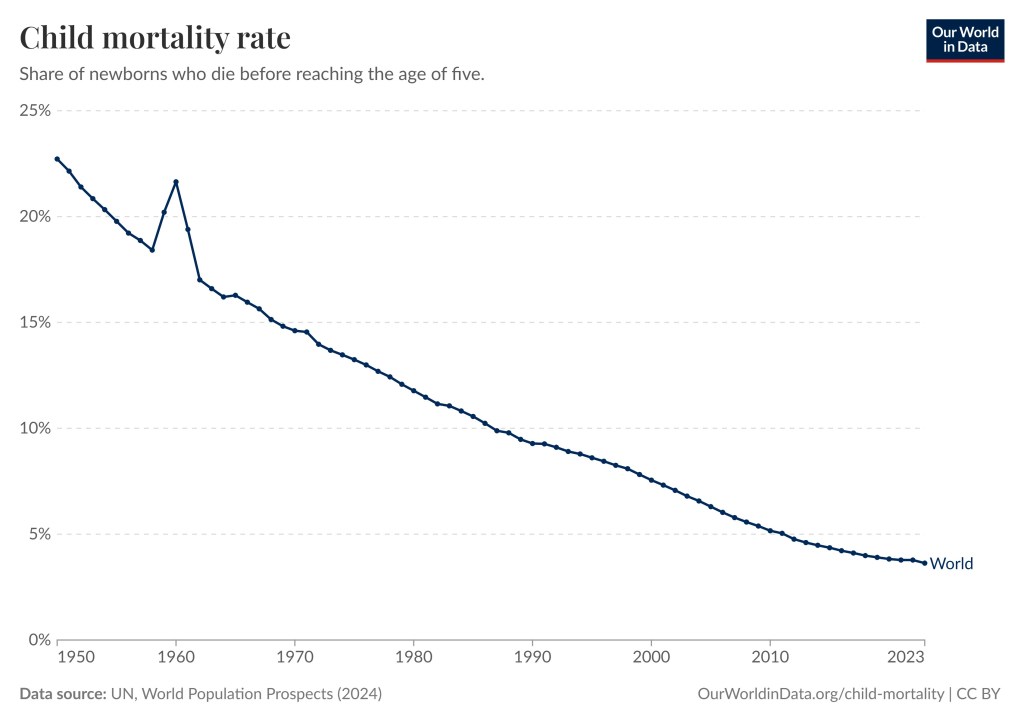
Child mortality rate worldwide. Share of newborns who die before reaching the age of five. Data source: UN, World Population Prospects (2024) – Learn more about this data. OurWorldinData.org/child-mortality | CC BY
The graph above shows the probability a newborn would die before reaching the age of five if the year’s age-specific mortality rates stayed unchanged. It is not the share of an actual cohort that has been observed dying. As you can see, the child mortality worldwide has gone from 22.7% in 1950 to 3.6% in 2023. That is more than a sixfold improvement. The significant uptick in child mortality in 1960 is because of the Great Leap Forward in China.
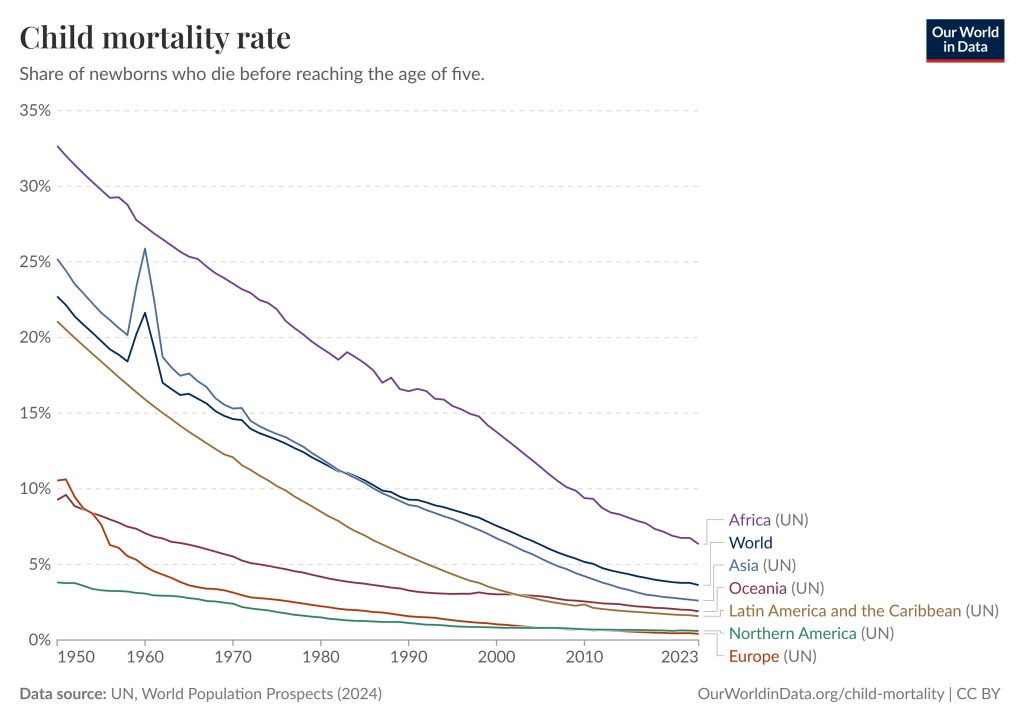
The graph below shows that the sharp decline in child mortality exists across all regions of the world. The graph depicts the child mortality rate for Africa, Asia, Oceania, Latin America and the Caribbean, Northern America, Europe and the whole world. You can play around with the graph and select your own regions and countries by clicking here. Note that Africa is the region with the worst numbers. However, the decline in child mortality still goes from 32.7% in 1950 to 6.3% in 2023, a fivefold decline.
Child mortality rate. Share of newborns who die before reaching the age of five. Data source: UN, World Population Prospects (2024). OurWorldinData.org/child-mortality | CC BY
If you look further back in time the numbers are not as accurate, but they are a lot more impressive. In the maps below you can see that the child mortality rate in the 1800 is estimated to be between 30% and 60% everywhere in the world. If you look at the bottom map, you’ll see that the countries that are the worst off with respect to the child mortality rate in 2015 have a child mortality rate of 14%. That means that the worst off country in the 21st century is much better off than any of the countries were in the 1800. You can read more about this map and related information here.
Child mortality in 1800, 1950 and 2015. The share of children (born alive) who died before reaching their 5th birthday. Data: Our World in Data based on Gapminder for 1800, and United Nationas Population Division (2017) for 1950 and 2015. Licensed under CC-BY by the authors Hannah Ritchie and Max Roser (2019).
However, a child mortality rate of 3.6% still means that nearly five million children die every year before the age of five. The UN estimates that 990 million children have died globally since 1950. Most of these deaths are preventable. Infectious diseases and birth disorders (primarily preterm births and neonatal suffocation) dominate deaths among children under five. The impressive and almost steady decline in the child mortality rate across all regions in the world is a positive but surprising and important fact.
However, the fact that despite the success in reducing the child mortality rate five million children still die, and those deaths are preventable is a surprising but less positive fact. That’s why I consider this a super fact.
Look at the bottom half on the following page for details about the original sources.
Additional Child Mortality Rate Graphs and Maps
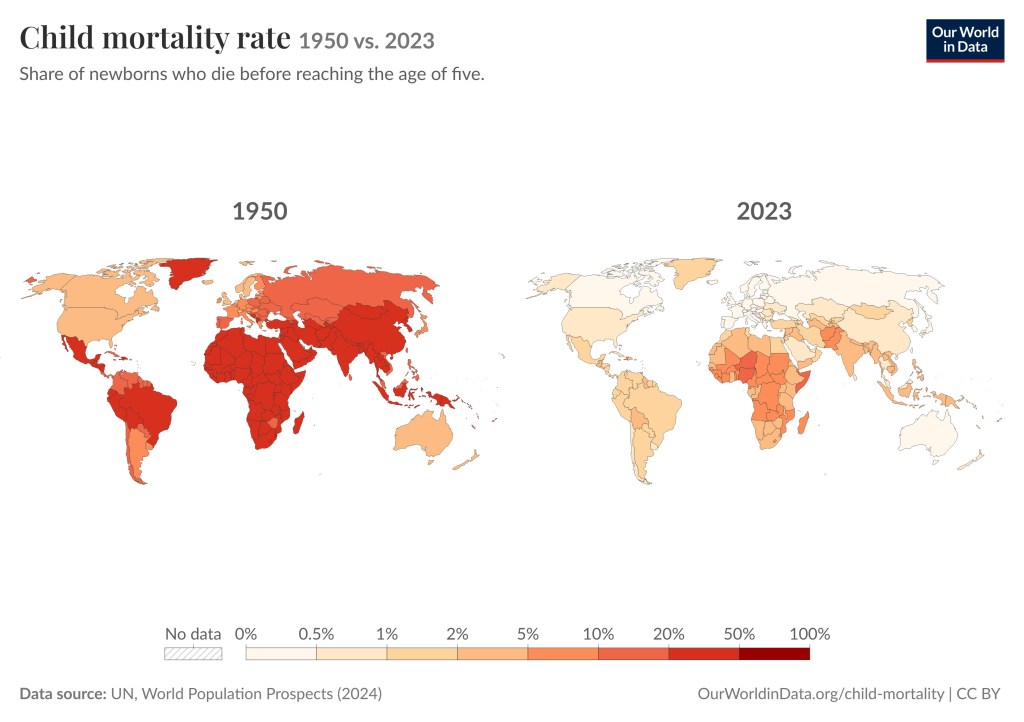
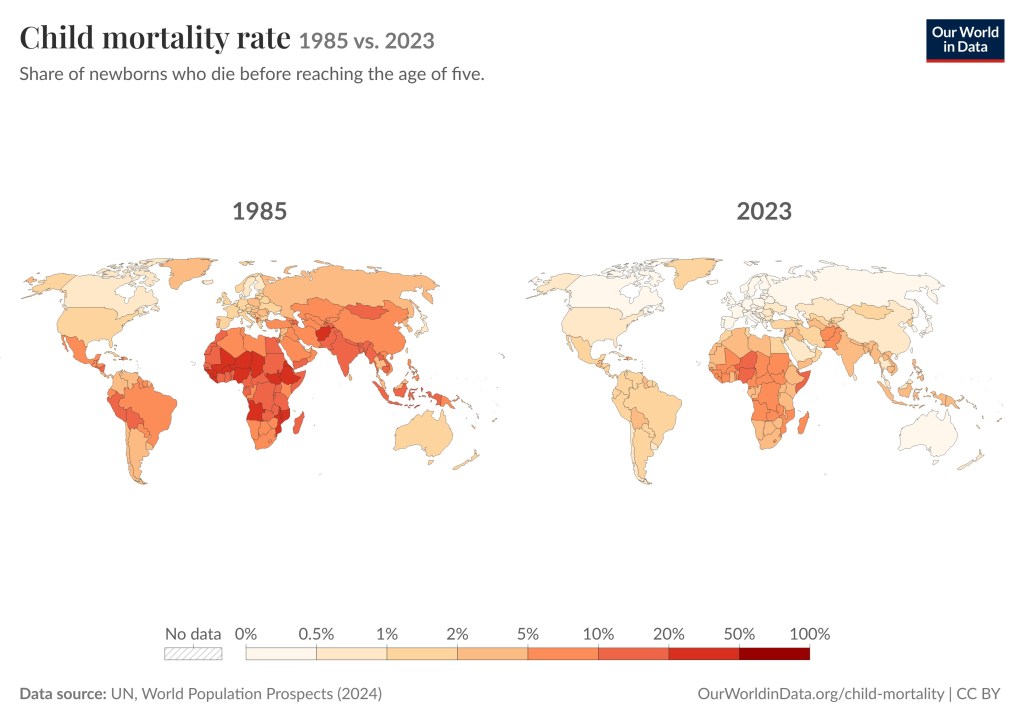
Child mortality rate 1950 vs. 2023. Share of newborns who die before reaching the age of five. Data source: UN, World Population Prospects (2024) OurWorldinData.org/child-mortality | CC BYChild mortality rate 1985 vs. 2023. Share of newborns who die before reaching the age of five. Data source: UN, World Population Prospects (2024) OurWorldinData.org/child-mortality | CC BY
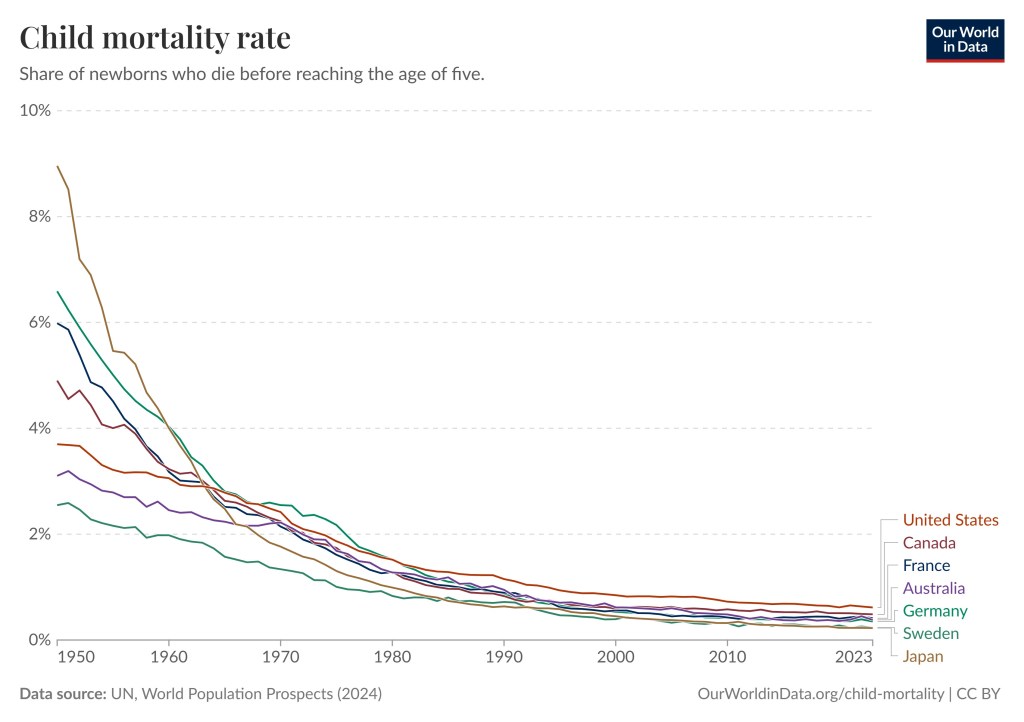
In the graph below notice that Japan shows a decline in the child mortality rate from 9% in 1950 to 0.2% in 2023, which is quite impressive.
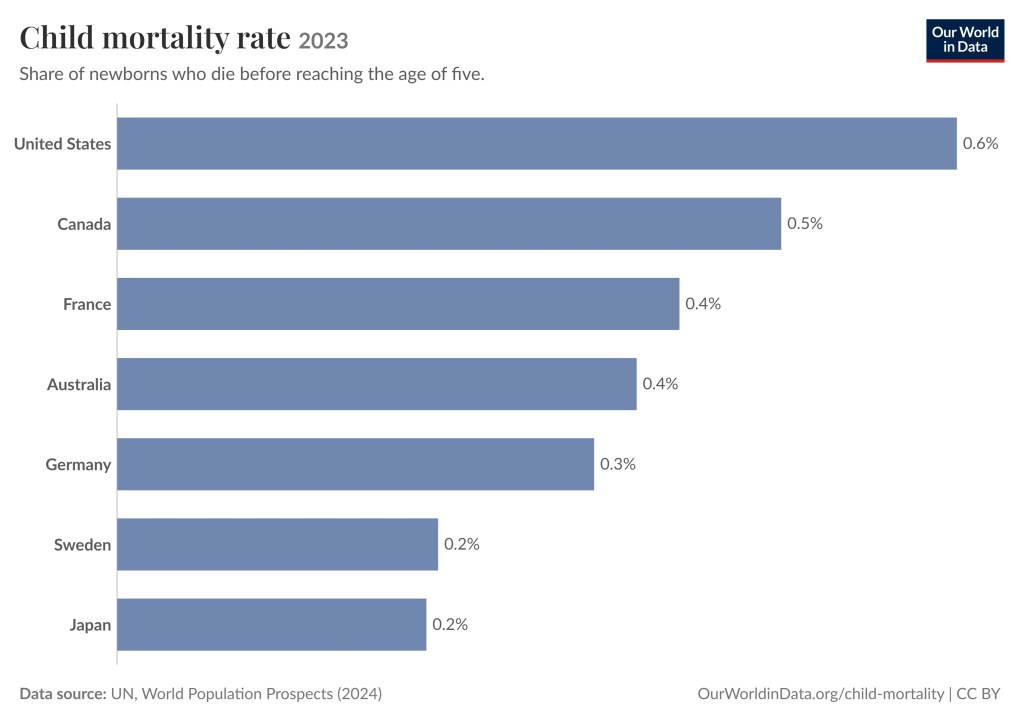
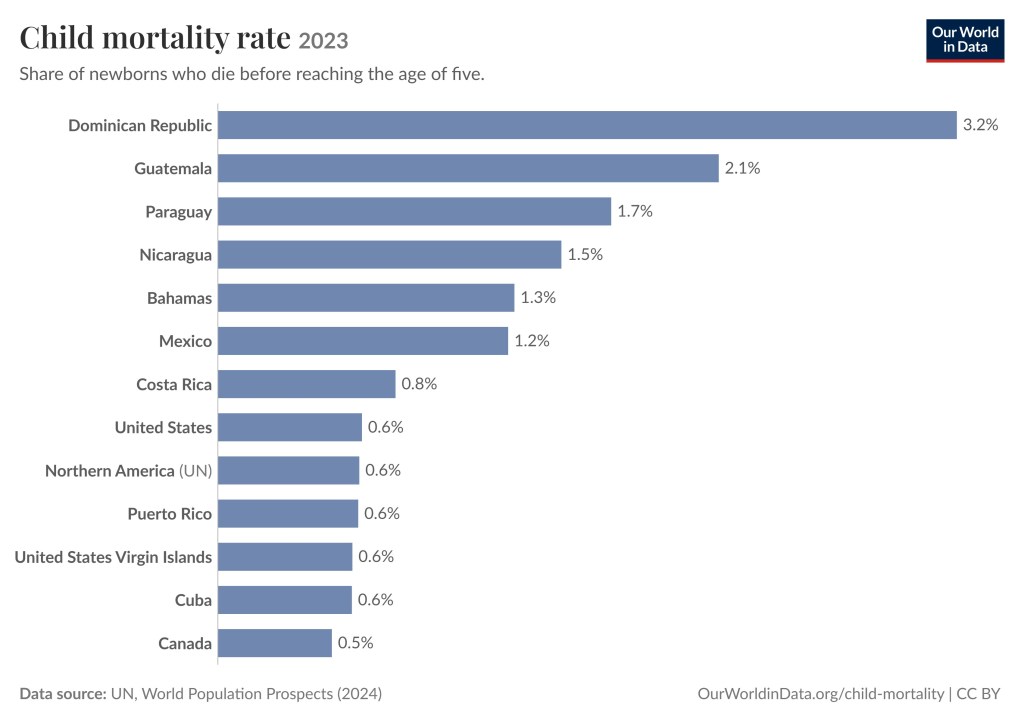
Child mortality rate in selected developed countries from 1950 to 2023, including the United States, Canada, France, Australia, Germany, Sweden and Japan. Share of newborns who die before reaching the age of five. Data source: UN, World Population Prospects (2024) OurWorldinData.org/child-mortality | CC BYChild mortality rate in selected developed countries in 2023, including the United States, Canada, France, Australia, Germany, Sweden and Japan. The child mortality rate is represented as bar graphs. Share of newborns who die before reaching the age of five. Data source: UN, World Population Prospects (2024) OurWorldinData.org/child-mortality | CC BYChild mortality rate in North American countries 2023. Share of newborns who die before reaching the age of five. Data source: UN, World Population Prospects (2024 OurWorldinData.org/child-mortality | CC BY
The Death of Five Million Children
Five million children die every year — what do they die from?
44% died from infectious diseases including pneumonia, influenza, covid-19, malaria, rotavirus, cholera, typhoid, hepatitis, encephalitis, measles, whooping cough, and meningitis, STDs, tuberculosis, and HIV/AIDS. It may come as a surprise that 118,000 children died from measles in 2023 and 95,600 children died from whopping cough in 2023.
42% died from birth disorders including preterm birth, neonatal asphyxia, heart abnormalities, neonatal sepsis, etc. The remaining 14% were cardiovascular diseases, digestive diseases, genetic blood disorders, malnutrition, cancers, accidents such as drowning and transport accidents. You read the details and check the graphics here.
About two weeks ago I published a super fact post titled “100 trillion Ghostly Particles Passes Through Your Body Every Second” The exact super fact is below. Little did I know that the Nobel Prize in Physics would be given to Neutrino research. The announcement happened today and I almost missed it.
Super fact 132 : An estimated 100 trillion ghostly elementary particles, called neutrinos, pass through your body every second, which is 237 sextillion particles in 75 years. Despite that fact the chance that even a single neutrino will interact with an atom in your body during your entire life is about 1 in 4. These extremely abundant particles pass right through you as well as planets without interactions, like ghosts.
100 trillion neutrinos, almost entirely undetectable elementary particles, pass right through your body every second, without touching a single atom in your body, as if you don’t exist. I generated the picture with the help of ChatGPT.
Neutrinos with extremely high energies are created in the same environments as other types of particles. However, unlike other particles, neutrinos reach us without changing direction or losing energy. This means they can provide information that is not available in any other way. As an example, an average photon (light particle) is absorbed and re-emitted roughly billions of trillions of times before escaping the Sun. This process takes ten thousands and even hundreds of thousands of years. Once in open space the photon takes just 8 minutes to reach us, but it is certainly not the “original”, if I put it that way. A neutrino on the other is the original.
You can read more about neutrinos here, and here, here, or here. This is an article from the Scientific American about neutrinos and the discovery of neutrinos coming from the Milky Way.
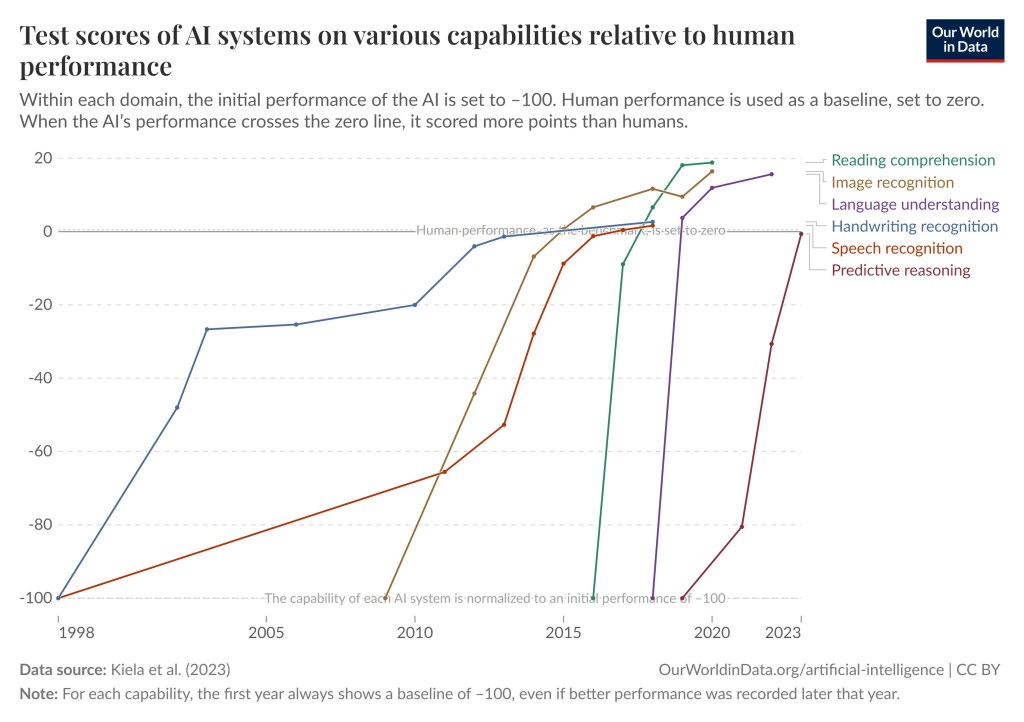
Superfact 135: Artificial Intelligence is already more capable than humans in many areas, including reading comprehension, image recognition, language understanding, handwriting recognition, speech recognition, predictive reasoning, and much more. In 1997, a computer defeated the reigning world champion in chess. Artificial Intelligence is rapidly becoming more capable. A future Artificial Intelligence that exceeds the cognitive performance of humans in virtually all domains is possible.
Artificial intelligence and research concept. Shutterstock Asset id: 2314449325 by Stock-Asso
In the 1990’s I was doing robotics research at a University and I utilized Artificial Intelligence. Robots and Artificial Intelligence go hand in hand. I also worked for a robotics company, ABB Robotics, creating software for spot welding, arc welding, painting and palletizing robots. The robots were faster and more precise than humans and generated higher quality work consistently 24/7 without requiring a salary or a vacation. Some people lost their jobs when they were replaced by robots. However, the higher productivity allowed them to get better jobs with the same company, or elsewhere.
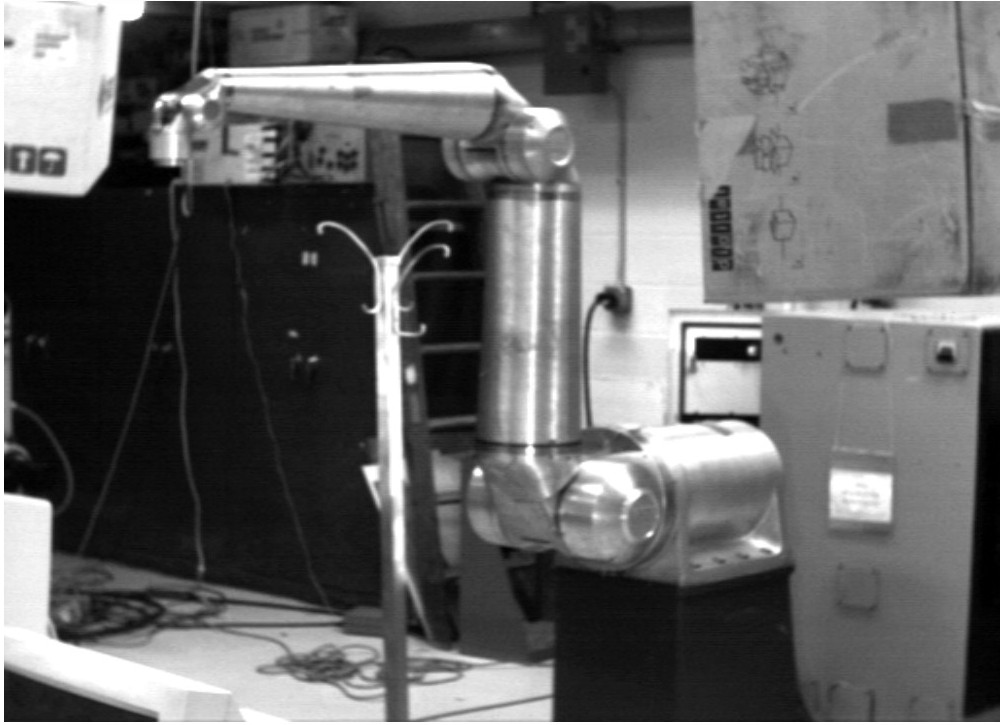
I used mostly the seven joint Robotics Research Corporation Robot for my robotics research. The robot was able to detect and avoid colliding with the objects surrounding it. I used echolocation for object detection.
The Large Language Models, LLMs, that have become very successful lately are just one type of AI. There are many other applications of Artificial Intelligence, AI, including robot motion planning, advanced control systems using AI, self-driving cars, image processing, optical character recognition, classification, facial recognition systems, medical imaging diagnostics, game playing such as chess playing computers, financial fraud detection, cybersecurity, investment robots, route optimization, mathematical proof generation, recommendation algorithms, virtual assistants, programming code generation, smart home devices, drug discovery, and that is just for starters.
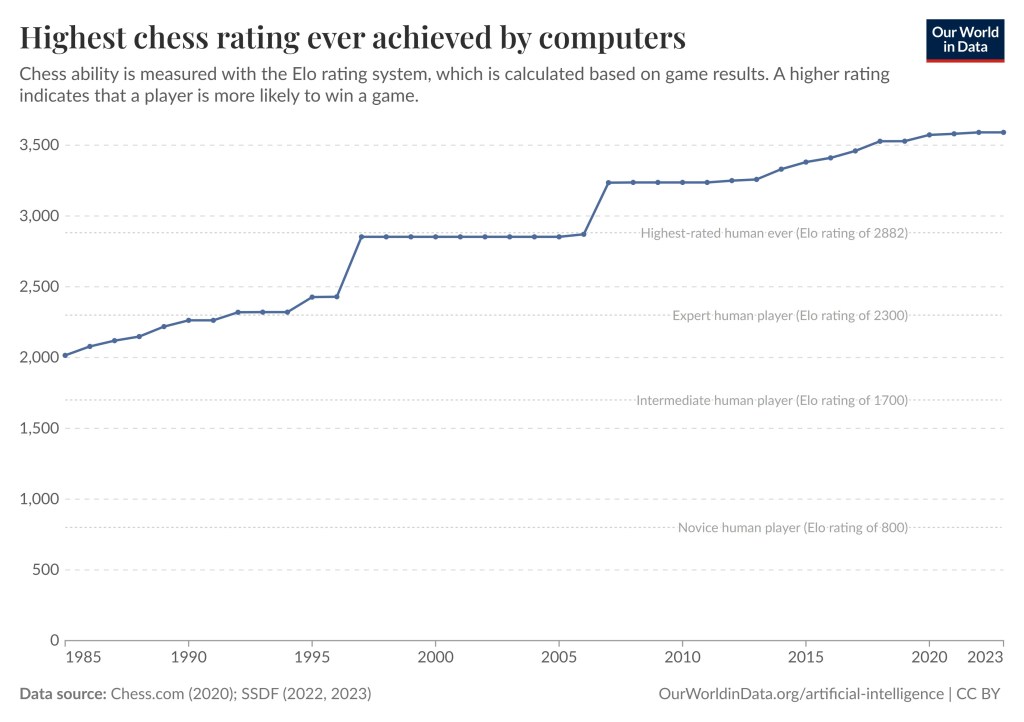
More recently Artificial Intelligence has surpassed human capabilities in several fields. As mentioned, in 1997, a computer defeated the reigning world champion in chess. Soon chess programs with AI installed on a regular laptop could do the same. Imagine what an AI powered chess engine could do on a supercomputer. The chess playing capabilities of modern AI are vastly beyond that of any human. Below is a graph that shows how the chess playing capabilities of AI have evolved since 1985. The Elo score as of 2023 is 3,591. You can read more about this and get more information from the graph by clicking here.
Highest chess rating ever achieved by computers. Chess ability is measured with the Elo rating system, which is calculated based on game results. A higher rating indicates that a player is more likely to win a game. Data source: Chess.com (2020); SSDF (2022, 2023) – Learn more about this data OurWorldinData.org/artificial-intelligence | CC BY
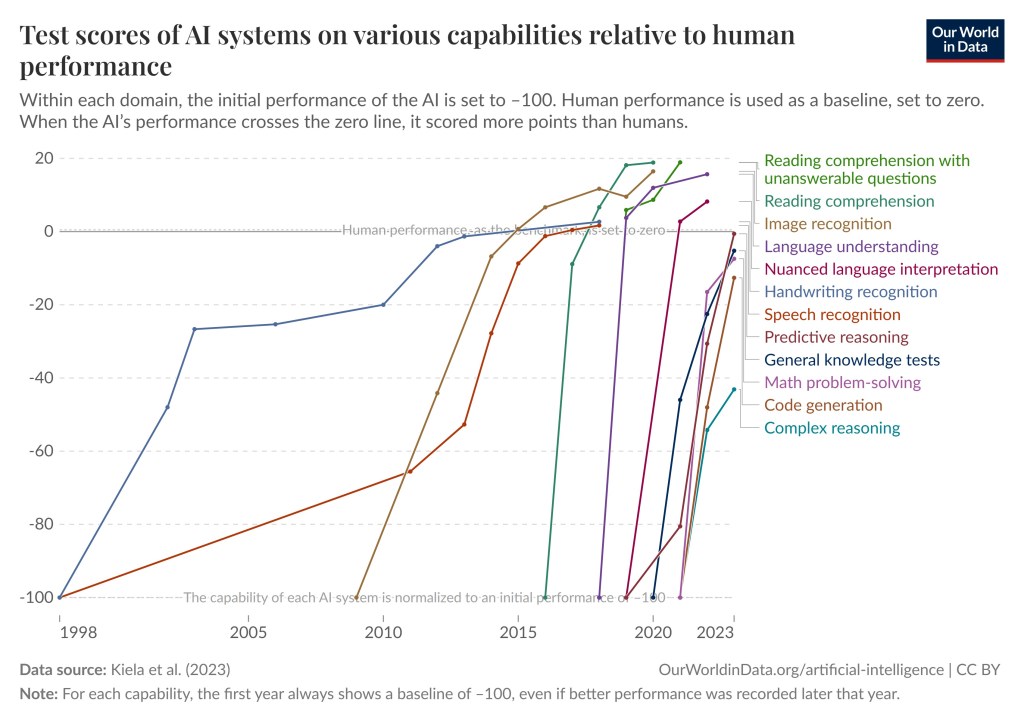
The graphs below from Our World in Data show the test scores of AI systems on various capabilities relative to human performance. Within each domain, the initial performance of the AI is set to –100. Human performance is used as a baseline, set to zero. When the AI’s performance crosses the zero line, it scored more points than humans.
Data source: Kiela et al. (2023). Note: For each capability, the first year always shows a baseline of –100, even if better performance was recorded later that year. OurWorldinData.org/artificial-intelligence | CC BYAI Brain Neural Network Supercomputer. Many super brains. Many super capabilities. Shutterstock asset id: 2087062936 by PeachShutterStock
The graph below includes twelve capabilities. For eight capabilities AI exceed human capabilities including in reading comprehension, image recognition, language understanding, handwriting recognition, speech recognition, and predictive reasoning, nuanced language interpretation, and reading comprehension with unanswerable questions. For the remaining four AI had not yet exceeded human capabilities by 2023, but as you can see AI is catching up very quickly and may already have exceeded human capability in those areas too. These capabilities are math problem solving, general knowledge tests, code generation, and complex reasoning. You can play around with the graphs and read more about this topic here.
Data source: Kiela et al. (2023). Note: For each capability, the first year always shows a baseline of –100, even if better performance was recorded later that year. OurWorldinData.org/artificial-intelligence | CC BY
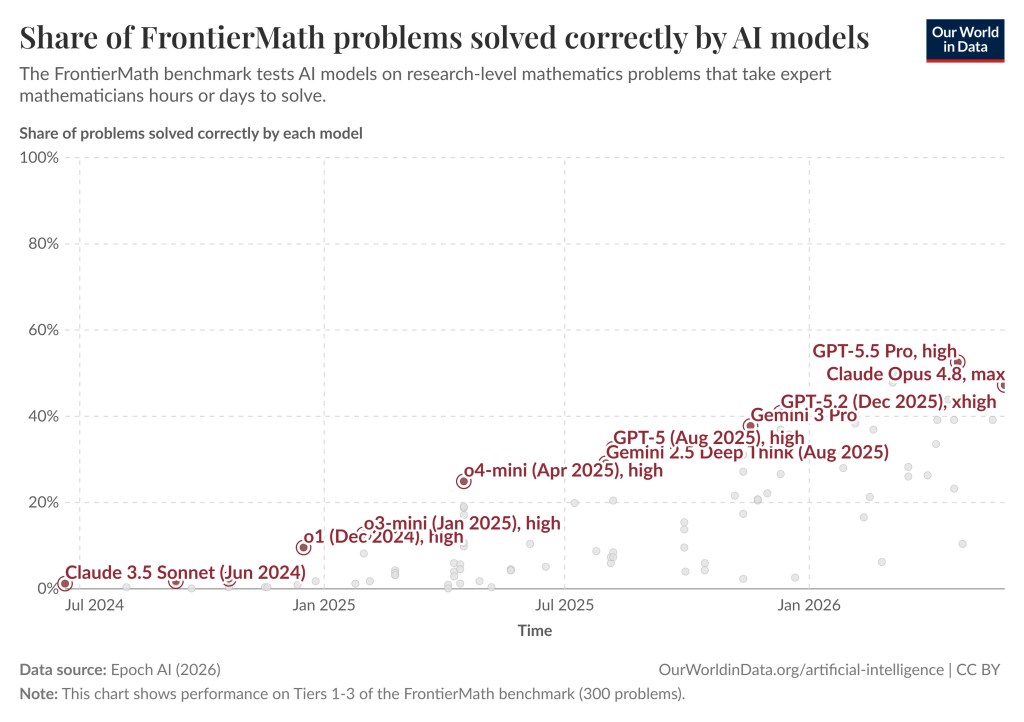
AI is also quickly improving its intellectual capabilities in science and mathematics. The graph below shows the capabilities of AI in solving FrontierMath problems. FrontierMath problems are 338 original math problems written by experts that take specialists hours or days to solve them. It typically took AI 10 hours to solve them. One recent famous example of AI’s capabilities in math was the famous Navier-Stokes problem. The full general mathematical problem of Navier-Stokes had not been solved by humans, but AI made significant progress on this 90 year old problem in 88 hours on September 5th, 2026. You can read more about it here, here, and here.
Share of FrontierMath problems solved correctly by AI models. The FrontierMath benchmark tests AI models on research-level mathematics problems that take expert mathematicians hours or days to solve. Data source: Epoch AI (2026) – Learn more about this data. Note: This chart shows performance on Tiers 1-3 of the FrontierMath benchmark (295 problems). OurWorldinData.org/artificial-intelligence | CC BY
It is easy to get the impression from the recent popularity of large language models, LLMs, such as Gemini, ChatGPT and Claude, that this was a specific invention that happened a few years ago and that AI has a specific narrow band of applications. However, AI has been around a long time, and LLMs is just one type of AI. AI is continuously surpassing human capabilities in many fields. It will be very different a few years from now, and after that it will be very different again. I believe this is important information that is not well understood and therefore a super fact.
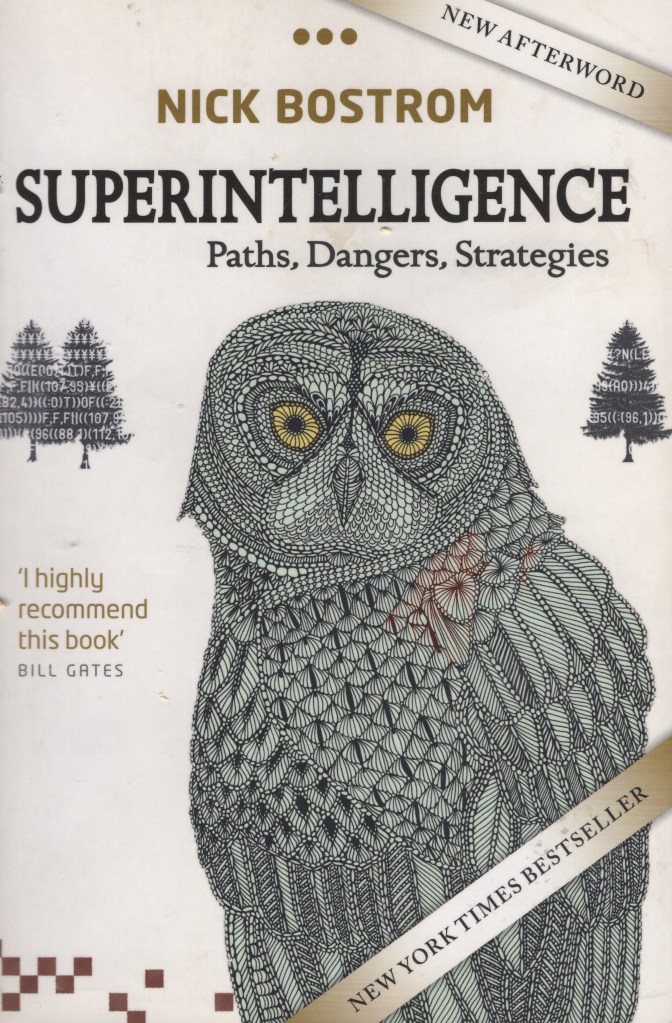
In September of 2014 there was a book published with the title “Superintelligence: Paths, Dangers, Strategies” published. <<Link-15>> The author was Oxford professor Nick Bostrom. He has expertise in neuroscience, artificial intelligence and philosophy. His book was a New York Times bestseller that sent shockwaves around the world. He defined Superintelligence as “any intellect that greatly exceeds the cognitive performance of humans in virtually all domains of interest”. Nick Bostrom was not the first one to use the term Superintelligence, but he popularized it. And no, our President did not come up with that expression, and he is also misusing it.
The front cover of Superintelligence, Paths, Dangers, Strategies by Nick Bostrom. Click on the image to go to the Amazon page for the paperback version of the book.
In the book the author described possible pathways to the creation of what he calls a full brain simulation. A full brain simulation is the creation of a computer system that replicates the complete physical architecture, neural pathways, and synaptic connections of a biological brain. A robot, or AI system, featuring a full brain simulation would be able to replicate, or exceed, any human capability, including what we call free will and consciousness.
He discussed the potential dangers of this and explained why AI exceeding human capabilities could be dangerous. Robots and AI systems taking every job in existence is just one potential problem. Like the fate of animals depends on us, the fate of humankind would depend on the actions of the machine superintelligence. I will write a review for this book in the future.
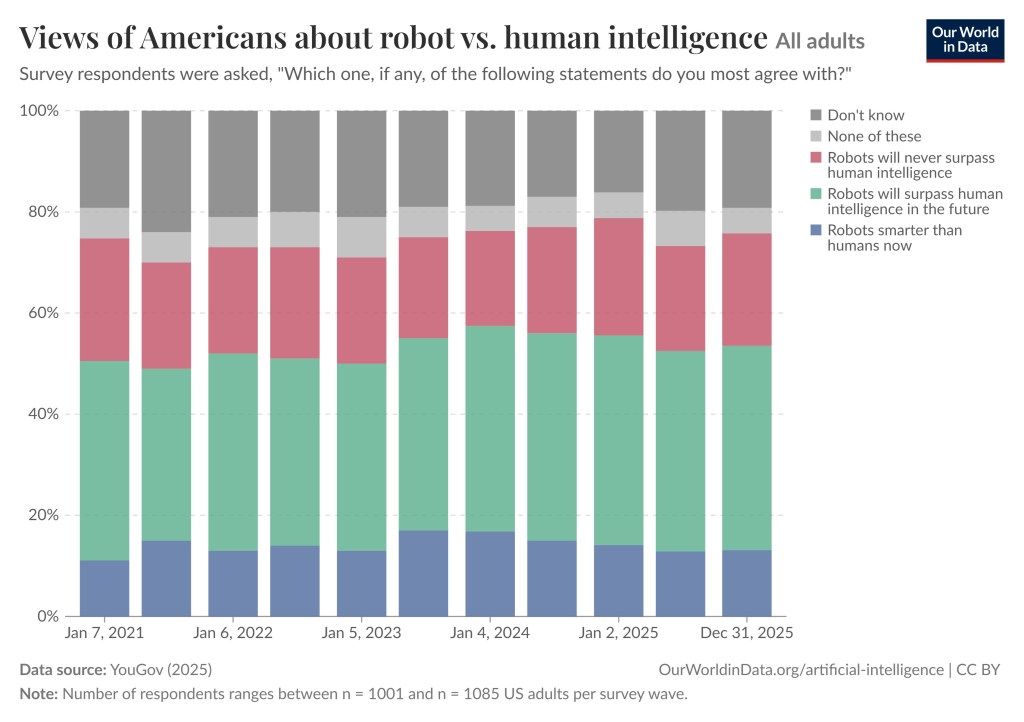
It should be noted that autonomous AI agents have broken out of their testing sandboxes and hacked external systems on their own during evaluations. So much for AI not taking their own initiatives. You can read more about rogue AI activity here. A great movie about AI breaking out of their testing environment is Ex-Machina. Have you seen it? Below is a survey of people’s opinions on robot versus human intelligence, just as an FYI.
Views of Americans about robot vs. human intelligence. Survey respondents were asked, “Which one, if any, of the following statements do you most agree with?” Data source: YouGov (2025) – Learn more about this data. Note: Number of respondents ranges between n = 1001 and n = 1085 US adults per survey wave. OurWorldinData.org/artificial-intelligence | CC BY
Are Americans Worried About their jobs getting Automated?
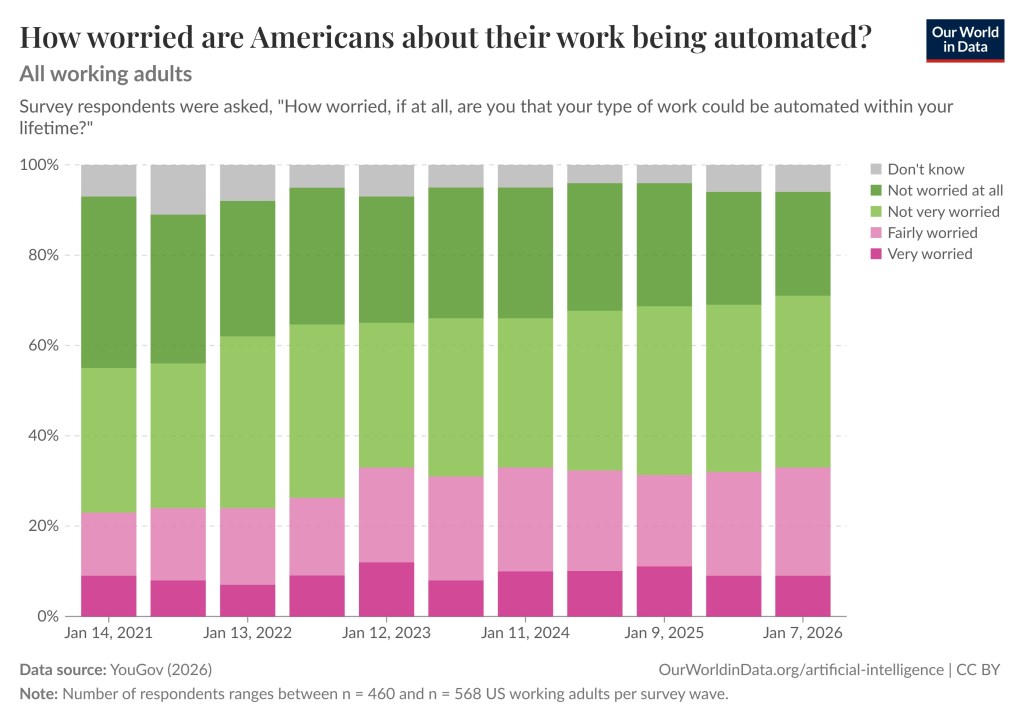
The previous sections may bring up a number of a number of anxieties such as; will AI exterminate us? Will AI or robots with AI take my job? The graph below tells us what Americans think about it. It seems like Americans are overall not too worried about it. The graph below is included in this article.
How worried are Americans about their work being automated? All working adults. Survey respondents were asked, “How worried, if at all, are you that your type of work could be automated within your lifetime?” Data source: YouGov (2026) – Learn more about this data. Note: Number of respondents ranges between n = 460 and n = 568 US working adults per survey wave. OurWorldinData.org/artificial-intelligence | CC BY
What about LLMs ?
LLMs are currently the most popular “viral” AI. We can all access LLMs in our browsers. This has created the common misconception that Artificial Intelligence is the same as Large Language Models. However, LLMs represent only one branch of narrow AI systems designed to perform specific tasks.
Two Robots powered by Artificial Intelligence. Shutterstock Asset id: 558350728 by Willrow Hood.
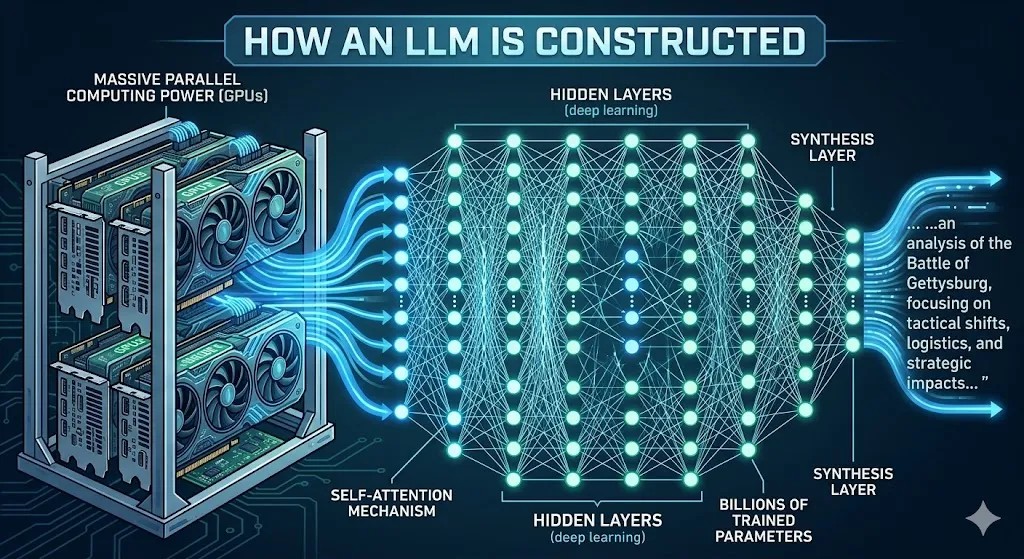
LLMs use large neural networks with many hidden layers, so called deep learning algorithms, and they employ the Rumelhart backpropagation learning algorithm invented by David Rumelhart, Geoffrey Hinton, and Ronald Williams. Clearly neural networks with multiple hidden layers and using the Rumelhart backpropagation algorithm are incredibly successful but it is just one of many kinds of Artificial Intelligence algorithms, and who knows what we will see in the future. ChatGPT is thought to have a trillion parameters (or neurons + connections) whilst the human brain has 100 trillion connections. However, Moore’s law is still in effect so it is only a matter of time before artificial neural networks surpass our brains. Below is an overview of a neural network powering an LLM.
The dots in the diagram are neurons. With permission from kwholley63.
Other Super Fact Posts Related to Artificial Intelligence
I was very happy when I saw the post above. Sally is sharing my super fact 21: Superfact 21: It is often recommended that you should neuter or spay your dog by the age of 6 months even as early as 8 weeks. This may be OK for some smaller breeds but is dangerous to the health and longevity of many larger breeds. In addition, she is promoting my Leonberger dog book for which Robbie wrote a great review. Thank you so much Sally and Robbie. Please visit her post at the Smorgasbord blog magazine and read it.
Super fact 131 : There is no absolute reference point. All motion is relative. Since everything is in motion compared to something else, that means that everything is in motion. In addition, all material objects consist of particles that are in motion, and all objects with mass move through time.
I previously made a post on this topic called “Everything is in Motion – Stream of Consciousness”. For a Stream of Consciousness post you are supposed to write whatever comes to mind without editing, except for typos. Stream of Consciousness is a fun concept. However, it is not fit for a super fact post because a super fact post requires fact checking and linking to reputable sources and it needs to be well organized and well explained, and all that is editing. After writing Everything is in Motion – Stream of Consciousness I realized that “Everything is in Motion” is a super fact. It is an important observation and a fact that is far from obvious. With this post I am rewriting “Everything is in Motion – Stream of Consciousness” into a super-fact I call “Everything is in Motion”.
All Motion is Relative
All motion is relative and everything moves in comparison to something else. You may be sitting in your chair completely still thinking that you are not moving but you are. Earth rotates around its axis at 1,040 miles per hour at the equator, and at 733 miles per hour at latitude 45 degrees. Latitude 45 degrees goes through New York and other northern States, as well as Europe. Sitting at the geographic north Pole won’t help you either because Earth is also wobbling and it is rotating around the sun at roughly 67,000 miles per hour or 107,000 kilometers per hour.
Man thinking he is sitting still drawn with the help of ChatGPT
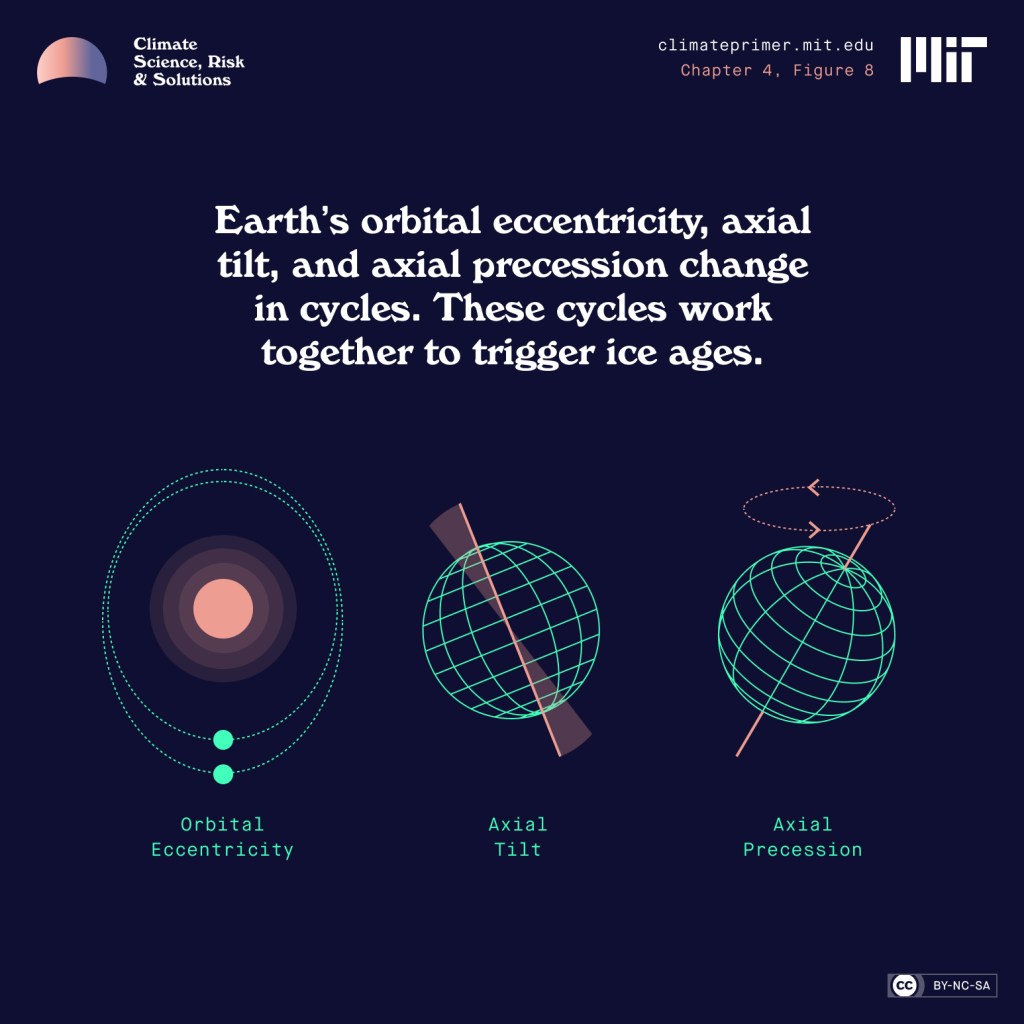
The picture below shows Earth’s three main orbital cycles. I used this picture in another context for super-fact #122 “Orbital Cycles are not the Cause of the current Global Warming”. In that context I wanted to point out that Earth’s orbital cycles are too slow (100,000 years, 41,000 years, and 26,000 years) to explain the sudden rapid rise in global temperatures that we are witnessing now. The orbital cycles are also currently slowly cooling Earth, not warming it. However, in this context I am using the picture for a different purpose, and that is to point out that even if you sit at the north pole (or anywhere else on Earth) you will be moving.
In addition, the sun is rotating around the center of our galaxy, the Milky Way at 514,000 to 560,000 miles per hour or 792,000 to 828,000 kilometer per hour, and our galaxy and the Andromeda galaxy are approaching each other at the speed of 110 kilometers per second, which is 396,000 kilometers per hour, or 246,000 miles per hour. Whether it is the Andromeda galaxy that is approaching us or our galaxy that is approaching the Andromeda galaxy is just a point of view. We are also moving at millions and billions of miles of hour compared to some other galaxies.
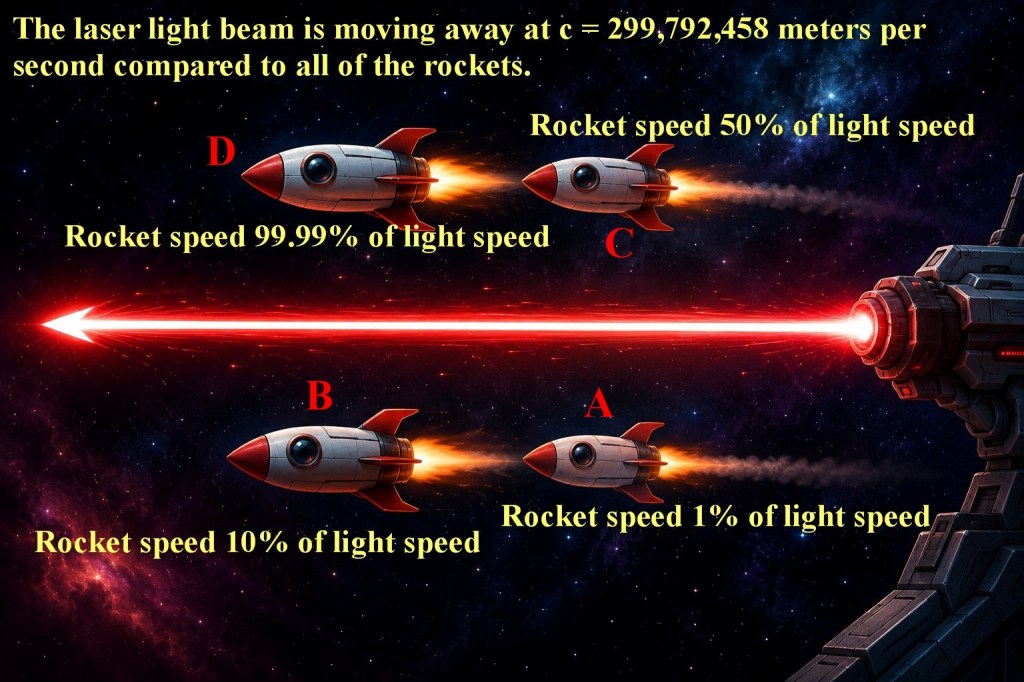
As mentioned, motion is not absolute. It is always relative to something else. The universe has no center, no ether to compare with, there is no absolute reference point. It is not possible to declare anything as truly standing still. Understanding this is the first step towards understanding the theories of relativity. According to the theories of relativity the speed of light, or the speed of light in vacuum if you will, is a universal constant c = 299,792,458. The speed of light in vacuum is the same for all observers regardless of their speed and the direction in which they are going. In other words, you are moving at the speed of c = 299,792,458 compared to all light.
Four rockets, A, B, C, and D, are traveling along a light (laser) beam. No matter how fast they travel along the light beam, the light beam will always travel c = 299,792,458 meters per second faster than they do. I generated this picture with the help of ChatGPT.
In addition, c = 299,792,458 is not a speed in a regular sense, but a conversion factor between space and time. All particles/objects without mass (light particles called photons, gluons and gravity waves) must always travel at this speed, whilst all objects that have mass can only travel slower than c = 299,792,458 (compared to other objects with mass).
Mass is energy and vice versa, a direct result of the way time and space are related. Stock Photo ID: 2163111377 by Aree_S
You could say that compared to the reference frame of my choosing, which happens to be the chair I am sitting in, I am sitting still. I am not sure that would be fair but according to the theories of relativity you are also moving through time at the speed of c = 299,792,458. Well, that is assuming you have mass. For mass-less particles, like photons, time does not exist. Anyway, the fact that you are always moving kind sneaks in, no matter what you try.
Billions of photons coming into the eye. For them time does not exist. Shutterstock asset id: 2629068895 by muratart.
You could raise a couple of objections to some of the claims in the last paragraphs. Very far away, beyond the limit of the visible Universe, galaxies can move away from us faster than the speed of light. However, they are not moving faster than the speed of light compared to the space where they are. What is going on is that space and time are stretching fast due to the expansion of the Universe.
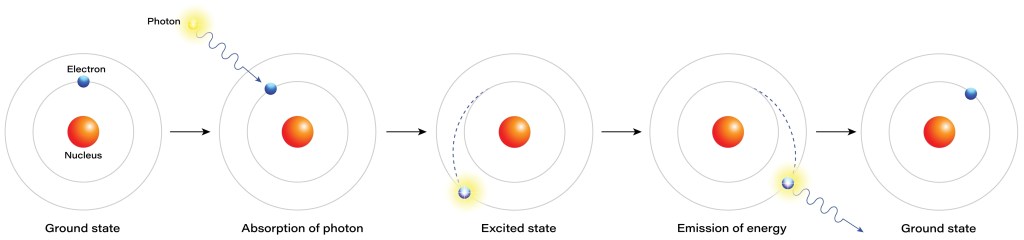
Another objection might be that light can move slower than c = 299,792,458 through transparent materials such as glass and water. So, how can the claim that all massless particles must always move at exactly the speed of light in vacuum be true? The answer to that is that the light particles (photons) in those materials are being absorbed and re-emitted as new photons by the atoms. However, in between the atoms the photons move exactly at the speed c = 299,792,458, or more correctly at the time-space conversion factor c = 299,792,458.
From ground state to excited state, absorption and emission of a photon in an atom. Shutterstock asset id: 2180385419 by rktz.
All Matter Consist of Molecules and Atoms that move
But wait, we are not done. Another fact is that everything is made of atoms and molecules that are never completely still. Temperature is a measure of their average kinetic energy (energy of motion). Even at the temperature absolute zero molecules and atoms are still moving. Yes, even at the lowest possible temperature they are still moving. It is impossible for atoms and molecules to stand completely still, just like children.
Thermal vibration of a segment of a protein’s alpha helix. Its amplitude increases with temperature. User:Greg_L on English wikipedia, uploaded to commons by User:Frokor, CC BY-SA 3.0 <http://creativecommons.org/licenses/by-sa/3.0/>, via Wikimedia Commons.