The goal of this blog is to create a list of super facts. Important facts that are true with very high certainty and yet surprising, misunderstood, or disputed by many. This blog aims to be challenging, educational, and fun, without it being clickbait. I determine veracity using evidence, data from reputable sources and longstanding scientific consensus. Prepare to be challenged (I am). Intentionally seek the truth not confirmation of your belief.
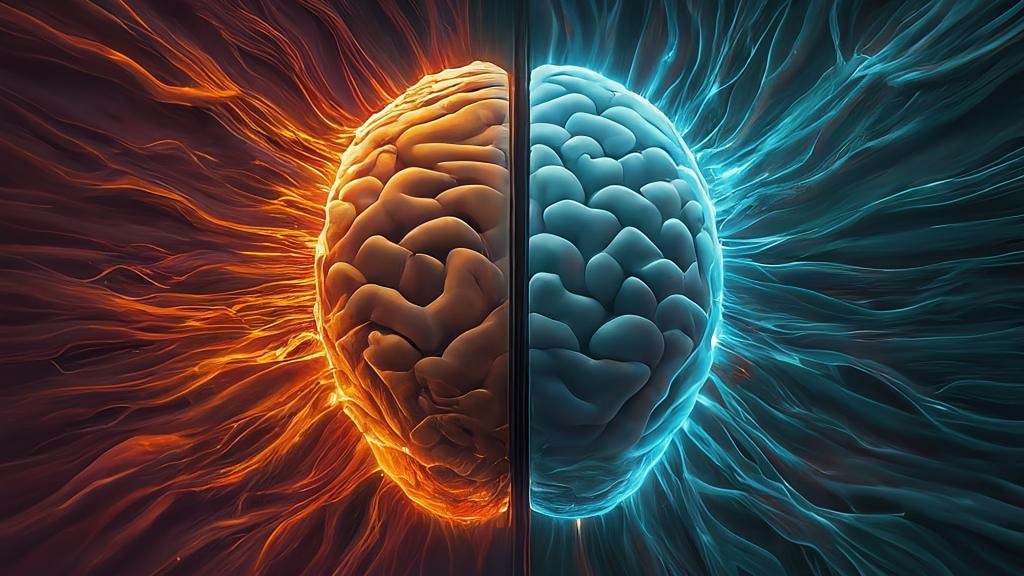
Super fact 134 : The idea that people have a dominant “left brain” or “right brain” that dictates their personality is a popular myth. Brain imaging studies show that people do not have a dominant hemisphere.
Shutterstock asset id: 2483871211 by Shutterstock AI
The left and right sides of the brain do tend to specialize in different tasks. For example, language tends to be on the left, and attention more on the right. Brain images studies show that we do not have a dominant hemisphere. Both halves of the brain work together and are used equally in most activities. You can read more about the topic here, and here, or here.
Four Minute Video on Left Brain versus Right Brain
The YouTube video below is 4 minutes long, but it presents a good overview of left brain versus right brain myth.
How did the right brain versus left brain myth get started ?
That the brain is divided into a left side and a right side has been known since ancient times. In the 1860’s it was discovered that speech was based predominantly in the left hemisphere of the brain. In the 1960’s Psychobiologist Roger Sperry studied “split-brain” patients who had their corpus callosum (the nerve bundle connecting the two halves) severed to treat epilepsy. Their neuroscience research seemed to show that one side of the brain tends to be more dominant in each person. Popular culture took these findings out of context and the right brain versus left brain myth took hold.
The human brain is divided into two hemispheres–left and right. Scientists continue to explore how some cognitive functions tend to be dominated by one side or the other; that is, how they are lateralized. Purple is the Right cerebral hemisphere. Blue is the Left cerebral hemisphere. Polygon data were generated by Database Center for Life Science (DBCLS), CC BY-SA 2.1 JP <https://creativecommons.org/licenses/by-sa/2.1/jp/deed.en>, via Wikimedia Commons. The gif is taken from this link.
Later research showed that the human brain does not favor one side over the other and that one side is not more dominant then the other, unless it is damaged. The two sides of the brain work in concert. You can read more about the topic here.
A related fascinating fact is that the human brain contains about 100 billion neurons and 100 trillion connections. That is 100 trillion parameters to use Artificial Intelligence speech. Which should be compared to the 175 billion (not trillion) parameters in ChatGPT 3.5, and one trillion in ChatGPT 4.0. Well AI neurons and connections/weights and those in the brain are not directly comparable. Another related interesting myth is that we only use 10% of our brain. We use our entire brain.
Superfact 133: Water vapor is responsible for roughly half of Earth’s total greenhouse effect, but unlike carbon dioxide or methane, water vapor condenses and falls as precipitation. Water molecules only stay in the atmosphere for about two weeks. We do not directly control global water vapor levels. When carbon dioxide warms the planet the atmosphere holds more water vapor, which amplifies the initial warming. However, water vapor does not drive global warming. Carbon dioxide emissions and to a lesser degree methane emissions drive global warming. Water vapor just amplifies the effect.
Water vapor is water in gaseous form, and it is invisible. This is a 3D illustration of a water molecule (H2O – two hydrogen atoms and one Oxygen atom). Shutterstock asset id: 1656757654 by Anusorn Nakdee
On social media you often see the claim that water vapor is a more powerful greenhouse gas than carbon dioxide, and the implicit implication is supposedly that our carbon emissions are not the problem. Alternatively, since water vapor has been around forever and is a more powerful greenhouse gas than carbon dioxide, global warming can’t be caused by greenhouse gases. What is getting lost in these posts is that we are not adding water vapor to the atmosphere like we are adding carbon dioxide (or methane) to the atmosphere. The amount of water vapor in the atmosphere will increase because a warmer atmosphere can hold more water vapor, but that is because of our carbon emissions in the first place. You can read more about that here, and here, and here.
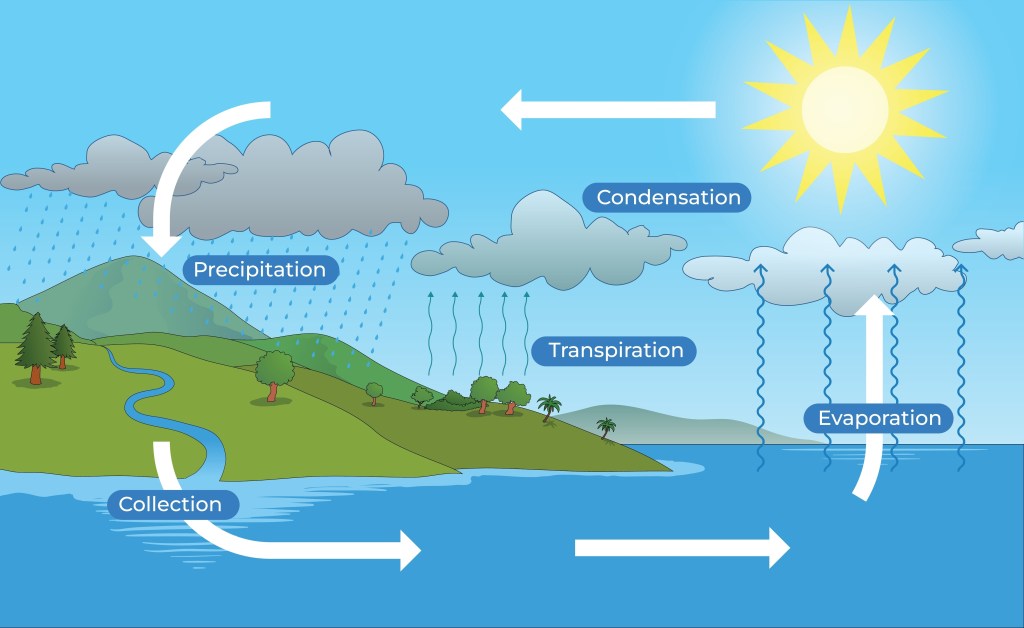
Illustration of simple water cycle diagram. Water vapor, a greenhouse gas, is added to the atmosphere from evaporation (the sea) and transpiration (soil, plants, etc.) Then it condenses into clouds and comes down as precipitation. It collects in rivers, etc., and ends up in oceans and lakes. – Shutterstock asset id: Asset id: 2524245337 by zombiu26
A related fact is that the water cycle is a relatively fast cycle compared to the carbon cycle. A water molecule stays in the atmosphere on average for two weeks according to MIT and nine days according to Wikipedia. Our carbon emissions stay in the atmosphere for several hundred years. In short, water vapor is not the driver of the current rapid global warming. That is chiefly carbon dioxide, but also methane, and deforestation.
It does not matter that water vapor causes a larger percentage of the warming than carbon dioxide. It is not what is causing the increase in the average global temperature. Since so many people have been fooled by the water vapor misdirection, incorrectly thinking that carbon dioxide is unimportant because water vapor is a more important greenhouse gas, this is an important fact that will come as a surprise to many. Therefore, it is a super fact in my opinion.
More on the Water Cycle and the Greenhouse Effect
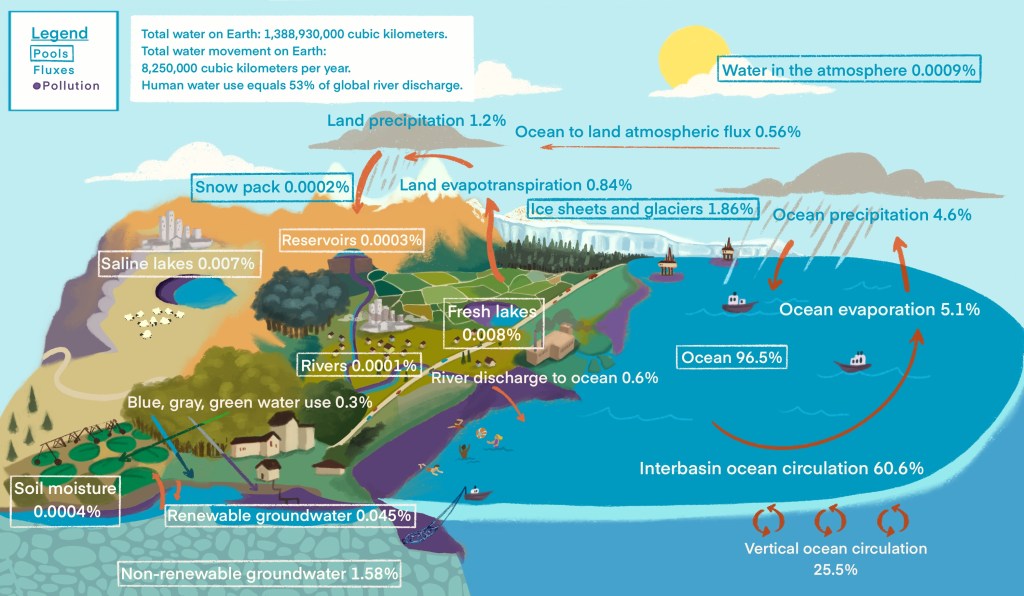
Below is a more detailed illustration of the water cycle for those who are interested. It should be noted that even though water vapor is not driving the rapid global warming we are witnessing, the very rapid global warming we are experiencing is affecting the water cycle, for example, the precipitation patterns around the world. You can read more about that here.
Water cycle showing human influences and major pools (storages) and fluxes. This is a more detailed picture than the one above. LangeLeslie and Anna Wright, CC BY-SA 4.0 https://creativecommons.org/licenses/by-sa/4.0, via Wikimedia Commons. This picture is taken from here.
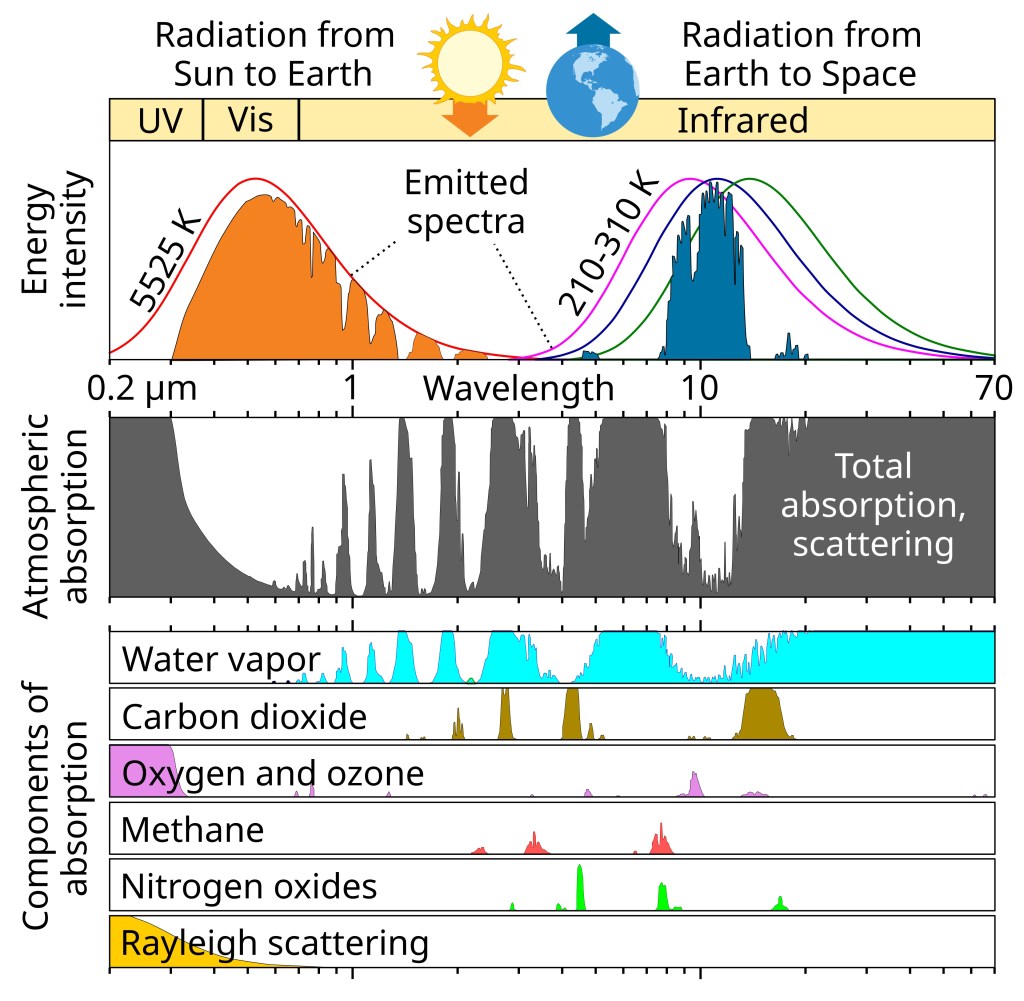
Another less simplistic argument based on water vapor as a greenhouse gas that tries to claim that carbon dioxide is not behind the rapid global warming we are seeing is that water vapor is such an effective greenhouse gas across all frequences that there is not much room for carbon dioxide to make it worse.
However, if you look carefully, you see that carbon dioxide and water vapor complement each other in the spectra and in addition, as mentioned, we are not increasing water vapor directly, but we are increasing the amount of carbon dioxide directly. It should be noted that, in addition, satellite measurements directly confirm that our emissions are warming the planet. The topic of absorption at different frequencies by carbon dioxide and water vapor is explored in greater detail in the book “The Physics of Climate Change by Lawrence M. Krauss”, which I reviewed here.
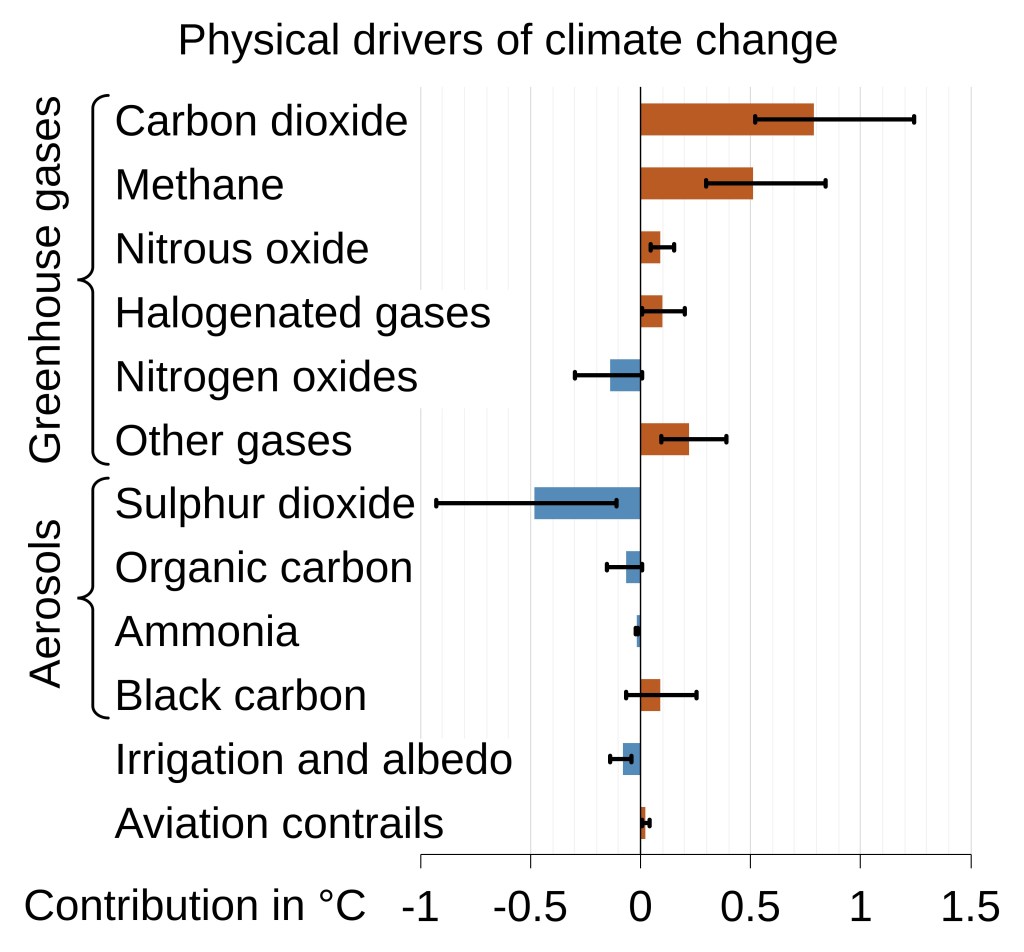
The absorption bands of Earth’s atmosphere (grey color) delimit its atmospheric windows (middle panel) and the effect they have on both down going solar radiation and upgoing thermal radiation emitted near the surface is shown in the top panel. The individual absorption spectra of major greenhouse gases plus Rayleigh scattering are shown in the lower panel. This figure was prepared by Robert A. Rohde Д.Ильин: vectorization (File:Atmospheric Transmission-ru.svg); Cepheiden translation back to english, CC0, via Wikimedia Commons. This figure below is taken from this website. Physical drivers of global warming that have happened so far. Future global warming potential for long-lived drivers like carbon dioxide emissions is not represented. Whiskers on each bar show the possible error range. Eric Fisk, CC BY-SA 4.0 https://creativecommons.org/licenses/by-sa/4.0, via Wikimedia Commons. The illustration is taken from this site.
Conclusion
Water vapor is a powerful greenhouse gas but unlike carbon dioxide and methane it is not driving the rapid global warming that we are seeing. We are directly increasing water vapor via water vapor emissions, and if we did it would just come raining back down pretty quickly. However, when carbon dioxide warms the planet the atmosphere holds more water vapor, which amplifies the initial warming.
The goal of this blog is to create a list of what I call super facts. Super facts are important and true facts that nevertheless are surprising to a lot of people, they are mind-blowing or misunderstood or disputed among non-experts. They are special facts that many of us can learn something important from or perhaps challenge us. However, I also make posts that are not super facts but feature other interesting information, such as this book review and book recommendation. The book is:
Green, American Style: Becoming Earth-Friendly and Reaping the Benefits by Anna M. Clark
Below I am listing the two editions on Amazon of this book. I bought the paperback version.
Hardback – Publisher : BakerBooks (January 1, 2010), ISBN-10 : 1616643242, ISBN-13 : 978-1616643249, item weight : 1.01 pounds. It costs $10.95 on US Amazon. Click here to order it from Amazon.com.
Paperback – Publisher : BakerBooks (April 1, 2010), ISBN-10 : 0801013348, ISBN-13 : 978-0801013348, 253 pages, item weight : 10.9 ounces, dimensions : 5.25 x 0.5 x 8.25 inches. It costs $4.99 on US Amazon. Click here to order it from Amazon.com.
The front cover of Green, American Style: Becoming Earth-Friendly and Reaping the Benefits by Anna M. Clark. Click on the image to go to the Amazon page for the hardback version of the book.
Amazon’s Description of the Book
Americans of all stripes are finding their footing in the green movement. What was once a road less traveled is quickly becoming a superhighway as those who were once reluctant find that going green is not about giving up. It’s about gaining more money, time, opportunity, health, and well-being even as we preserve the American lifestyle in a rapidly changing world. Green, American Style is a guide to going green and loving it. Its uniquely American perspective means it speaks to readers from their own paradigm, taking into account the largely conservative values of much of this country, its democratic and capitalistic history, and its resistance to reining in.
More than a list of ways to reduce, reuse, and recycle, this book explores the green movement from the diverse perspectives of business, faith, and lifestyle, recognizing the economic, physical, and spiritual benefits of sustainable living.
Save Money Become Healthier and Save the Planet too
The author, Anna Clark, is the founder and President of the company EarthPeople LLC. In this book she presents hundreds of ways companies and citizens can become more environmentally sustainable, while becoming healthier and save money at the same time. Becoming “green” does not have to be a great sacrifice, and you don’t need to adopt a certain environmentalist attitude, or politics. There are practical advantages to you personally as you adopt a greener lifestyle. She refers to this as the green advantage. She is also stating that Green is patriotic. It is our best chance to preserve our way of life for the future.
Climate Change / Global Warming is happening, and the scientific evidence clearly shows that we are the cause. We know it is not natural. Unfortunately, a lot of people have a negative emotional reaction to this reality. Instead of arguing about this issue, and risking turning off some readers, the author focuses on the positives of sustainability and the things we can all agree on. Sustainability is not a political decision but a better way to live.
She is also not an all-or-nothing advocate. For example, she says that you can eat less meat, but you don’t need to become a vegan if that is not what you want. I can add to that that the average American eats 220 pounds of meat per year, which corresponds to 330 million tons of carbon emissions, or 5-6% of our total emissions in the US. If you eat 110 pounds of meat instead of 220 pounds of meat you have removed 50% of those emissions. If you go from eating 10 pounds of meat per year to being vegan you’ve reduced only 3%. All-or-nothing is hard and there are so many other ways that you can reduce your impact on the environment. You choose what fits you and reaching for the low-hanging fruit is smart.
At the same time, she does not shy away from the problems. She mentions the danger of being so dependent on oil, not the least considering national security, and the need for developing alternatives, preferably clean energy sources. She discusses freshwater scarcity, the world losing species at a rate thousands of times faster than the natural extinction rate, and the dangers of excessive carbon dioxide levels. She discusses the many toxins in our environment and how to avoid them.
In the book she describes her interviews and interactions with several important personalities in sustainability including the billionaire and oil tycoon T. Boone Pickens and the billionaire and CEO Roger Barnett. She advocates for eco-capitalism and for LEED certified buildings. She herself lives in a platinum level LEED certified residence. The book features a lot of resources and hundreds of links, and the second part of the book lists 85 easy ways to save the planet and money at the same time. It is not that strange. If you save energy and gasoline, and you waste less and you don’t buy things you don’t really need, you’ll save the planet and money too. In fact, you can easily save thousands of dollars. You may not know how to do that, but the book will tell you.
She also lists 25 ways to remodel your home to make it greener and saving energy. I found that we have already done several of the things listed. She also discusses gardening and composting. I can add that she correctly states that EVs not only save you gas money, but they are significantly cleaner than regular cars even with dirty grids. Due to some untrue rumors, there is some confusions about that. I can add that EVs has come a long way since this book was published.
The author also talked about the environmental studies program at St. Marks School of Texas, the school our boys attended. We live next to that school. This was more of a fun and for me personal portion of the book. The book also features some warnings. When you go shopping, there are third party-verification labels and non-specific generic labels that don’t mean anything such as “natural”, “cage free”, and “free range”. Be a smart shopper.
In summary, this book may be a bit old, but it contains a lot of useful and helpful information that is still relevant today. Therefore, I highly recommend it to everyone. You certainly don’t have to be an environmentalist to put the advice in the book to practice and save some money, become a bit healthier and save the planet at the same time.
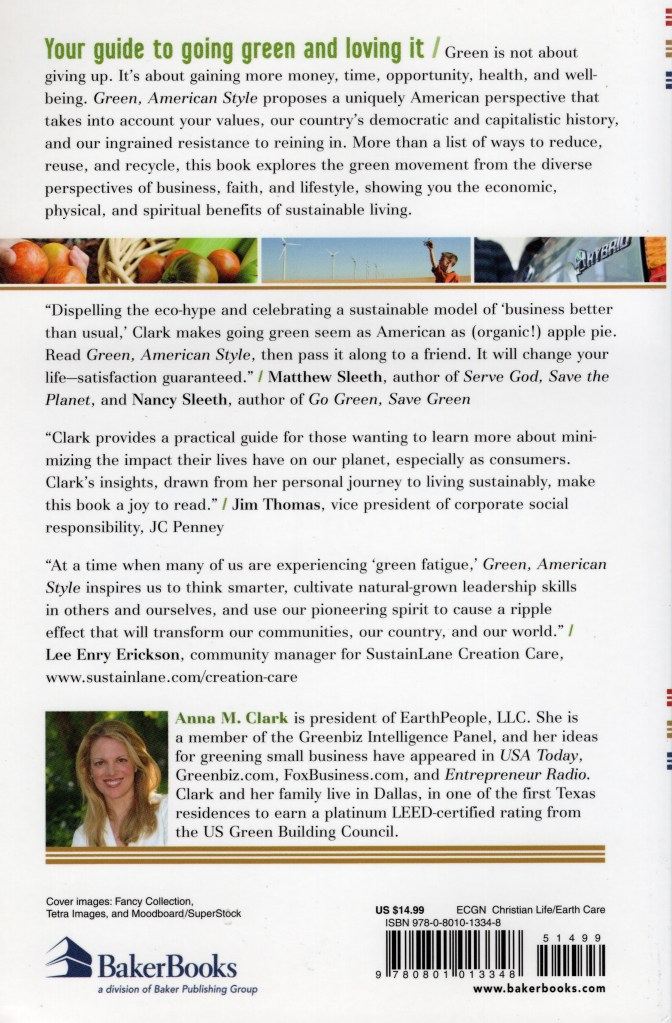
The back cover of Green, American Style: Becoming Earth-Friendly and Reaping the Benefits by Anna M. Clark. Click on the image to go to the Amazon page for the paperback version of the book.
About the Author
Anna Clark is president of EarthPeople (www.earthpeopleco.com), a consulting and communications firm that helps organizations of all sizes save money and bolster their brands through profitable green strategies. A featured blogger for Greenbiz.com and SustainLane.com, Anna writes on topics ranging from green living to leadership. Anna lives with her family in Dallas in one of the first residences in Texas to earn a platinum LEED-certified rating from the US Green Building Council. For the more on all things green, visit www.annamclark.com.
Super fact 132 : An estimated 100 trillion ghostly elementary particles, called neutrinos, pass through your body every second, which is 237 sextillion particles in 75 years. Despite that fact the chance that even a single neutrino will interact with an atom in your body during your entire life is about 1 in 4. These extremely abundant particles pass right through you as well as planets without interactions, like ghosts.
100 trillion neutrinos, almost entirely undetectable elementary particles, pass right through your body every second, without touching a single atom in your body, as if you don’t exist. I generated the picture with the help of ChatGPT.
Neutrinos are tiny subatomic particles, often called ‘ghost particles‘ because they barely interact with anything else. They are capable of passing right through our planet Earth as if it wasn’t there. As mentioned, an estimated 100 trillion neutrinos pass through your body every second.
Neutrinos do not interact with electromagnetic forces and not with the strong nuclear force. The electromagnetic forces are what is governing molecules, atoms, and matter and the strong nuclear force governs the nucleus of atoms. The only forces that neutrinos interact with are the weak nuclear force and gravity, which both are weak forces, and the weak nuclear force has a very short range. In addition, the mass of neutrinos is extremely tiny. That is why neutrinos pass through atoms as if they aren’t there, and it is why trillions of neutrinos can pass through your body without touching you even the slightest and it is also why they are completely harmless. This also makes them extremely hard to detect.
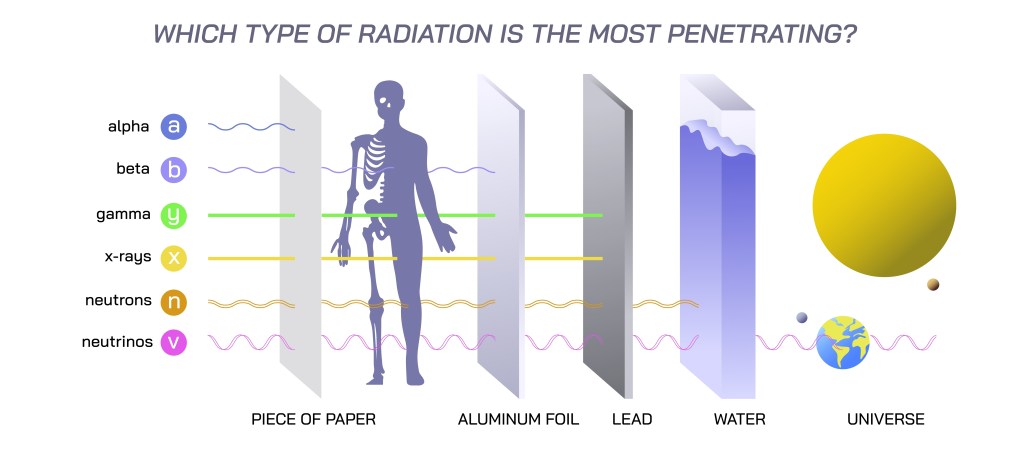
Alpha radiation is stopped by paper. Beta radiation (electrons) is stopped by aluminum foil. X-rays and gamma radiation (high energy photons) are stopped by a sheet of lead. Neutrons with certain energies can be stopped by a container of water. Neutrinos cannot even be stopped by a planet. Shutterstock asset id: 2313420693 by Anshuman Rath
An enormous amount of neutrinos flows right through your body as if you don’t exist. They are coming from the sky and from the ground below after passing through earth and none of them will touch any part of you. This is a mind blowing and surprising but not well known fact and therefore a super fact in my opinion.
The Mass of Elementary Particles
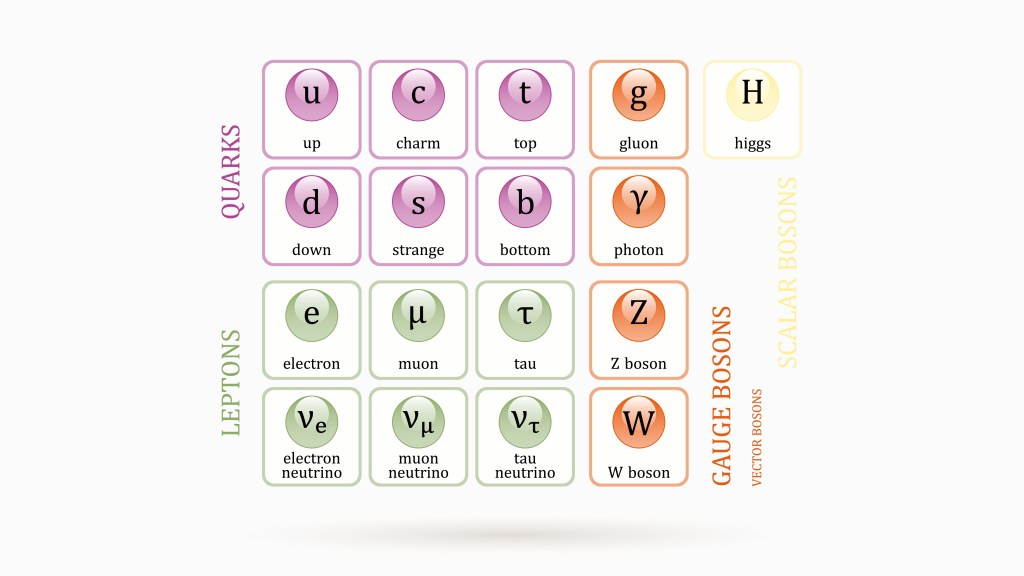
More than 200 subatomic particles have been discovered and there are probably many more that have not yet been discovered. Examples of subatomic particles are protons, neutrons and electrons. However, only some of them are elementary particles, or in other words fundamental particles. The electron is a fundamental particle, but the proton and the neutrons are not. Protons and neutrons are called composite particles and consist of quarks, gluons and mesons. The neutrino is an example of a fundamental particle like the electron. Quarks are other examples of fundamental particles.
Electrons are lightweight. They weigh 0.511 MeV/c², which is 1,836 times lighter than a proton, which weighs 938.272 MeV/c². The positron, which is the electrons anti-particle weighs exactly the same as the electron. The muon, which is very similar to an electron but is unstable and is 206.77 times heavier than an electron weighs 105.66 MeV/c². The tau is also similar to an electron and is about 3,477 times heavier than an electron and weighs 1,776.86 MeV/c². Quarks are also much heavier than electrons. Photons and gluons are massless.
The neutrino is a lepton and is in some ways similar to an electron, but it has no charge and does not interact with electromagnetic forces at all. The neutron also does not have any charge, but it does interact with electromagnetic forces, which makes it a lot easier to detect. As in the case for the electron there are lighter and heavier versions of neutrinos, the electron-neutrino, the muon-neutrino and the tau-neutrino. Here comes the shocker; the heaviest flavor of neutrino, the tau-neutrino weighs less than 0.12 eV/c² or 0.00000012 MeV/c² making it at least 4 million times lighter than an electron. However, the neutrinos may be a lot lighter than that. We don’t know. They have mass but it is very tiny.
Considering how tiny neutrinos are, and that they don’t interact with the electromagnetic force at all (unlike other neutral particles) and don’t interact with the strong nuclear force at all, it is understandable that neutrinos are like ghost particles, almost impossible to detect. Neutrinos are too light to be so called dark matter, but a hypothetical heavier form of neutrino called the sterile neutrino is a plausible candidate for dark matter.
I was very happy when I saw the post above. Sally is sharing my super fact 21: Superfact 21: It is often recommended that you should neuter or spay your dog by the age of 6 months even as early as 8 weeks. This may be OK for some smaller breeds but is dangerous to the health and longevity of many larger breeds. In addition, she is promoting my Leonberger dog book for which Robbie wrote a great review. Thank you so much Sally and Robbie. Please visit her post at the Smorgasbord blog magazine and read it.