The goal of this blog is to create a list of super facts. Important facts that are true with very high certainty and yet surprising, misunderstood, or disputed by many. This blog aims to be challenging, educational, and fun, without it being clickbait. I determine veracity using evidence, data from reputable sources and longstanding scientific consensus. Prepare to be challenged (I am). Intentionally seek the truth not confirmation of your belief.
Congrats, we love your writing and want to share it with the world.
Hi thomasstigwikman,
We’ve selected your post (We Can See What Stars Are Made of) for Freshly Pressed, a showcase where we feature editors’ picks and community favorites on WordPress.com.
We are thrilled to share your post with our wider audience.
Your post will appear at wordpress.com/discover/, where members of the WordPress.com community can read, comment, like your post, and subscribe to your site to get notified whenever you publish new content.
Thank you for being part of the biggest and best community of bloggers around the world. We’re proud to be the platform that makes your voice heard.
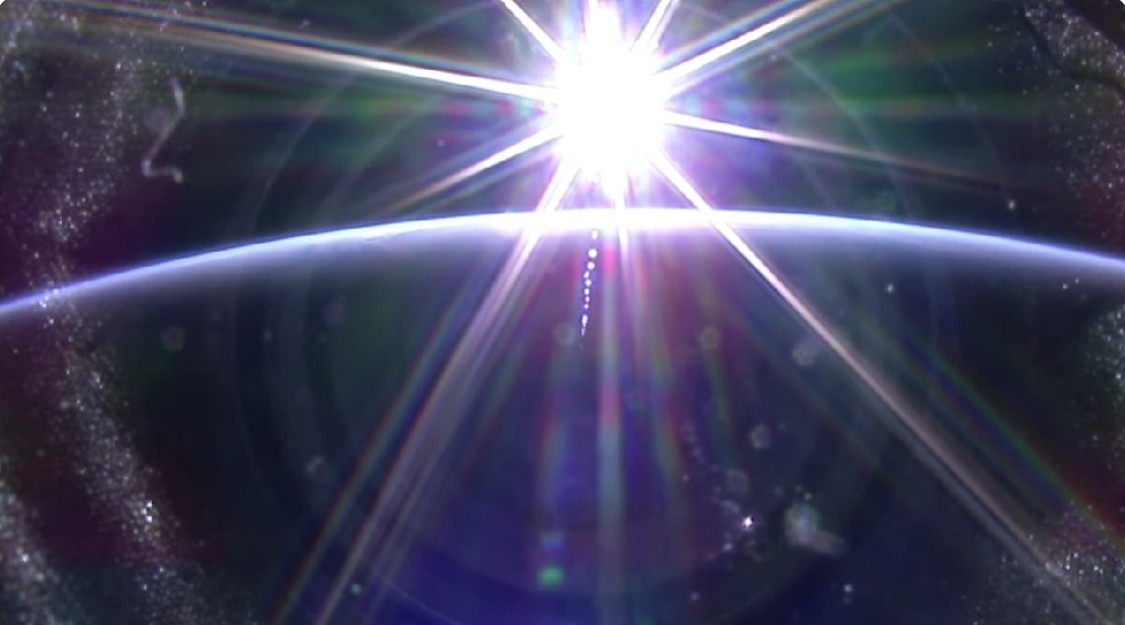
Superfact 105: The Sun is white, but the Sky steals its Blue is a poetic way of saying that the sun’s light is scattered by the atmosphere giving the Sun a yellowish tint as well as giving us our blue sky. From space the sun looks completely white.
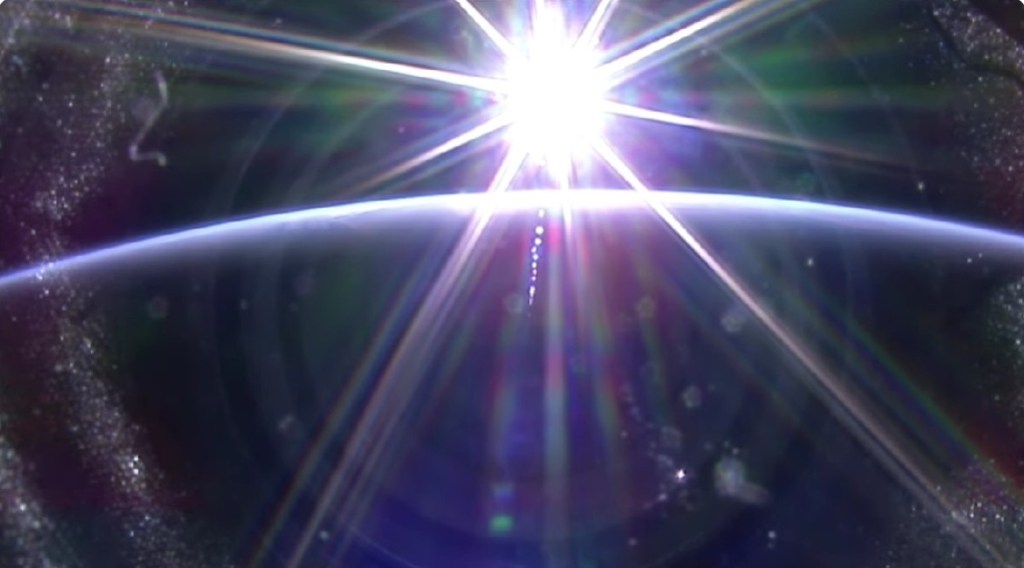
Sunset from the International Space Station by NASA
Viewed from space the sun is entirely white. White light consists of a mix of all the colors of the rainbow. However, viewed from earth the sun has a yellow tint, which gets more pronounced, it even dips into orange, as the sun nears sunset. That does not happen in space as can be seen below in the one minute sunset timelapse video taken from the International Space Station.
Sunset Timelapse from the International Space Station
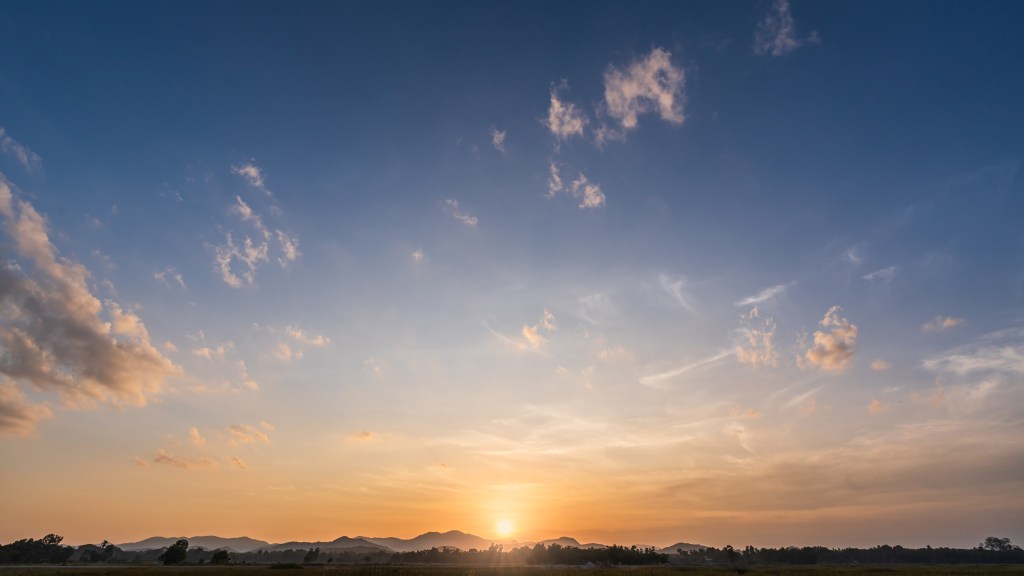
On earth the sunset looks more like something in the picture below.
The sky dusk has a dramatic background featuring a summer season golden sunset landscape. The light is at the horizon is an orange and yellow color with blue sky above. Shutterstock asset id: 2670235703 by Nature Peaceful
The sun is a so called yellow dwarf star, or a G-type main-sequence star. The term yellow dwarf is a bit of a misnomer, because they range in color from white, for more luminous G-types like the Sun, to only very slightly yellowish for less massive and less luminous G-type main-sequence stars. The sun emits all the colors of the rainbow simultaneously, but the most dominant color is green. However, this looks white to us.
When sunlight enters Earth’s atmosphere, tiny air molecules scatter shorter, blue wavelengths of light in all directions. This scattering is what makes the sky look blue. This is called Rayleigh scattering. Because much of the blue light is removed, the remaining wavelengths of light that reach your eyes combine to make the sun appear yellow. This is a super fact because it is a basic but surprising fact, and we know it is true.
Rayleigh Scattering
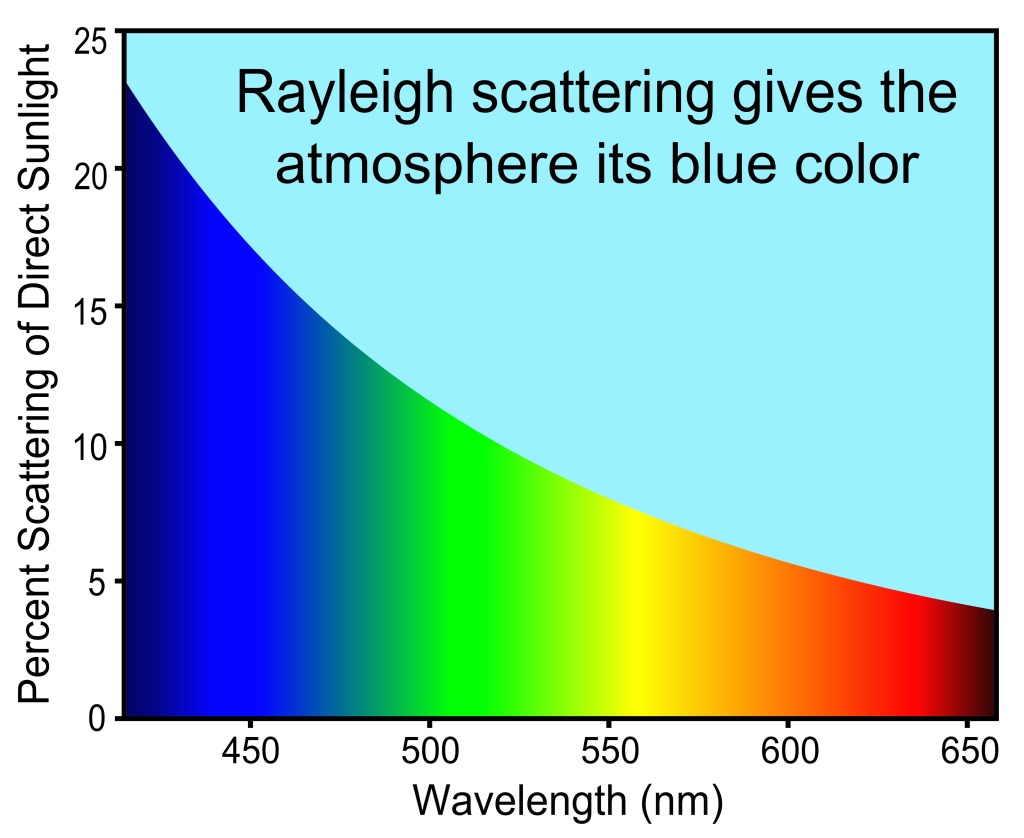
The blue color of the sky is caused by Rayleigh scattering of sunlight by the gases in the Earth’s atmosphere. The image below shows the degree to which Rayleigh scattering occurs at different wavelengths / frequencies of light. Blue has the shortest wavelength (highest frequency) for visible light and red the longest (lowest frequency). The curve shows that blue light scatters more than red light. It should be noted that UV light (not shown) scatter even more. The scattering curve shown is calculated for sunlight passing vertically through the atmosphere.
Figure showing the greater proportion of blue light scattered by the atmosphere relative to red light. Robert A. Rohde derivative work:KES47 (talk) (converted to SVG)., CC BY-SA 3.0 http://creativecommons.org/licenses/by-sa/3.0/, via Wikimedia Commons.
Superfact 104: The evolution of eyes is convergent, meaning different, unrelated animal species independently evolved similar types of eyes. Biologists estimate that eyes have evolved independently between 40 to over 65 different times across various lineages. An example is the evolution of Cephalopod eyes (like squid and octopus) and vertebra eyes.
First of all, eyes evolved. Creationists often say that eyes are too complex too have evolved. That is because the eye is composed of many interdependent, finely tuned parts, for example, the cornea, iris, retina and lens. And that it cannot function without all those components already evolved. This is referred to as the argument for irreducible complexity.
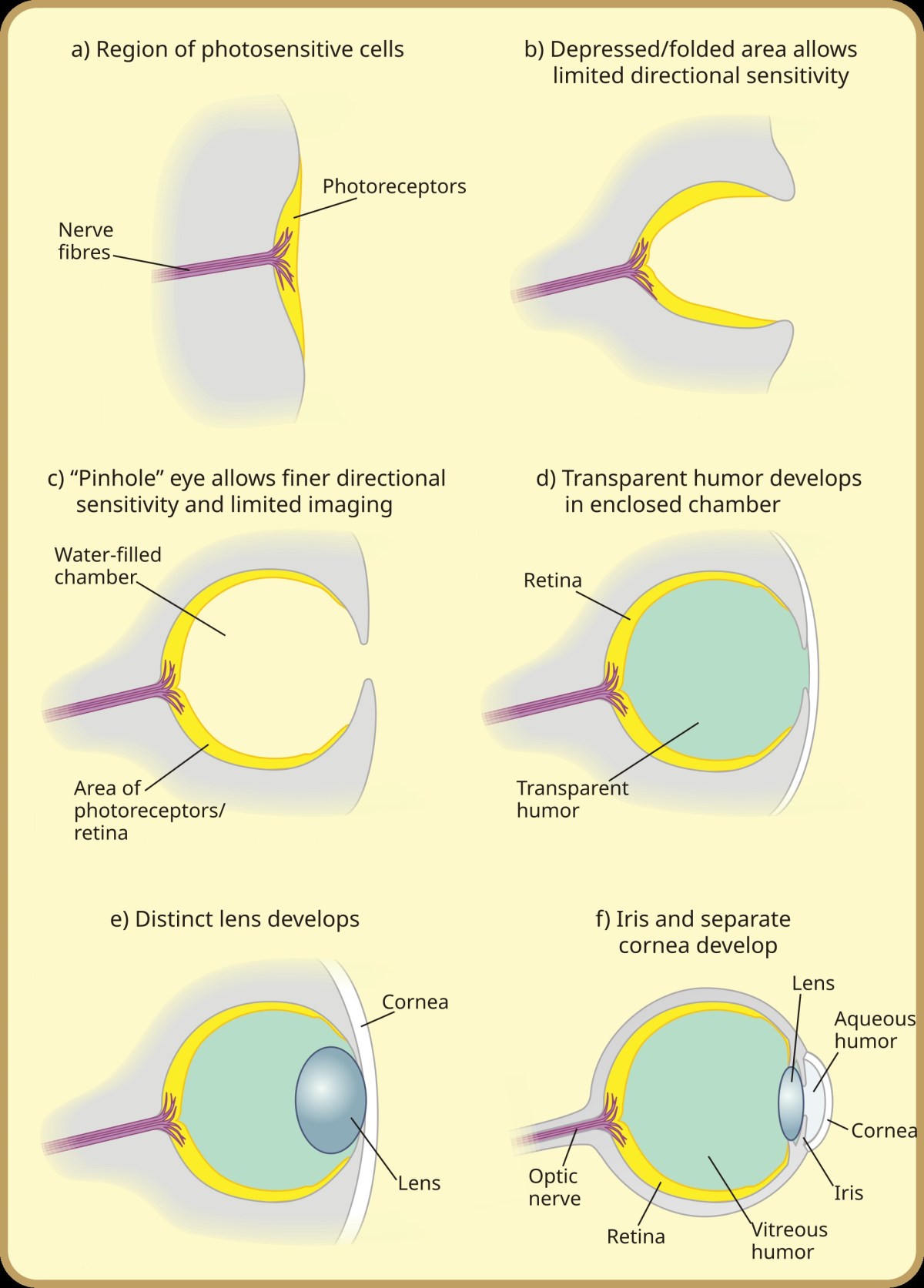
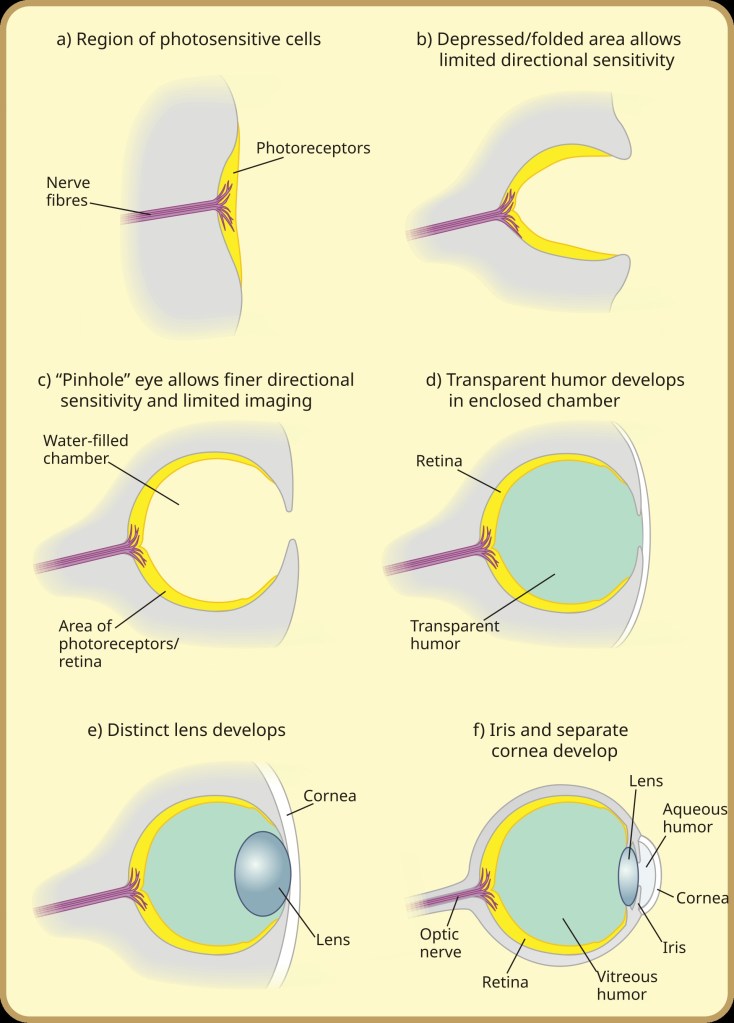
The problem with that argument is that evolution is not linear. The various intermediate steps may not have functioned as the final product but could still have provided evolutionary advantage. There are many intermediate “eyes” existing today in nature. As you can see in the picture below the evolution of the vertebra eye did not start with all the current parts.
Major stages in the evolution of the eye in vertebrates. Matticus78 at the English-language Wikipedia, CC BY-SA 3.0 http://creativecommons.org/licenses/by-sa/3.0/, via Wikimedia Commons.
In addition, the evolution of eyes is largely convergent. Biologists estimate that eyes have evolved independently between 40 to over 65 different times across various lineages. The cephalopods (like octopuses and squid) and vertebrates (like humans, mammals, birds and fish) evolved their camera-style eyes completely independently. This is one of nature’s most famous examples of convergent evolution, where two unrelated species arrive at the exact same biological solution to survive in their environments.
The fact that eyes evolved and that the irreducible complexity argument does not work comes as a surprise to creationists. That the various kinds of eyes in nature evolved separately but converged on similar complex structures is in general an amazing fact. It is a kind of an important fact that is true. Therefore, it is a super-fact in my opinion.
Eyes Are not an Example of Irreducible Complexity
The evidence that the complexity of eyes is not an example of irreducible complexity is strong. We can trace lineages via DNA and sub-optimality. We can also simulate the evolution of the eye using computers. In a simulation based on mutations and natural selection it took 363,992 generations to evolve an eye from an eyespot (light-sensing organelle) to a complex camera type eye, which probably corresponds to around half a million years. See The Evidence for Evolution by Alan R. Rogers.
I can add a personal anecdote. In my job as a software engineer trying to find better algorithms for sorting mail using the photos of the mail, including the address block, I tried using genetic algorithms. Genetic algorithms is a type of Artificial Intelligence that simulates evolution to create better systems (better algorithms and software). The genes corresponding to the best algorithms were allowed to propagate, recombine and mutate. That was the natural selection component.
What I saw was that the genetic algorithm could evolve the system into a complex and effective system of interdependent complex components that did not exist at the beginning. Several complex components working together did not require that components/parts evolve one after another. They can go through several formats from primitive to advanced and they can have different functions along the way. Some parts might evolve and then disappear and new kinds of parts pop up, as the total algorithm kept evolving. There is no reason to believe that irreducible complexity even exists.
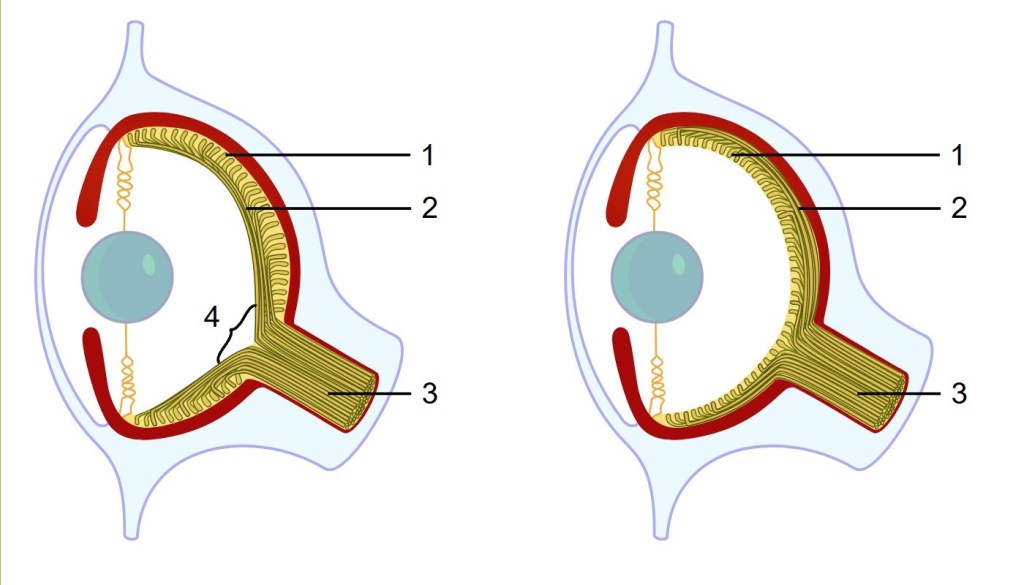
While both eyes share features like a cornea, iris, lens, and retina, they were built from different starting materials and possess some structural differences. In vertebrate eyes, the nerve fibers route before the retina, blocking some light and creating a blind spot where the fibers pass through the retina. In cephalopod eyes, the nerve fibers route behind the retina, and do not block light or disrupt the retina. In other words, the cephalopod eyes not having a blind spot are more perfect than our eyes.
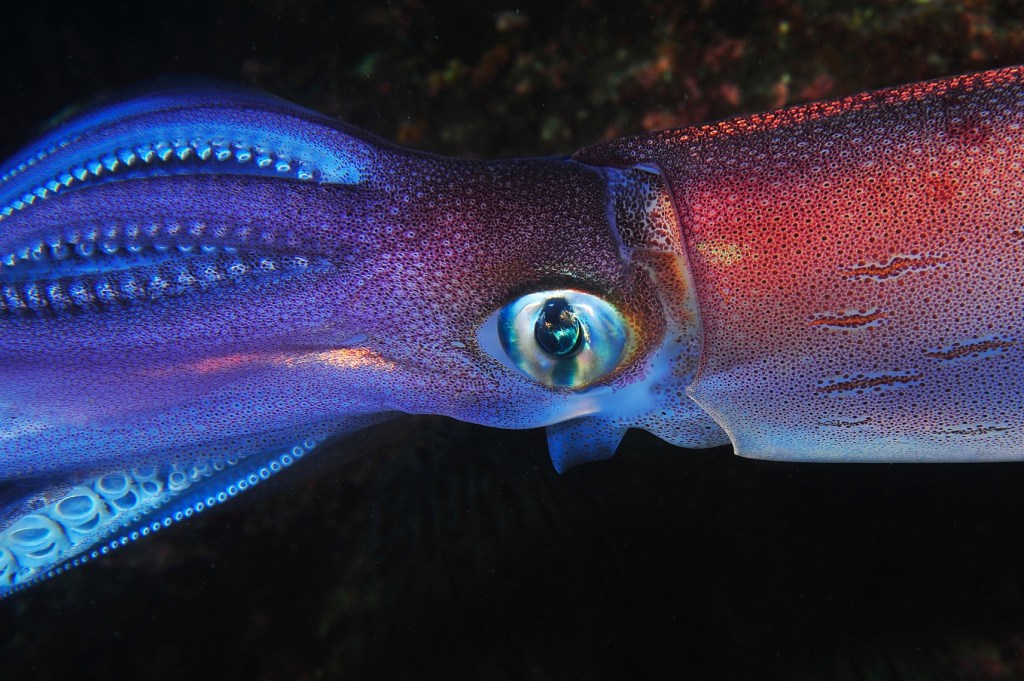
Look into the loving eyes of the squid. He does not have a blind spot. Atlantic Ocean squid macro photo. Shutterstock asset id: 1859007028 by Rui Palma
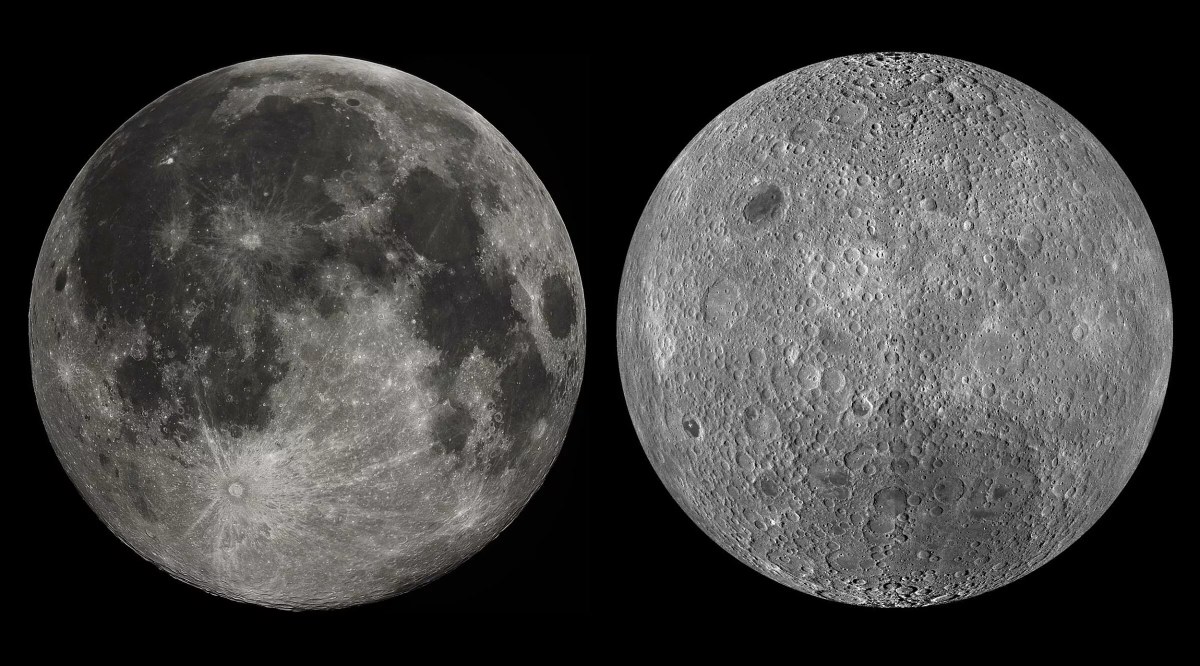
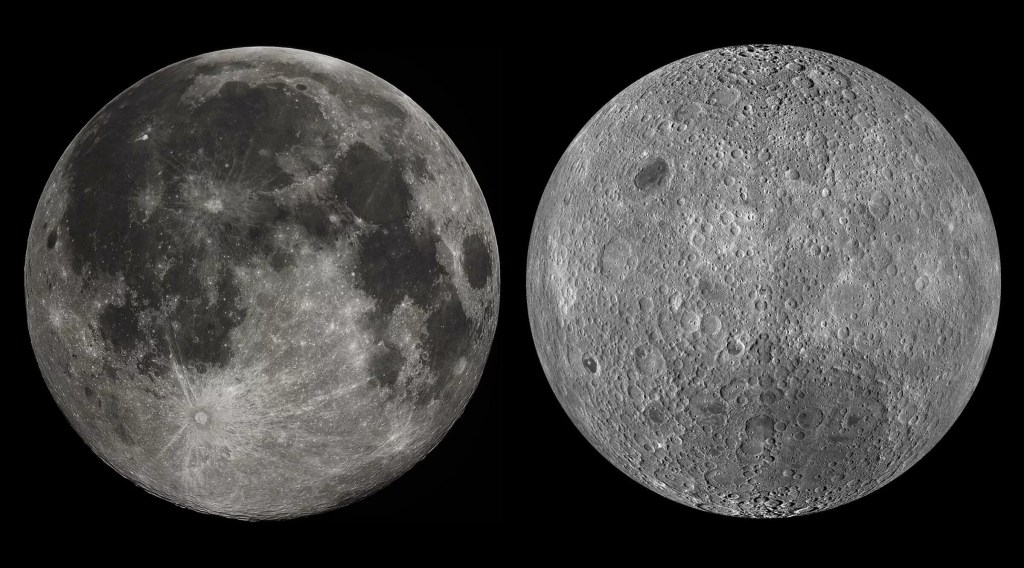
Super fact 103: The moon is always turning the same side towards us. This side is often referred to as the near side of the moon. The back side, which we can’t see from Earth, is often referred to as the far side of the moon. However, there is no side of the moon that is always dark. The near side of the moon and the far side of the moon both have day and night (in a 29.5 day cycle). Another interesting fact is that even though the near side and the far side of the moon get the same amount of light they are very different.
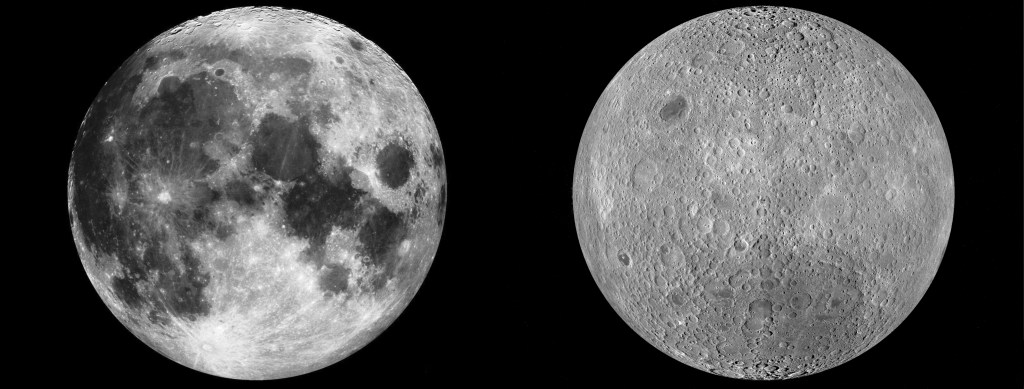
The near side of the Moon on the left and the far side of the Moon on the right. They are both full about once a month but at different times. They look quite different and are quite different. Elements of this image were furnished by NASA. Stock Photo ID: 2157518223 by Claudio Caridi.
Below is a youTube video showing an animation composed of actual satellite photos by NASA. It shows the far side of the moon, illuminated by the sun, as it crosses between the DSCOVR spacecraft’s Earth Polychromatic Imaging Camera (EPIC) and telescope, and the Earth – one million miles away.
The video has frequently been shown on social media, and I’ve seen many comments stating that it is fake because the back side / far side of the moon is not dark in the video. However, the sun is behind us in the video and shining on both Earth and the far side of the moon. The far side is not always dark.
This is a super fact because many people mistakenly think there is a permanently dark side of the moon, which we know is incorrect and understanding the basics about the moon, the most prominent celestial object in the sky, aside from the sun, is kind of important.
Moon Photos
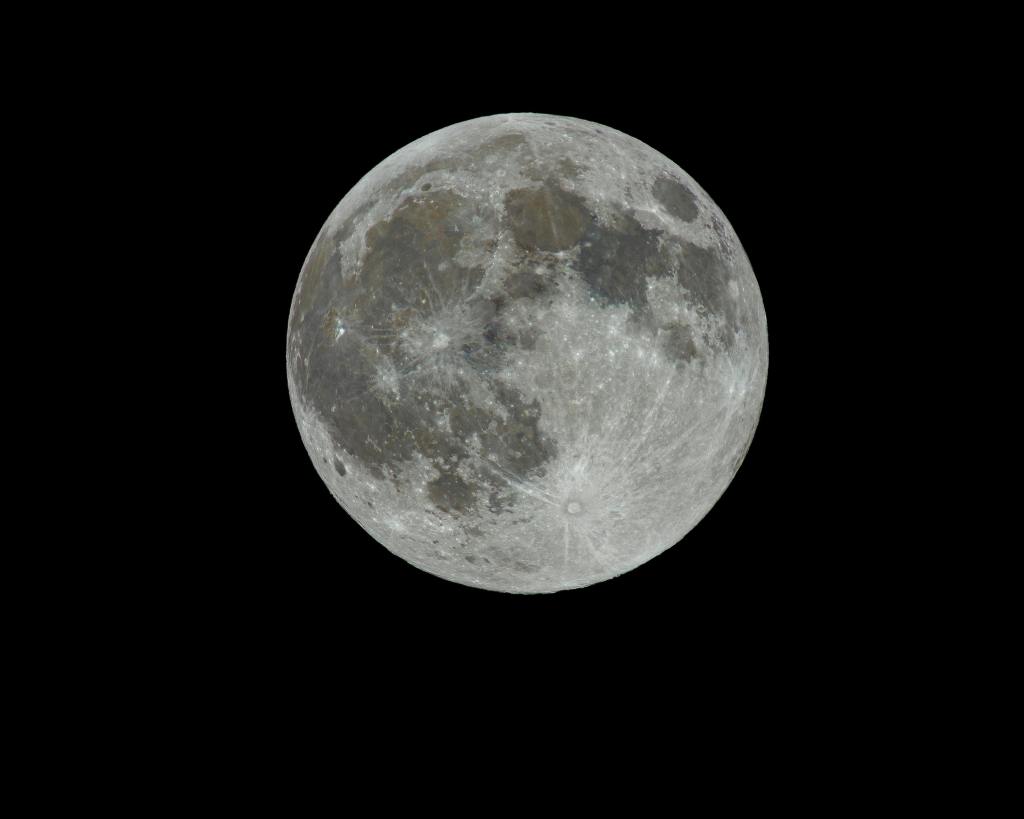
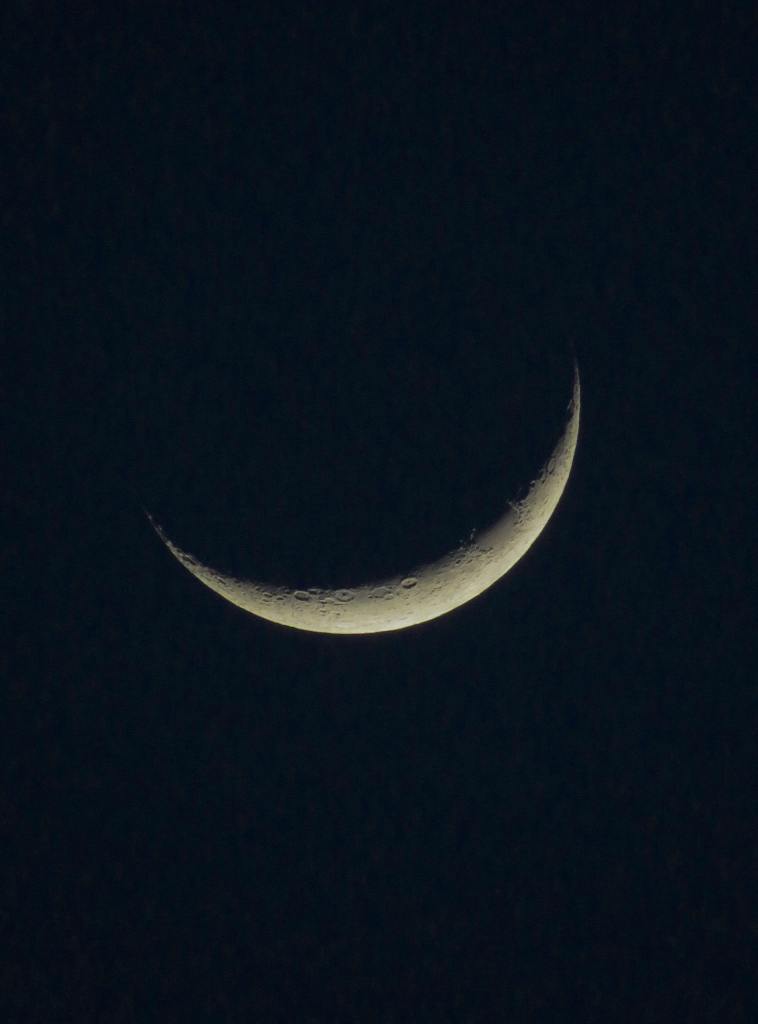
This is a close up photo of the near side of the moon. It is a full moon. Free picture from Pexels by Jay Brand.This is also a close up photo of the near side of the moon, but it is a crescent moon, which means that the far side, or the back side, is the side that is mostly lit up. In other words, the far side of the moon has day. Free picture from Pexels by Sevde.
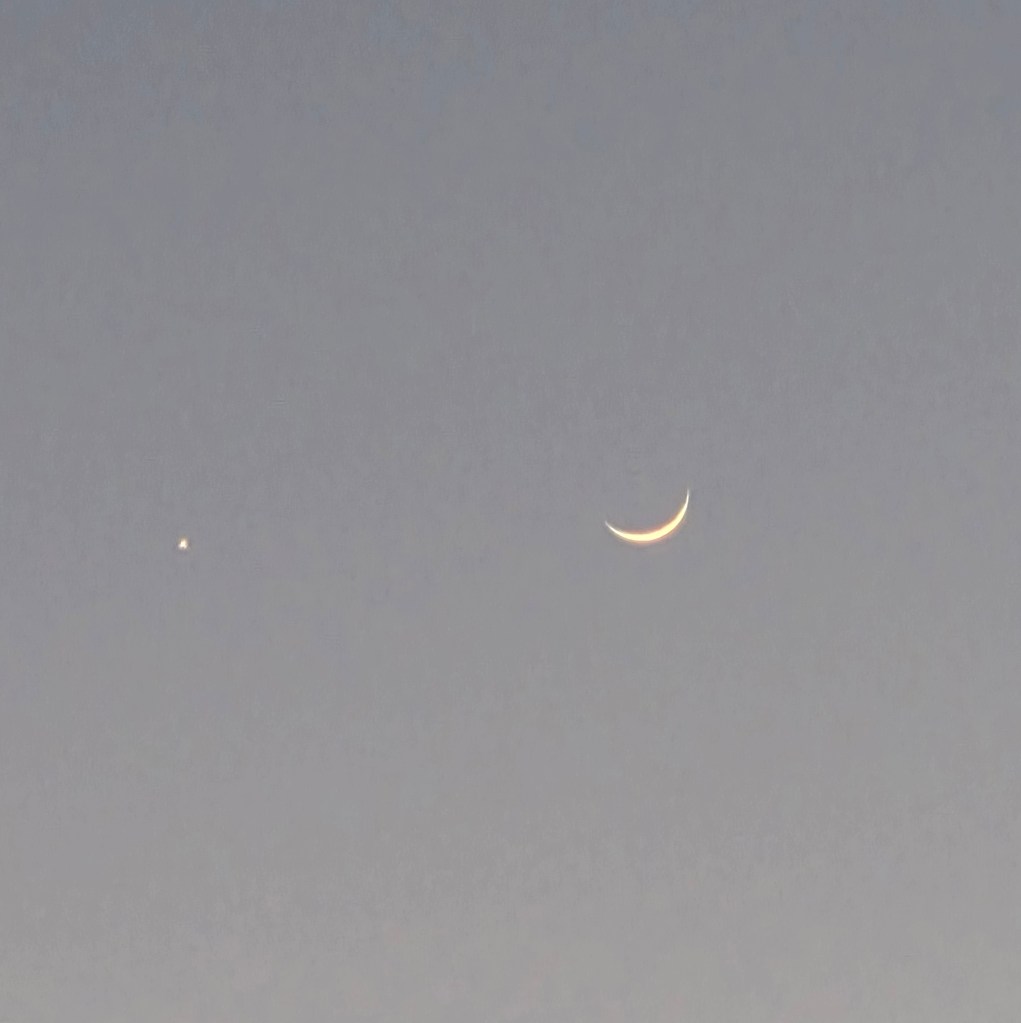
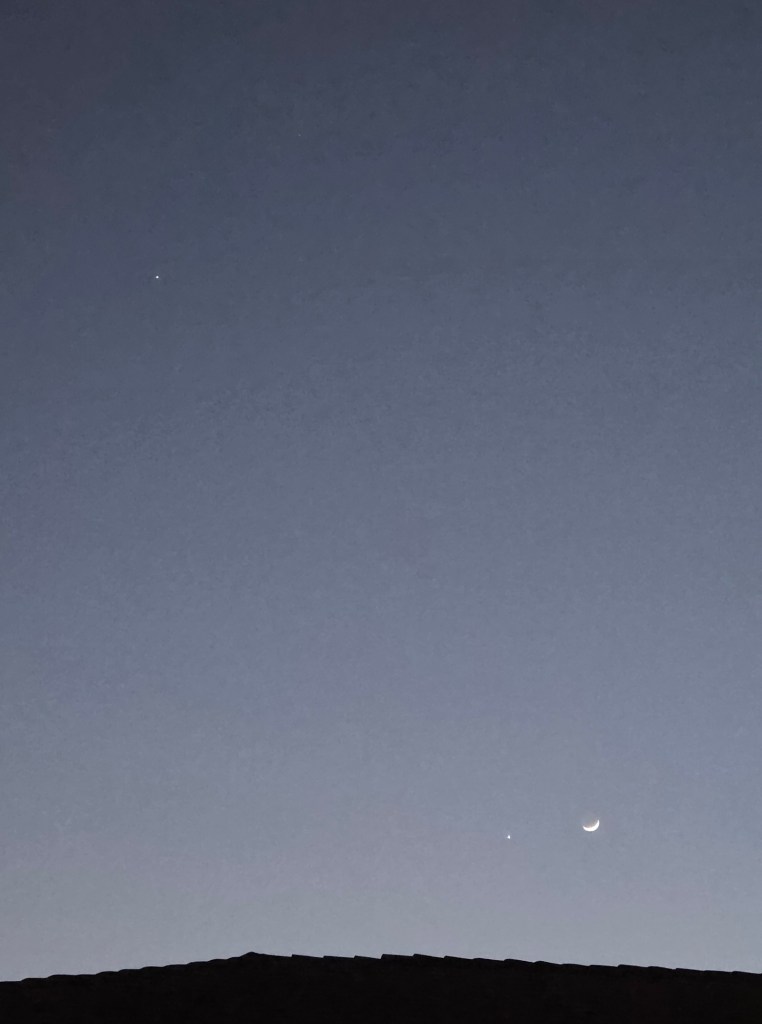
I took the photo below with my phone a few minutes ago this evening. The little dot on the left (it is not twinkling) is the planet Venus. The moon is currently a crescent, which means that at the moment of my writing this the back side / far side of the moon has day. The sun is shining down on the far side, and it is reflecting light back into space. The back side / far side is almost a full moon right now, but we can’t see that from Earth.
The dot on the left is Venus. On the right is the crescent moon. This photo is taken with my phone a few minutes ago (as of this posting).This is a zoomed out photo taken at the same time as the photo above. I zoomed out to capture a second dot up in the left corner. That’s another planet, the planet Jupiter (also not twinkling).
Interesting Moon Facts
I thought I might as well mention a few interesting facts about the moon.
The Moon’s nearside and farside Image: NASA LRO / Jatan Mehta
The far side of the moon is different. As you can see in the YouTube video and photo above, the far side looks different from the nearside and it is different in appearance and terrain. The near side of the moon has large, dark, flat-lying basins called maria. They look like oceans. The far side is a lot more rugged and covered by lots of craters. Another difference is that the far side of the moon has a much thicker crust compared to the near side.
The moon is drifting away from earth at about 3.8 centimeters per year. The moon is moving away from earth due to the gravitational forces between the moon and earth, which also causes tidal bulges in the Earth’s oceans and the moon. Back in high school I took a difficult physics test for a competition and one of the questions was to show that the moon was moving away from earth due to gravitational forces and calculate by how much. I did not solve that one.
The moon was likely created by a celestial collision. The most widely accepted explanation for the existence of the moon is that the Moon was created when a planet-like object, the size of Mars slammed into Earth, soon after the solar system began forming. That was about 4.5 billion years ago.
NASA found water on the moon. In 2020, NASA announced the discovery of water on the surface of the Moon. The NASA video below features more interesting facts about the moon.
If you visit this link you’ll find an interactive 3D animation using the NASA Visualization Technology Applications and Development (VTAD) technology. By using your mouse, you can view the moon from many different angles and positions (both the near side and the far side of course).
Super fact 102: Stars twinkle but planets do not. Planets reflect sunlight, like the moon, whereas stars emit intense light like the sun. However, stars are thousands of times further away.
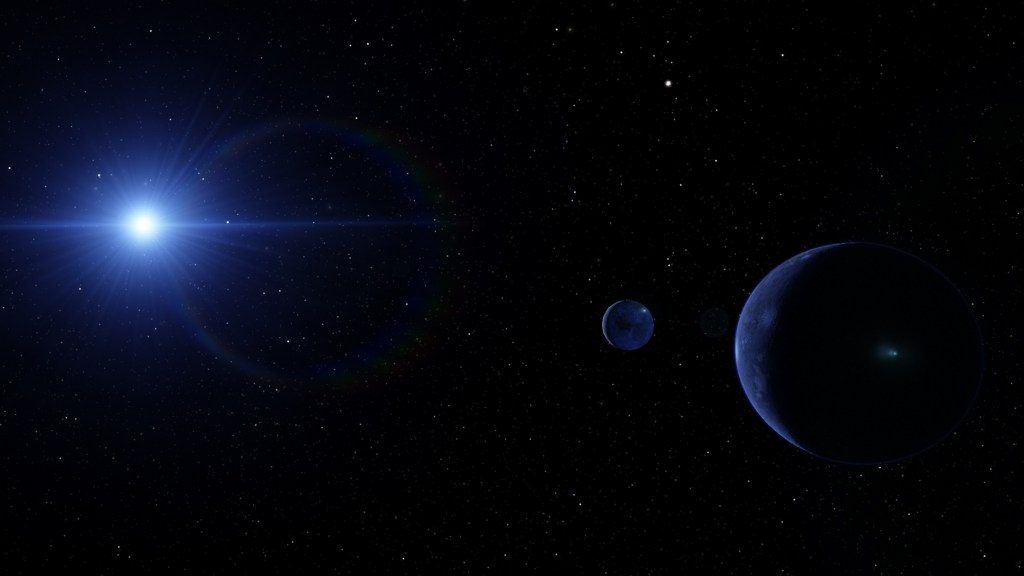
The light from stars is intense allowing stars to have much smaller discs in the sky for the same amount of light as a planet. Shutter Stock Illustration ID: 566774353 by Nostalgia for Infinity.
The Sun and the Moon appear to have roughly the same sized disk in the sky, about 0.5 degrees of arc, because the Sun is roughly 400 times wider than the Moon but also about 400 times farther away. However, the moon, which reflects sunlight but does that emit any, is much fainter than the sun in our sky. The Sun provides approximately 400,000 times more light to Earth than the full Moon. If you were to move the sun farther away until it provided the same amount of light as the moon you would have to move the sun 632 times farther away until it became a tiny point in comparison to the moon.
The planets in our solar system, Venus, Jupiter, Mars, Mercury, Saturn, etc., appear in the sky as small discs reflecting light whereas the stars appear as intense points of light with a disc diameter that is thousands of times smaller than that of the planets. However, we can’t see the difference with the naked eye. Both planets and stars appear like points of lights to us, but the difference in disc size in the sky is very big.
Planets reflect light whereas the stars appear as intense points. Shutterstock asset id: 2709145593 by buradaki
Because stars are tiny intense points of light Earth’s atmosphere can easily refract (bend) their light. This is known as scintillation. I can add that the light from stars that are low in sky go through more atmosphere and therefore twinkle more. Since planets appear as tiny discs rather than tiny points, planets create a steadier beam of light, which averages out atmospheric turbulence. In addition, dust particles in space and in the atmosphere can more easily block the light from stars compared to that of planets, because the planets have much larger discs in the sky (thousands of times larger).
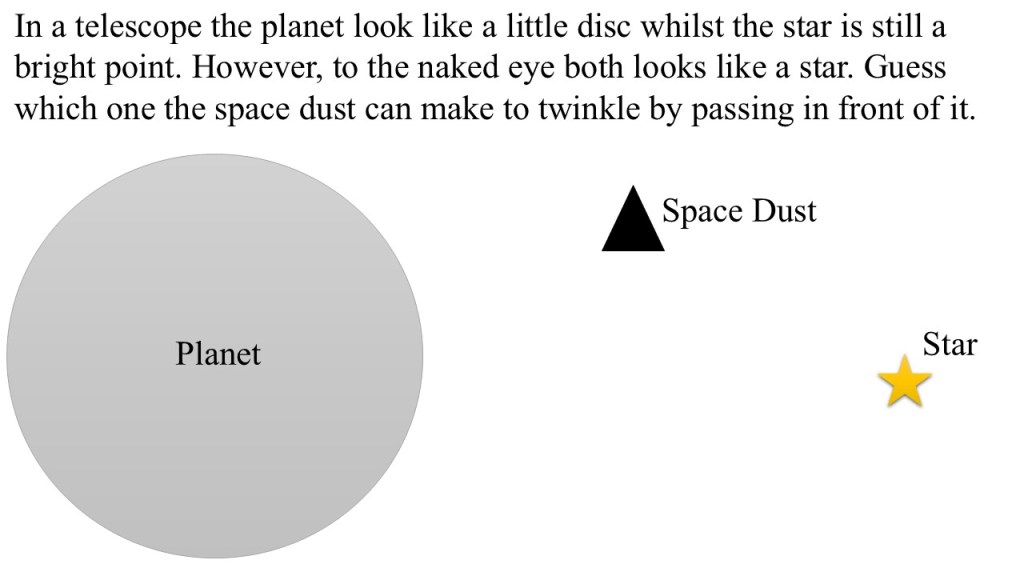
To the naked eye a planet and a star point look light points of light. In a telescope the planet will turn into a disc, but the star will remain a bright point of light. For example, a piece of space dust can easily make the star twinkle by moving in front of it but won’t do that to the planet. Note: planets are much smaller than stars, but they are much closer and can look bigger.
Since this fact is not scientifically under question, a lot of people don’t know it, and it is kind of important to anyone interested in the night sky, I consider it a super fact. I should say that I borrowed this super fact from Jacqui Murray’s blog worddreams.
Planets Reflect Light like the Moon
Planets reflect light. They don’t shine and emit light like the sun or the stars.
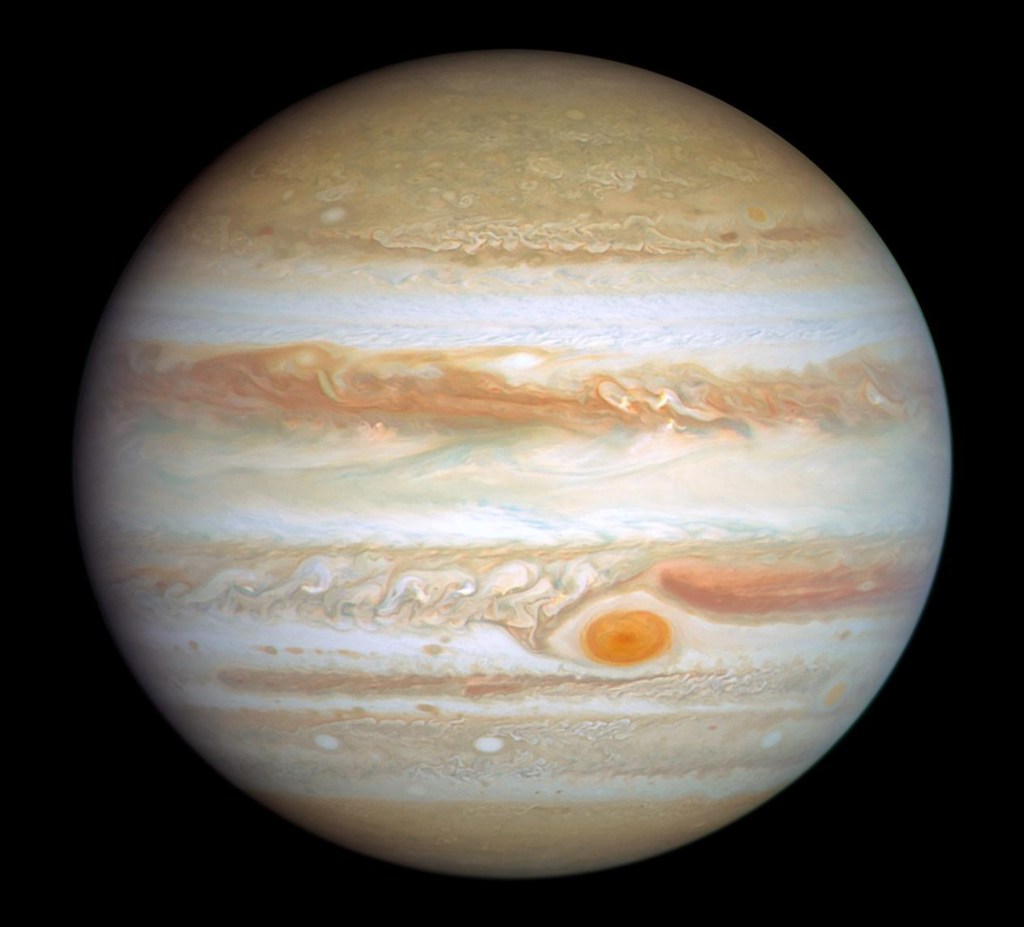
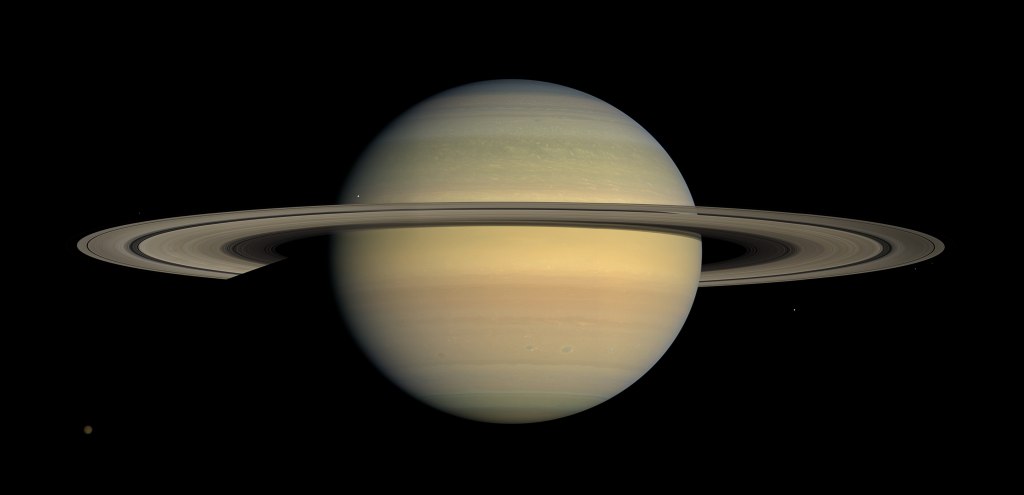
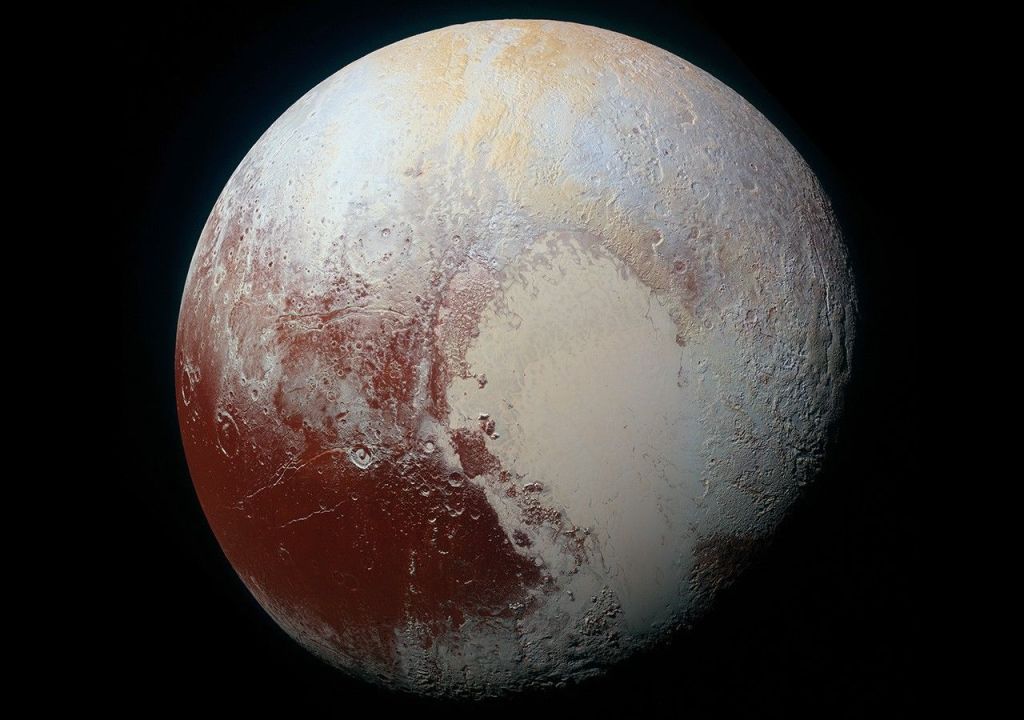
Jupiter in true color, taken by the Hubble Space Telescope in January 2024Saturn and its prominent rings, as captured by the Cassini orbiter. This natural color view of the planet Saturn was created from images collected shortly after Cassini began its extended Equinox Mission in July 2008.Pluto from NASA/JHUAPL/SwRI. NASA / Johns Hopkins University Applied Physics Laboratory / Southwest Research Institute, Public domain, via Wikimedia Commons. NASA’s New Horizons spacecraft captured this high-resolution enhanced color view of Pluto in 2015.


 Super Facts