
Please take a look at Smorgasbord Blog Magazine’s of my super fact #19 “An account impersonating you on Facebook does not mean you have been hacked“.
Category: Super fact
This post is about a super-fact. The goal of this blog is to create a list of facts or insights that are important and not trivia, known to be true, and yet highly surprising, shocking, amazing, or widely disputed amongst the public but not disputed among the scientists or experts in the relevant fields. However, not all of my posts are super-facts. This category distinguishes posts that are super-facts.
Mosquitos and Snakes Kill Hundreds of Thousands of People Annually

Super fact 98 : The deadliest animals in the world are mosquitos, snakes and dogs. Mosquitos kill an estimated 760,000 people each year. Snakes kill an estimated 100,000 people each year. Dogs kill an estimated 40,000 people each year. By comparison humans kill on average 600,000 other humans annually due to wars and violence.
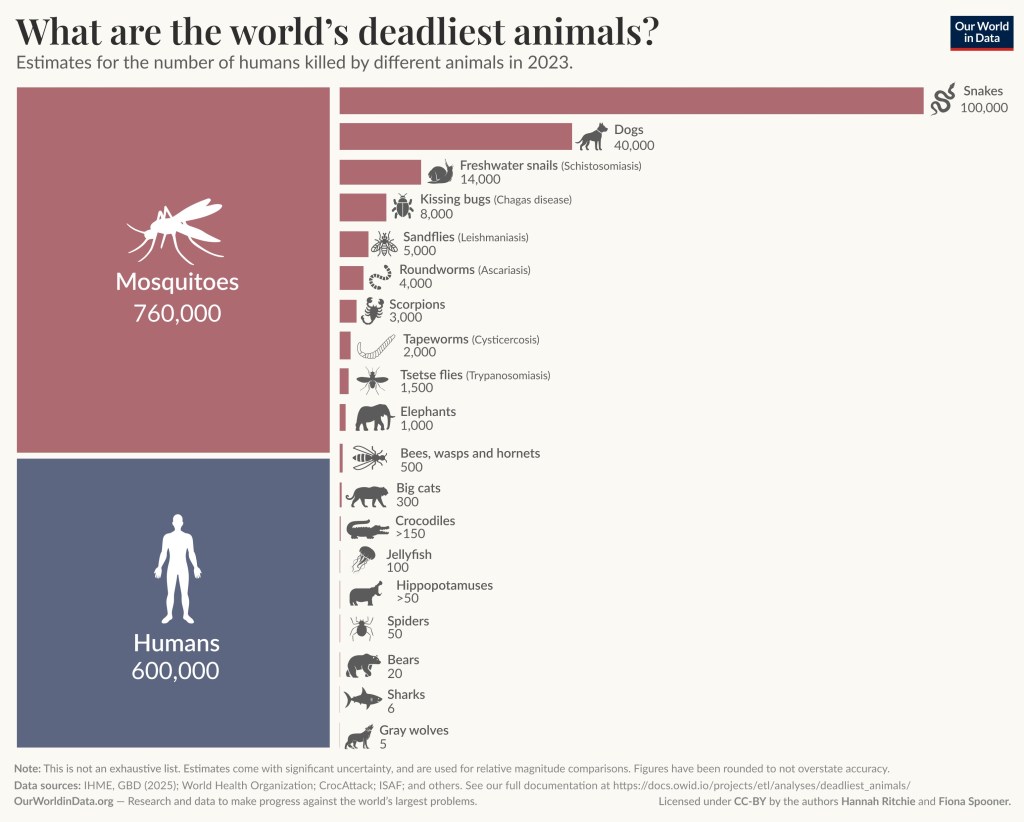
The first time I heard that the deadliest animal in the world was the mosquito I was surprised. After I heard that the reason was all the diseases that mosquitos spread, such as malaria, dengue fever, and yellow fever, it made more sense to me. I recently learned that snakes kill 100,000 people every year. It surprised me because it seemed like a lot to me.
I was also surprised to learn that our best friends the dogs, come in as number three on the list of deadliest animals, at an annual kill rate of 40,000 people. Even though scorpions are not at the top of the list they kill 3,000 people annually, while spiders only kill 50 people. We have both venomous spiders and scorpions where I live, but I’ve been worried about spiders, not scorpions. It is also surprising to me that sharks only kill about 6 people per year. I guess my super fact 98 is a collection of facts regarding “killer animals” rather than one specific fact. I am hoping that at least one of the facts will be surprising to you.
I should mention that the numbers vary over time and different sources give different statistics. Therefore, the numbers should be seen as ballpark numbers and not exactly. However, Our World in Data is considered one reputable and highly reliable data source that is frequently cited in scientific journals, and access is free.
Mosquitos Kill 760,000 People Each Year
Mosquitos are the biggest killers of humans by far. 80% of those deaths are the result of malaria which is transmitted and spread by the Anopheles mosquito. We have made progress against malaria, and it used to be worse. In the 20th century 150 to 200 million people died from malaria, which is more than one and half million people per year. Smallpox killed 300 million people in the 20th century, but it was entirely eradicated by 1977 thanks to the smallpox vaccine. The two existing vaccines for malaria are relatively recent (2021 & 2023), not as effective as the smallpox vaccine was, and not yet as widely used, which is one reason malaria is still a major health concern.
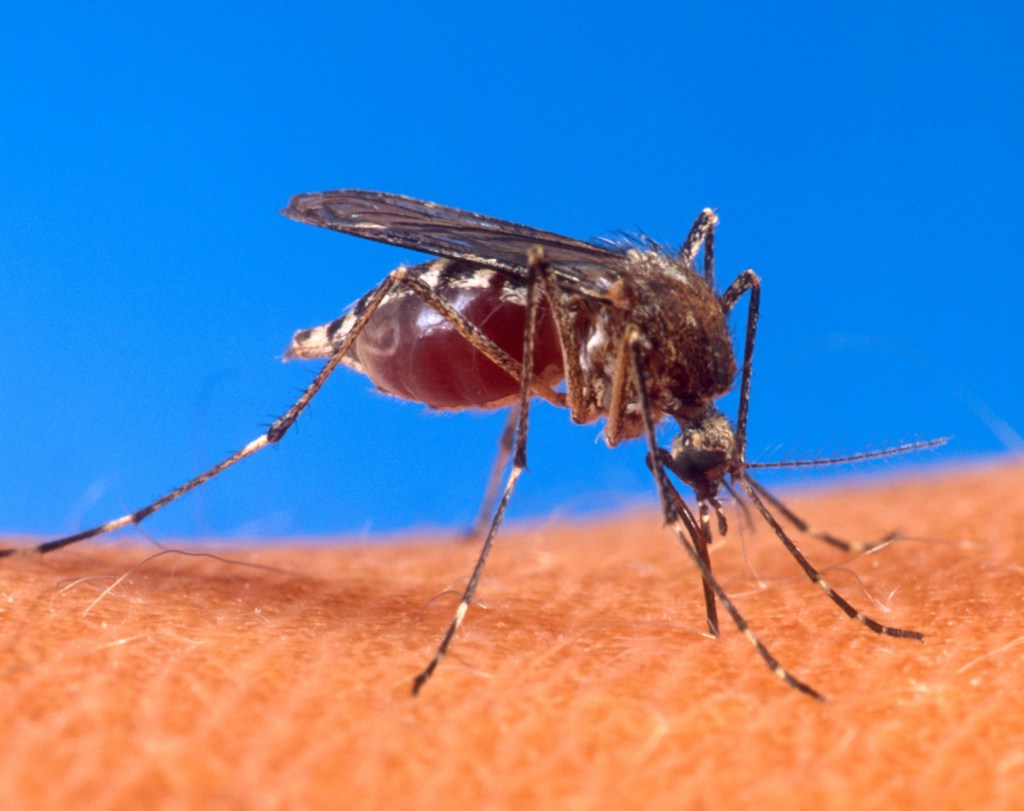
In addition, mosquitos spread other diseases killing more than 100,000 people every year. Dengue fever, yellow fever and Japanese encephalitis, are a few of the more dangerous mosquito borne diseases.
Snakes Kill 100,000 People Each Year
The death toll from venomous snakes is uncertain but it is likely to be 100,000 deaths per year. The World Health Organization estimates that snake bites kill between 81,410 and 137,880 each year.
The most venomous snake in the world is the Inland Taipan. Its venom can kill over 100 people in a single bite. However, due to its shy nature and remote Australian habitat, no human deaths have been attributed to it. The most dangerous snake to humans, in terms of fatalities, is often considered the Russell’s viper, responsible for 25,000 deaths annually. Other snakes that kill several thousand people every year are the saw-scaled viper, the common krait, the Indian cobra in Asia, and the black mamba.



Dogs Kill 40,000 People Each Year

Even though there are some large and dangerous dogs, most deaths caused by dogs is from rabies resulting from being bitten by a rabies infected dog. See the horror movie Cujo.
Freshwater Snails, Kissing Bugs, Sandflies, Roundworms are Mass Killers
Other critters that kill thousand of people every year are freshwater snails, kissing bugs, sandflies, and roundworms. These critters kill people by infecting them with dangerous parasites or as in the case of roundworms, being a dangerous parasite.
Scorpions Kill 3,000 People Each Year but Spiders Only 50
I was at an overnight outing with the guys at work. I had just moved to Texas. We were standing or sitting around the fire drinking beer when I asked a question. I’ve heard about the scorpions in Texas, but I’ve never seen any. How common are scorpions?
A coworker named Gary told me to turn around, so I did. Behind me was a tree, and the tree was covered by crawling scorpions. Well, I was glad I did not lean on it. The scorpions I saw were the striped bark scorpion.
The reason scorpions kill a lot more people than spiders is that some scorpion species have a very potent and deadly venom. Some spiders are dangerous too, but spiders tend to have less potent venom.

The Big Cats kill only 300 People Annually and Sharks Only 6
Would you prefer to stay in a room with a Tiger or with a mosquito? Mosquitos kill 760,000 people every year, whilst Tigers only kill a handful of people every year. However, Tigers don’t kill less people than mosquitos because they are less dangerous than mosquitos. The difference is exposure. Mosquitos are everywhere but not Tigers. If Tigers were as common as people and everywhere people were, the numbers probably would be different.

Other Posts Related to Animals
- A Tarantula Hawk Encounter.
- Grizzly 399 is dead 20241024.
- Wind power is not a major cause of bird death.
- There are flying Turkeys.
- Neutering or spaying a dog at 6 months old can be dangerous to their health.
- Do You Ever See Wild Animals.
- Red Touches Yellow Kill A Fellow.
- Marsupial Planet.
- Robotics And Leonberger Dogs.
- The Moose or Elk Conundrum.
- Ten Amazing Fish Facts.
- The Wild Mammal Biomass Has Substantially Declined.
- The Extinction Rate is Much Higher Than the Natural Baseline Rate.
- Humans and Chimpanzees Have a Common Ancestor.
- 10 Wind Blowing Facts About Birds.
- Birds are Avian Dinosaurs.
- The Evolution of Whales is No Longer a Mystery.
- Reindeer Hide Memories.
To see the other Super Facts click here
Electrons Have Spin Without Spinning
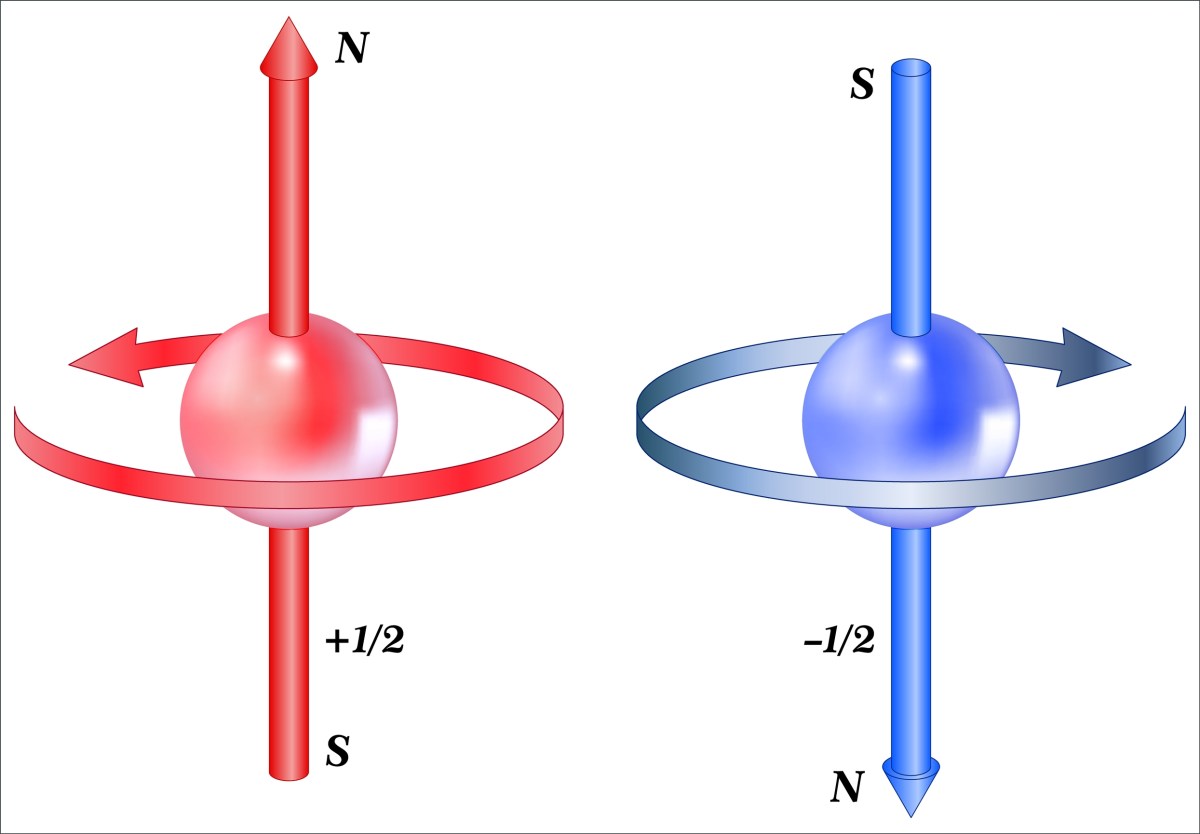
Super fact 97 : Things that spin have an angular momentum and if electrically charged they also generate a magnetic field (magnetic dipole). This is true for electrons and many other elementary particles. However, electrons are not physically spinning. This “spin” is an intrinsic property like electrical charge or mass. In addition, the electron has “Spin 1/2,” meaning you must rotate its wave function 720 degrees (two full circles) to get back to where you started. Moreover, this half spin oddity makes the existence of matter possible.
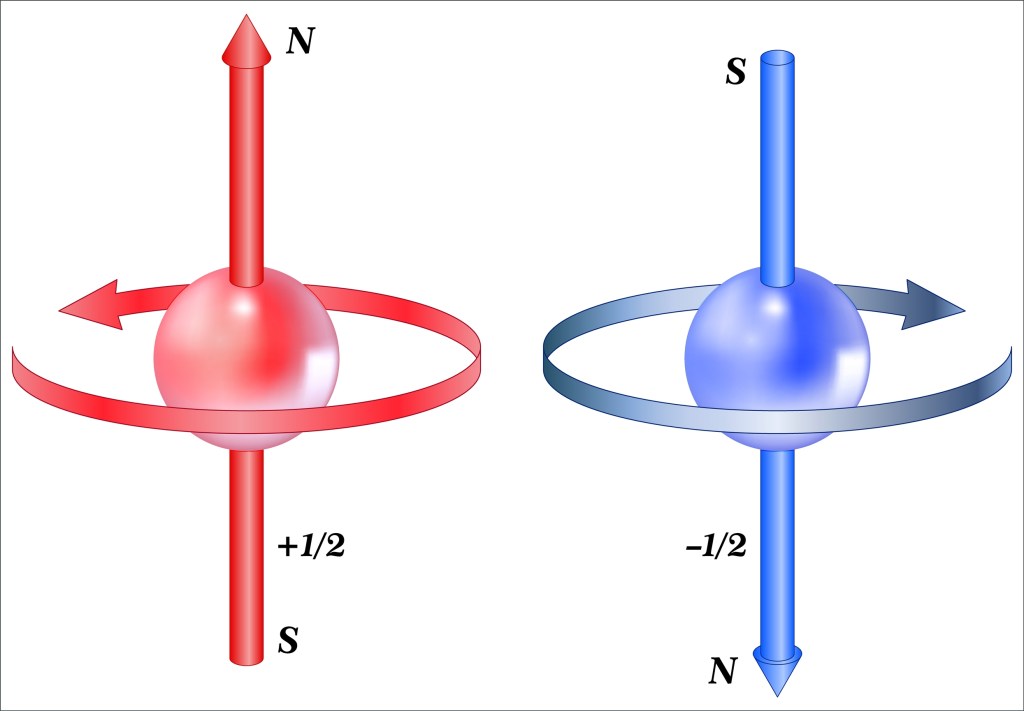
An electron with spin +1/2 will align parallel with an external magnetic field while an electron with spin -1/2 will align in the opposite direction. The existence of intrinsic spin and the fact that the half spin property requires you to rotate the electron’s wave function twice to get back to where you started is very surprising. Particles with half spin (electrons, protons, positrons, muons, etc.) are called Fermions. It is also surprising that the half spin property makes the existence of matter possible. These true but surprising facts are important, which is why I consider this a super fact.
Angular Momentum and Magnetic Dipoles
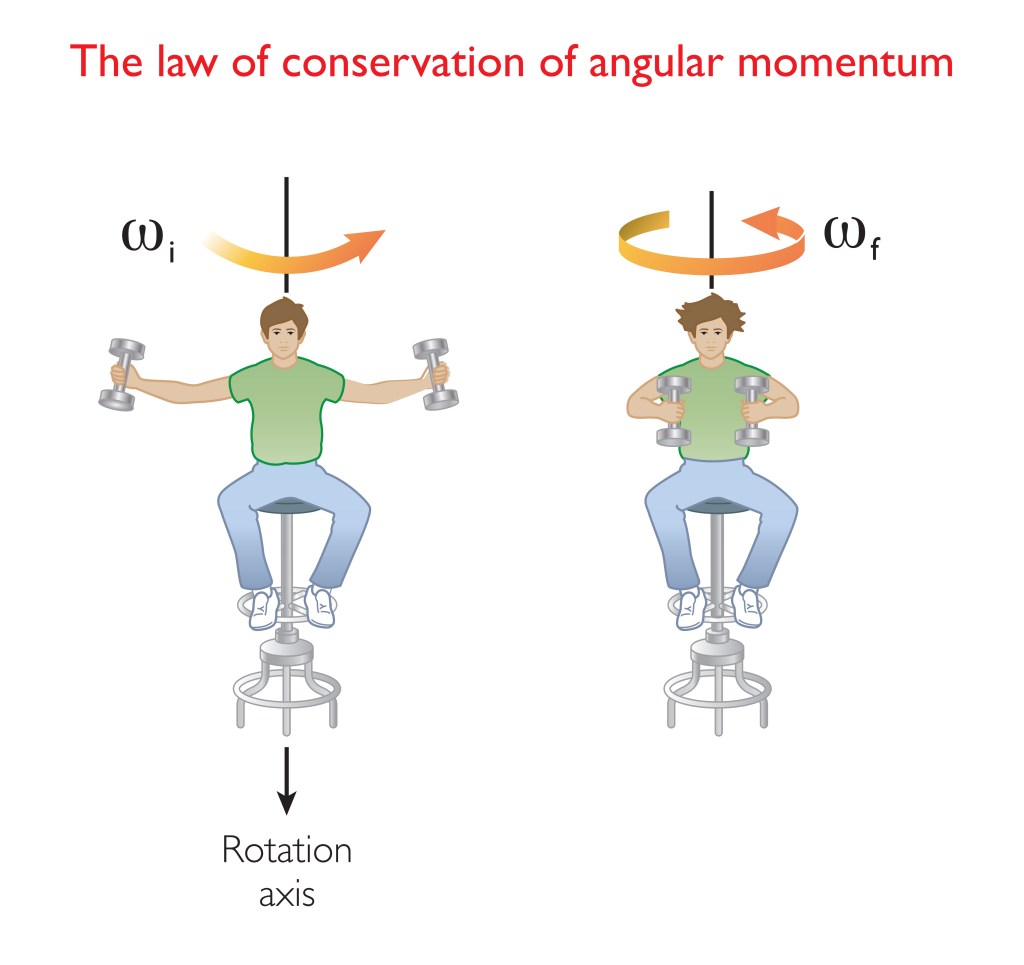
The picture above gives an example of the law of conservation of angular momentum. Bringing weights closer to the body speeds up the rotation. Another example of the law of conservation of angular momentum is when you try to tip the axis of the rotation. This would be the man tipping over. You can’t do that without applying a force. The electron, and other subatomic particles with spin, display this gyroscopic effect, like a spinning top. As mentioned, charged particles such as the electron, positron or proton, also generate a magnetic field as if they were spinning. However, the strange fact is that despite that electrons and other particles with spin display these spin properties, they aren’t spinning.
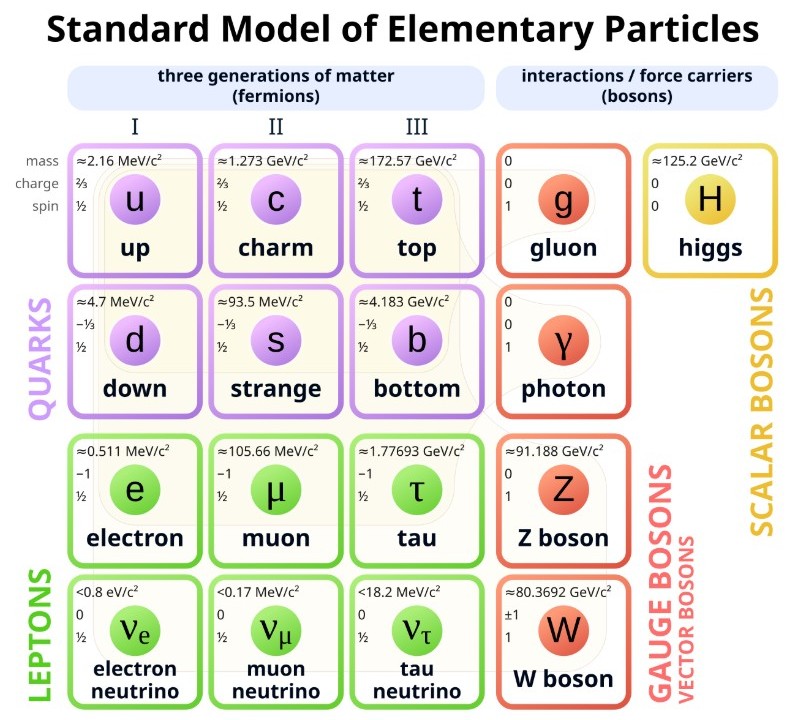
Below is an overview of the elementary particles. An elementary particle is a fundamental subatomic building block of the universe that cannot be divided into smaller components. Notice that the proton and the neutron are not listed because they are not fundamental particles. They consist of three quarks. The top number is the mass (0.511 MeV/c2 for an electron). The number below that is the charge (-1 for an electron) and the bottom number is spin (1/2 for an electron). The diagram shows three intrinsic properties per particle.
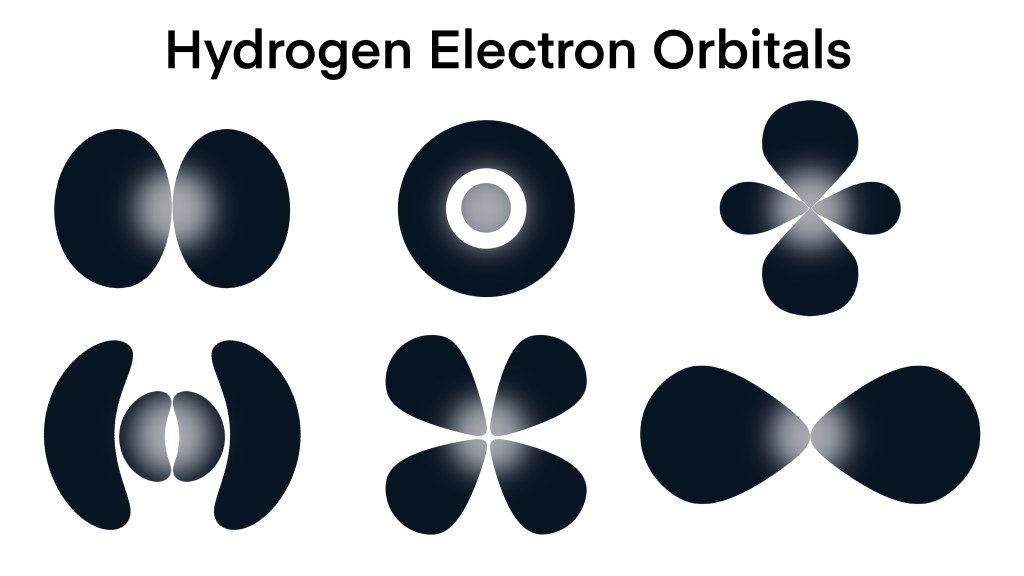
Electron Orbitals
I should explain something about particles and waves. Subatomic particles are associated with quantum waves. This is quantum mechanics. For example, an electron is in a sense both a particle and a wave, or more correctly neither. However, it exhibits both point like particle characteristics and wave characteristics depending on circumstances. Below is a picture showing the standing quantum waves representing an electron in different orbitals (different states) in a Hydrogen atom.
Hydrogen atoms only have one electron, but that electron can exist in different orbitals (sort of different orbits). A standing wave is a wave that is not spreading out, like the waves going back and forth in a bathtub. You can’t really say that the electron is orbiting the nucleus like a planet. The standing quantum wave, or electron cloud, or orbital are more accurate ways to view it.
There is some confusion as to what the standing quantum waves represent. The Copenhagen interpretation says that the electron exists in superposition, or all possible states, until measured. The quantum wave indicates the probability that you will find the electron in a certain place when you measure. The square of the amplitude of the wave is the probability that you will find the electron at that point. When you measure it and find out where the electron is the wave will collapse.
Other interpretations say that the electron is in a specific place, you just don’t know where, but again the square of the amplitude of the wave is the probability that you will find the electron at that point. Yet other interpretations say that the quantum wave is a real physical thing that guides the electron (pilot waves). The so called many-worlds-interpretation say that all possible outcomes of a measurement happens but in an infinite number of parallel universes (multi-verses).
Then some people say that the quantum wave does not exist at all, other than as a probability distribution. It represents what the observer knows about the system, nothing else. If you don’t know where the electron is, then the wave is all over the place. If you measure where it is then the wave collapses. Then we also have the you-don’t-know-what-you-are-talking-about-just-shut-up-and-calculate interpretation. The latter interpretation is focused on using the equations, for example the Schrödinger and Dirac equations, to make predictions and measurements and it ignores what’s behind the scenes. This interpretation is popular in college physics classes.
Whichever interpretation you prefer, the you-must-fully-rotate-the-wave-function-twice-to-get-back-to-start property leads to the Pauli exclusion principle.
The Pauli Exclusion Principle
The Pauli exclusion principle states that two identical fermions (such as electrons) cannot occupy the same quantum state simultaneously. For example, two electrons in the same orbital must have opposite spin +1/2 and -1/2 and you could never add a third electron. This adds structure to the atom and to the nucleus. If you did not have the Pauli exclusion principle everything could just fall into one point, and you could walk through walls. Matter as we know it could not exist. This is why fermions (electrons, muons, positrons, quarks, protons, neutrons, etc.) often are referred to as matter particles and bosons (photons, gluons, etc.) are referred to as radiation.
It turns out that that the Pauli exclusion principle is a direct result of the half spin of fermions, in other words, that you have to rotate the associated wave twice around to get back to the original.
Do you think this is confusing ? Don’t feel bad. Richard Feyman one of the most prominent pioneers of quantum mechanics and Nobel Prize winner in physics said, “I think I can safely say that nobody understands quantum mechanics”.
Other Super Facts Related to Modern Physics
- The Speed of Light In Vacuum Is a Universal Constant.
- Two events may be simultaneous for some but not for others.
- The Bizarre Reality of Black Holes.
- Every Symmetry is Associated with a Conservation Law.
- There is strong evidence for the Big Bang.
- Time Dilation Goes Both Ways.
- The Pole-Barn Paradox and Solution.
- Time is a Fourth Dimension.
- Electric Charge is not the only type of Fundamental Charge.
- Superfluid Liquids are Like Magic.
- The Edge of the Observable Universe is 46.5 billion Light Years Away.
To see the other Super Facts click here
Nuclear Energy is Relatively Clean and Safe
Superfact 96: Nuclear power is a relatively clean and safe energy source that produces no atmospheric emissions during operation. However, there are some problems with nuclear power, but they are often overblown.
Clean energy sources are often defamed by disinformation and misunderstandings. For example, wind power turbines are not bird killing machines. Contrary to what you often hear wind power is indeed a very clean, cheap and sustainable energy source. Nuclear power is another misunderstood energy source. Wind power, solar power, hydro, and nuclear power are all considered clean energy because they produce no greenhouse gases or air pollution during operation and they also have very low life-cycle emissions.
The graph below from Our World in Data depicting lifetime greenhouse gas emissions (construction, operation, disposal) and safety data for the European Union, show that the lifetime greenhouse gas emissions of coal power is 162 times higher than those of nuclear power and coal kill 820 times as many people as nuclear power. The lifetime greenhouse gas emissions of natural gas are 120 times higher than those of nuclear power and kill 613 times as many people as nuclear power. The difference is staggering.
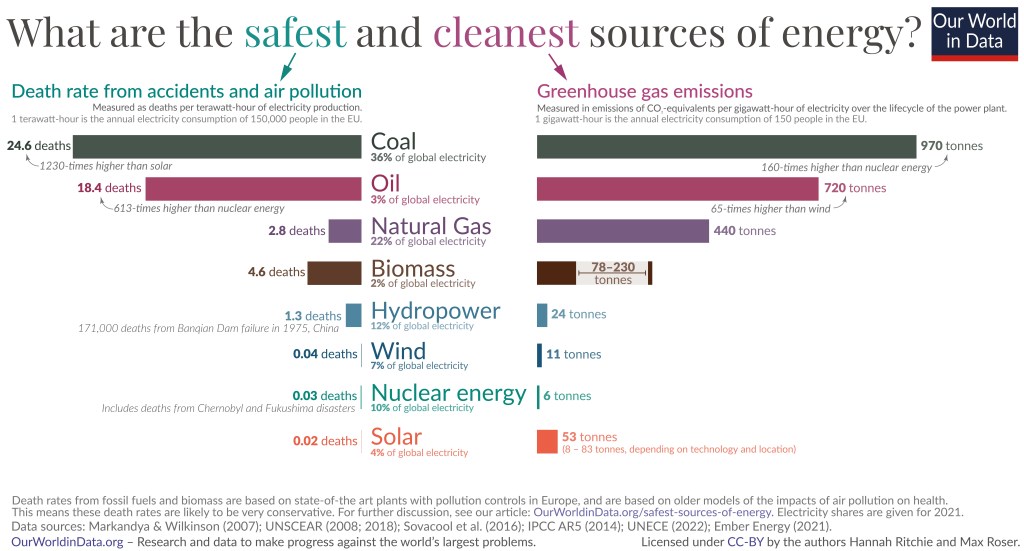
In the graph above, greenhouse gas emissions are measured of CO2 equivalents per Gigawatt-hour of electricity over the lifecycle of the power plant. 1 Gigawatt-hour is the annual electricity consumption of 150 people in the EU. Death rate from accidents and air pollution is measured as deaths per Terawatt hour of electricity production. 1 terawatt hour is the annual electricity consumption of 150,000 people in the EU.
I should mention that there are problems with nuclear power that are not entirely covered by the graph above, including radioactive waste, a history of spectacular accidents, and a perceived connection to nuclear arms. However, as you will see later in this post, even though these problems get a lot of media attention, they are not as scary as one might think. However, it should be noted that nuclear power in its current form is not a cheap source of energy, but that is a different topic.
I consider this a super fact because nuclear power is often thought of as an extremely dangerous and dirty source of energy, which is not the case.
How Does Nuclear Power Work ?
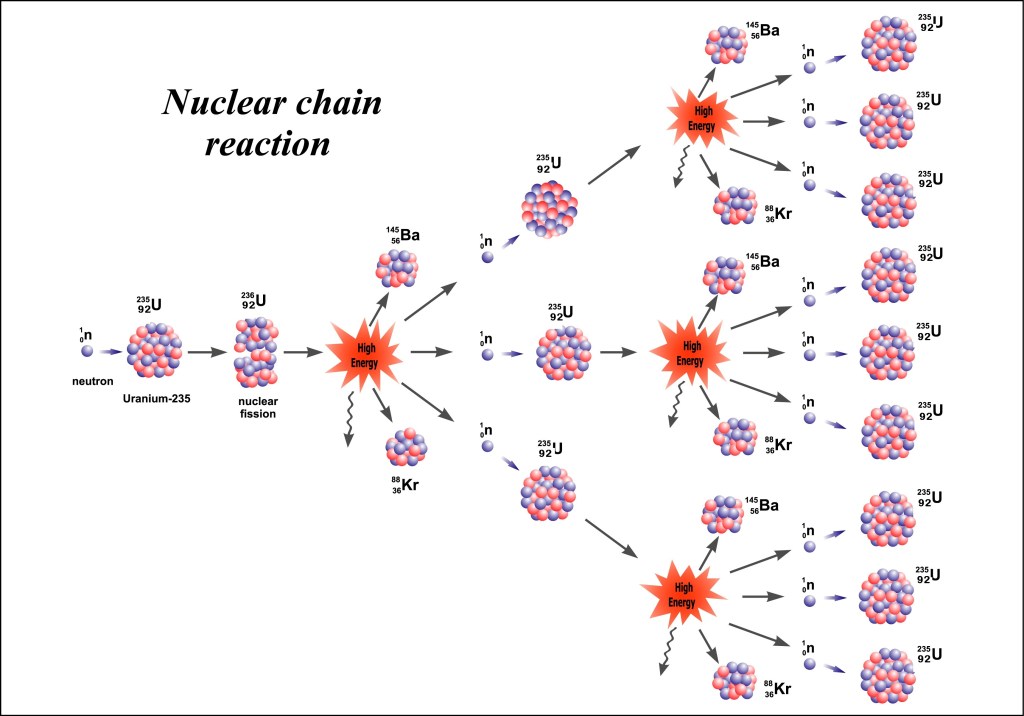
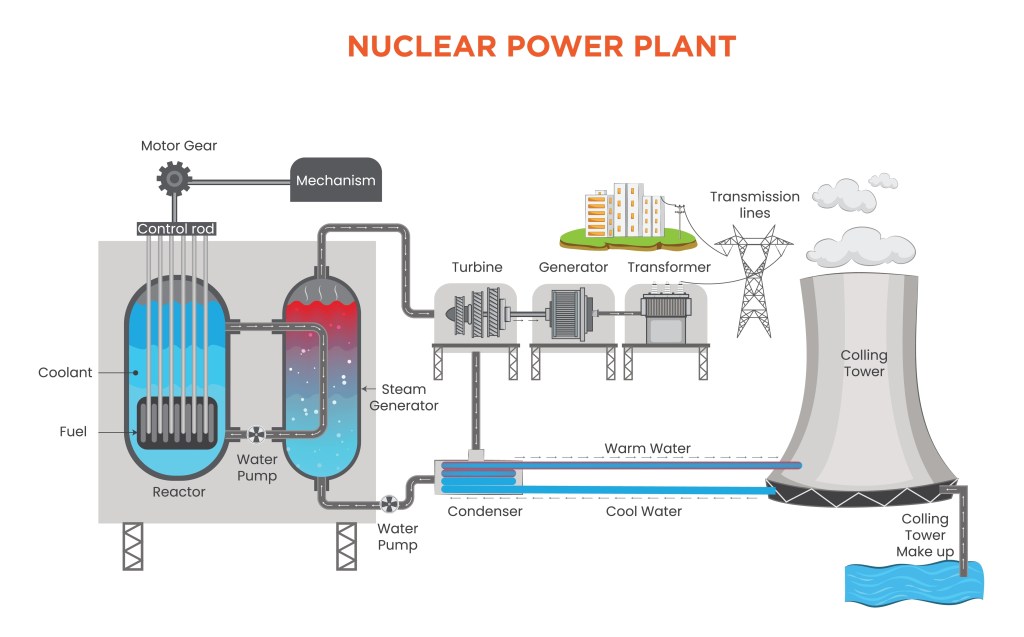
The fuel (fuel rods) in a nuclear power station consists primarily of stacked ceramic pellets made of low enriched uranium dioxide housed inside sealed metal tubes. The uranium consists primarily of two uranium isotopes U-238, which has 92 protons and 146 neutrons and U-235, which has 92 protons and 143 neutrons. Uranium always has 92 protons. The isotope that is used for fission is U-235. Natural Uranium consists of 0.7% U-235, trace amounts of U-236 and the rest (99.3%) is U-238. The uranium in nuclear fuel rods is either natural (0.7% U-235) or a few percent of U-235 (low enriched uranium). This should be contrasted with a uranium atomic bomb which has at least 80% U-235 (highly enriched).
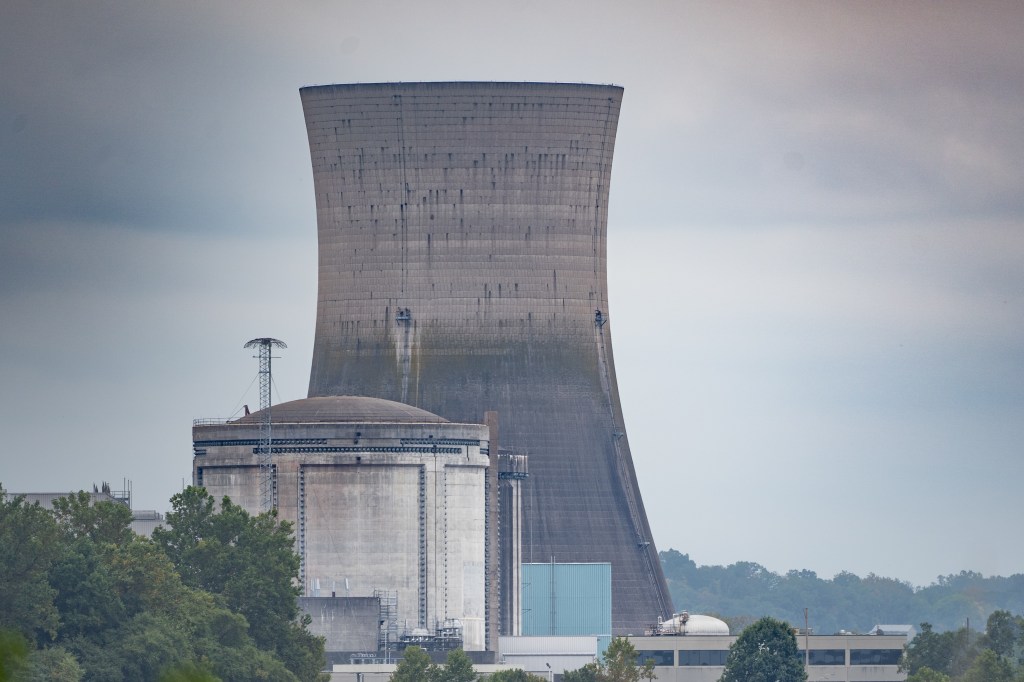
A nuclear power plant generates electricity using heat from nuclear reactions. Inside the reactor, atoms of fuel (uranium) undergo nuclear fission, where they split apart and release a large amount of heat. The fuel rods (see picture below) in a nuclear power station consist primarily of stacked ceramic pellets made of low enriched uranium dioxide housed inside sealed metal tubes. There are also control rods in a nuclear power station, which consist of materials with a high neutron absorption cross-section. The control rods are used to regulate the reaction. If they are fully inserted the reaction will stop. Also note that nuclear reactors have a containment shield (at least in western countries).
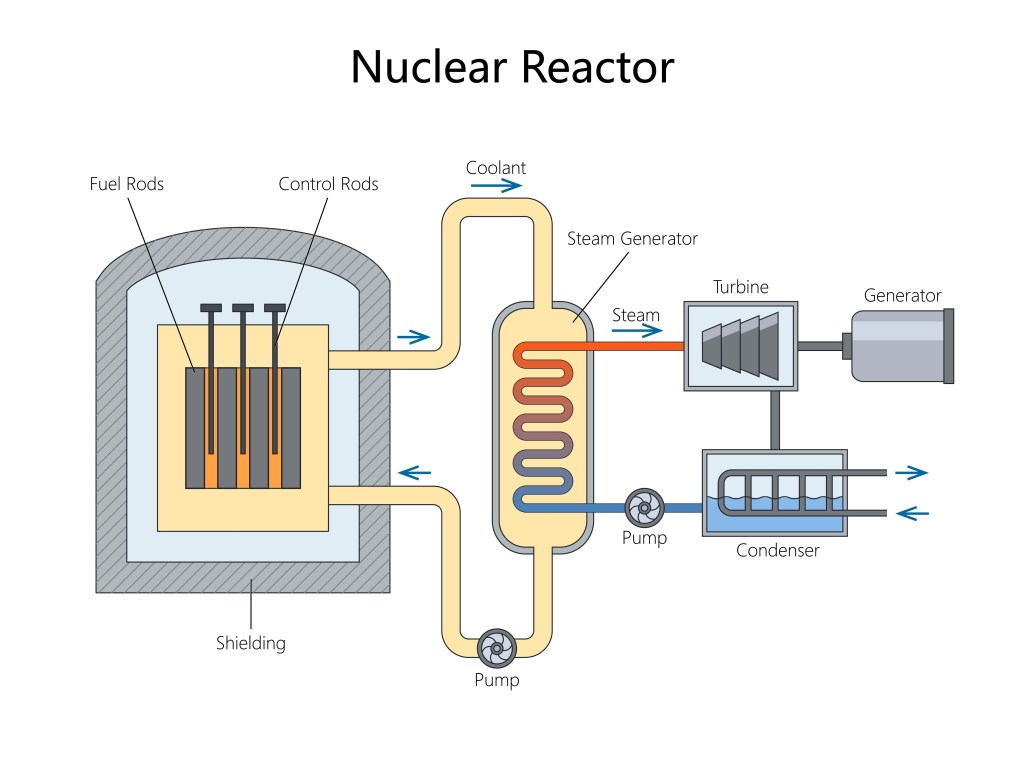
Below is an alternative illustration.
What about Chernobyl ?
The Chernobyl disaster, which occurred on April 26, 1986, was the worst nuclear disaster in history. 50 people died as a direct result of the disaster and an estimated 4,000, perhaps 10,000 future cancer deaths are predicted from the disaster. However, it should be noted that an estimated half million people died from coal pollution in the United States over the first two decades of the 21st century. You have to compare.
Another, thing to keep in mind is that the Chernobyl reactors were RBMK reactors (Reaktor Bolshoy Moshchnosti Kanalnyy), an extremely flawed, old and dangerous design that only exists in Russia (or the former Soviet Union). Above I mentioned that the control rods slow down the nuclear reaction when inserted between the fuel rods and stop the reaction when fully inserted. In an RBMK reactor, it is the other way around. The control rods speed up the reaction when inserted. Add the fact that the Chernobyl reactor did not have a containment shield designed to contain a major release of radioactivity, unlike Western reactors and that the Soviet Union was an authoritarian and secretive regime that made things much worse. A nuclear disaster similar to Chernobyl is highly unlikely to happen in the West.
The Fukushima nuclear disaster was caused by a severe earthquake and a 15 meter tsunami. Around 2,300 died from the evacuation, and 15,000 people died from the Earthquake, but it is estimated that no one, or perhaps one person died as a direct result from the nuclear disaster itself. As mentioned no one died from the Three Mile Island accident.
What about Radioactive Waste?
Radioactive waste stored on-site at nuclear power stations (spent fuel) is often millions of times more radioactive than long-term disposal waste. It is important to remember that highly radioactive isotopes decay fast (that’s why they are dangerous), which means that long-term disposal waste is not very dangerous. We are surrounded by radioactivity and our by far largest exposure to ionizing radiation comes from the radon in our basements.
Does nuclear power for energy generation increase the risk for nuclear weapons proliferation?
While commercial nuclear energy and weapons programs share technology, they are distinct processes. The historical data and studies show that national nuclear energy programs in general don’t lead to the development of nuclear weapons. No country officially developed nuclear weapons based on a pre-existing commercial nuclear power industry. Typically, nuclear-armed nations developed dedicated, military-focused, and often secret reactors to produce plutonium or facilities to enrich uranium for weapons. Also, the issue is mostly moot for countries that already have nuclear weapons, such as the United States.
Conclusion
Nuclear power is clean and safe. It might be our cleanest energy source that can provide baseload power. However, there are other concerns including the possibility of spectacular accidents, radioactive waste and the possibility that nuclear power for energy might aid nuclear weapons proliferation. Luckily, it appears that these concerns are overblown. It should be noted that nuclear power, as implemented today, is not cheap energy, but that is a different topic.
To see the Other Super Facts click here
The Deadliest War in this Century was in Congo
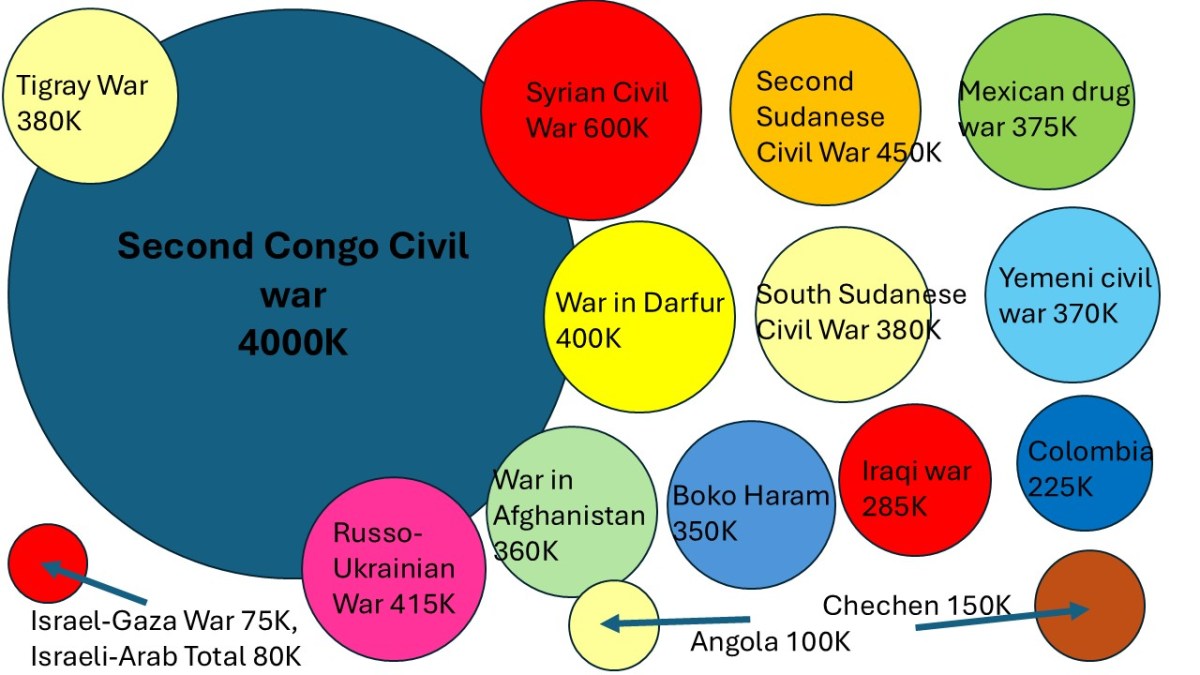
Super fact 95 : More than 4-5 million people died in Congo Civil War 1998 to 2003 and its aftermath (until 2007). In addition, some of the other of the deadliest wars in the 21st century are not well known.
Below : 21st Century death toll from different wars, current and recent.
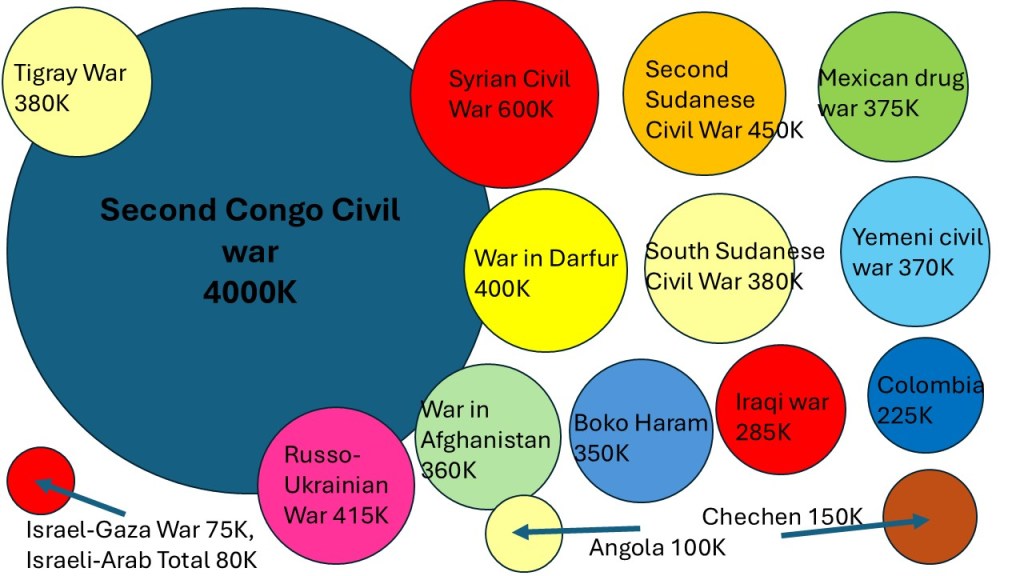
Notes on the graphics above:
- The 16 wars included in the graphics above roughly correspond to the deadliest wars in the 21st century. However, a few of the wars included in the graphics are not among the 16 deadliest wars of the 21st century.
- Some of the wars included above started in the 20th century. The number of deaths estimates corresponds to the portions that happened in the 21st century.
- The number of deaths from the Congo Civil War include famine and plagues that resulted from the war.
- I had a hard time finding an estimate for just the 21st century portion of the Congo Civil War. However, the vast majority of the deaths happened in the 21st century.
- The death estimates for the Russo-Ukrainian War might be underestimated due to unreliable reporting by Russian authorities.
- The Israeli-Gaza war may seem smaller than expected. However, media attention does not necessarily correspond to the size of the devastation of a conflict.
- The estimate for the number of deaths for the current Iran-US-Israel war is between 3,600 to nearly 5,400 deaths, which is too small to be part of this post.
- There are / were hundreds of wars and conflicts in the 21st century.
I consider this a super fact because it is true, an important history fact and despite the enormous losses in the Congo Civil War a lot of people do not know much about it and may not even have heard about it.

Deadliest Wars in the Twenty First Century
- The Second Congo Civil War 1998 to 2007. With an estimated 3 million to 5.4 million deaths. Read about it here, here, or here.
- The Syrian civil war 2011 to 2024. With an estimated 580 thousand to 610 thousand deaths.
- Second Sudanese Civil War 1983 to 2005. With an estimated 2 million deaths in total, with 300,000 to 600,000 deaths occurring in 21st century.
- Tigray War 2020 to 2022. With an estimated 160 thousand to 600 thousand deaths.
- War in Darfur 2003 to 2020. With an estimated 400 thousand deaths.
- Russo-Ukrainian War 2014 to present. With an estimated 350 thousand to 480 thousand deaths.
- Mexican drug war 2006 to present. With an estimated 350 thousand to 400 thousand deaths.
- South Sudanese Civil War 2013 to 2020. With an estimated 380 thousand deaths.
- Yemeni civil war 2014 to present. With an estimated 370 thousand deaths.
- War in Afghanistan 2001–2021. With an estimated 360 thousand deaths.
- Boko Haram insurgency 2009 to present. With an estimated 350 thousand deaths.
- Iraqi war 2003 to 2017. With an estimated 270 thousand to 300 thousand deaths.
- Colombian conflict 1964 to present. With an estimated 450 thousand deaths but with about half of those deaths happening in the intense fighting of the 21st century.
- Chechen conflict 1994 to 2009. With an estimated 80 thousand to 230 thousand deaths, most of those, 150 thousand, happening in the 21st century.
- Angolan Civil War 1975 to 2002. With an estimated 800 thousand deaths many in the final years of the conflict with an estimated 100 thousand in the 21st century.
- Burundian Civil War 1993 to 2005. With an estimated 550 thousand to 800 thousand deaths, many in the final years of the conflict with an estimated 50 thousand deaths in the 21st century.
- The Arab Israeli conflict 1948 to present (multiple wars) . With an estimated 200 thousand deaths in total with 80 thousand deaths happening in the 21st century.
- The Israel Gaza conflict (2023 to present). With an estimated 75 thousand deaths.
To read related posts of mine see “We are living in relatively peaceful times“ and “Deadliest Civil War Was the Taiping Rebellion”.
 Super Facts