EV Cars Indeed Emit Less Carbon Pollution

Super fact 29: EV Cars emit less pollution than Internal Combustion Engine Cars, even considering manufacturing, disposal and EV Cars being charged by dirty grids.

EV Cars emitting less carbon pollution is a Super Fact

At least here in Texas it is quite common to hear people say that EV cars do not reduce emissions. After all EV cars use electricity from the dirty grid. It is also frequently implied that environmentalists and people who care about fossil fuel emissions do not understand that the electricity for EV cars typically comes from the dirty grid. However, the environmentalists I know do know that. In fact, they typically know more and have sometimes done the math. This is why I consider it a super fact. We know that it is true that EV Cars emit less carbon pollution. This is a fact that matters, it is not trivia, and yet this fact is frequently disputed, argued over, or surprising to people.

EV Cars are more efficient than Internal Combustion Engines

For starters, EV cars are much more efficient than Internal Combustion Engine cars, or ICE, and even a coal-fired power plant is less wasteful than a car engine. The net result is that the emissions caused by EVs via the electrical grid are significantly less per mile. The miles per gallon equivalent (MPGe) for electric vehicles (EVs) varies by state/grid and depends on the model of the car but in general it is much better than for an ICE . Replacing gasoline-powered cars with EVs saves energy, regardless of the energy source used to recharge the EVs. For an ICE 16-25% of the original energy goes to the wheels whereas for an EV 87-91% of the original energy goes to the wheels.
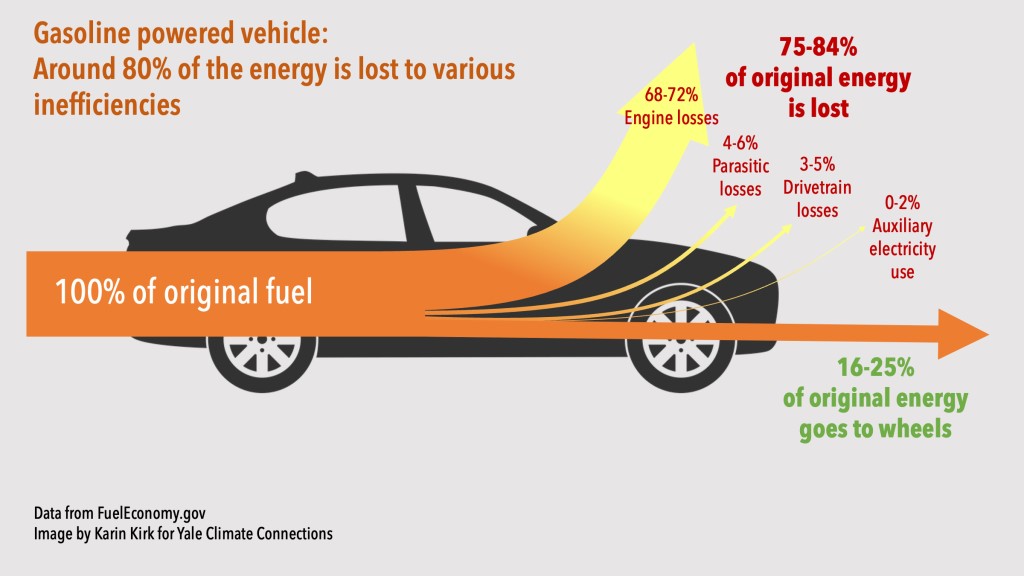
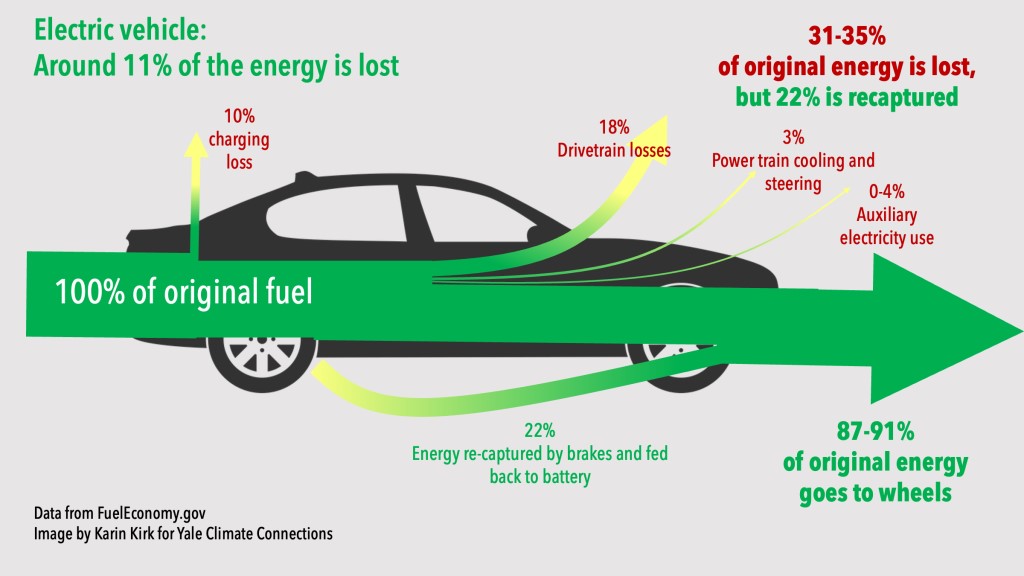
Image showing an ICE car and its various carbon losses | EV Cars Indeed Emit Less Carbon Pollution
16-25% of original energy goes to the wheels. Data from FuelEconomy.gov, Image by Karin Kirk for Yale Connections.
Image showing an EV car and its various carbon losses | EV Cars Indeed Emit Less Carbon Pollution
87-91% of original energy goes to the wheels. Data from FuelEconomy.gov, Image by Karin Kirk for Yale Connections.

The Manufacture and Disposal of EV Cars

It takes more energy to manufacture an EV battery for an EV car than it does to produce a combustion engine. So, the production of an electric vehicle does emit more carbon than a petrol car. However, the lower emissions resulting from driving an EV means that an electric car quickly pays back that debt, so to speak. It is typically paid back within two years, according to Hannah Richie, the research director at Our World in Data. The statistics show that switching from an average ICE to an equally sized EV will save 1.2 tons of carbon emissions per person and year. That is a lot considering that the average carbon footprint per year is 4 tons worldwide and 14.4 tons per year for an American.

So, are electric vehicles definitely better for the climate than gas-powered cars? This article from MIT answers the question in the affirmative. The graph below includes construction of facilities, manufacturing of vehicle and battery, production of fuel, vehicle operation as well as disposal. It  is taken from this government website and this article also answers the question above in the affirmative. This is an article from the Department of Energy is stating the same thing.
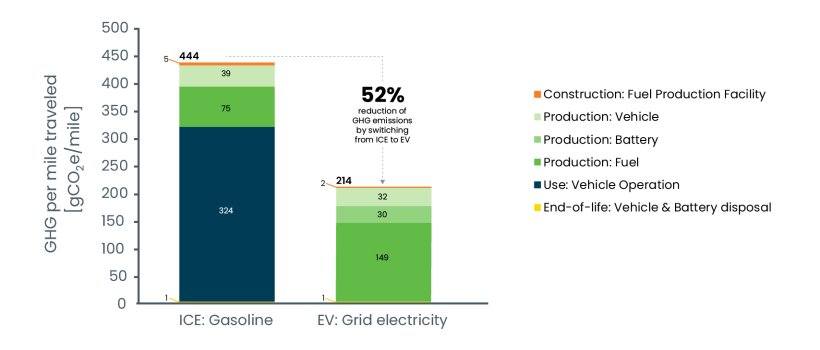
The histogram graph show that if you consider construction of facilities, manufacturing of vehicle and battery, production of fuel, vehicle operation as well as disposal the total average greenhouse gas emissions from EV cars is 52% less.
Lifecycle greenhouse gas emissions comparison of average gasoline car and average EV.

Hannah Richie at Our World in Data also states that other environmental damages related to EVs such as mining for minerals are less than the damage from mining and extraction for fossil fuel cars, and she claims that the price of lithium-ion batteries has fallen by 98% over the last three decades. It should be noted that EVs are becoming increasingly common. According to Our World in Data in 2022, 88% of all cars sold in Norway were EVs and 54% of all cars in Sweden were EVs.
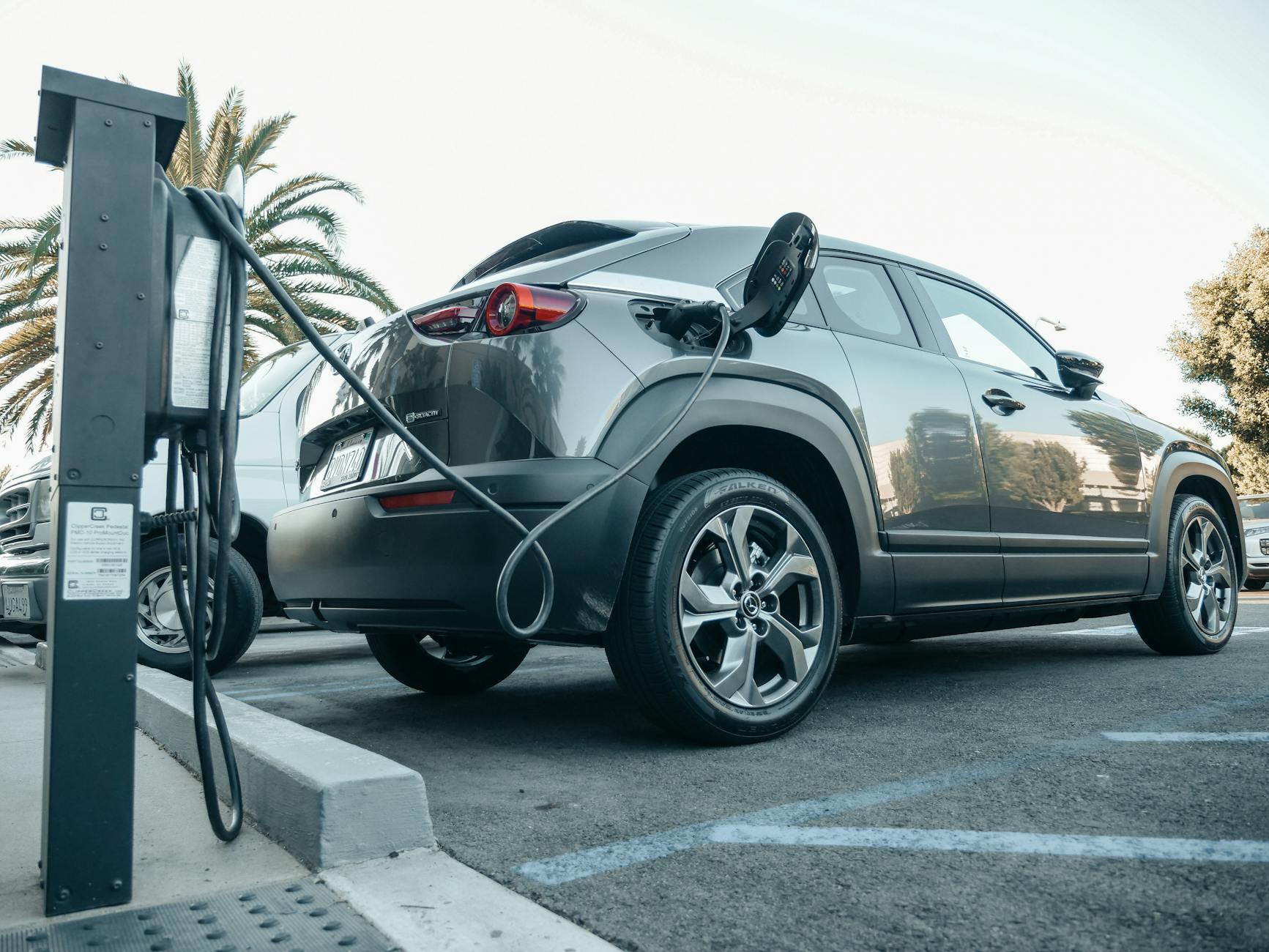
EV Cars Indeed Emit Less Carbon Pollution
Photo by Kindel Media on Pexels.com

Other EV Myths

There are other EV myths that you may want to have debunked, such as Electric vehicle batteries are unreliable and need to be replaced every few years. In 2011 battery failures were common, 7.5%, but in 2023 battery failures were 0.1%. See this article for details and other myth debunking. A related post is my post on electrification.

I should add that there are some drawbacks with EVs such as the easy with which you can charge them, depending on your location. This post is not a promotion of EVs, and I do not drive an EV for various reasons. This post, like most posts in this blog, is about correcting misinformation and getting the facts correct.
To see the other Super Facts click here

Neanderthals Never Lived in Africa

Super fact 27: Neanderthals never lived in Africa. Neanderthals, or Homo Neanderthalensis, lived in Europe and Asia but never in Africa.

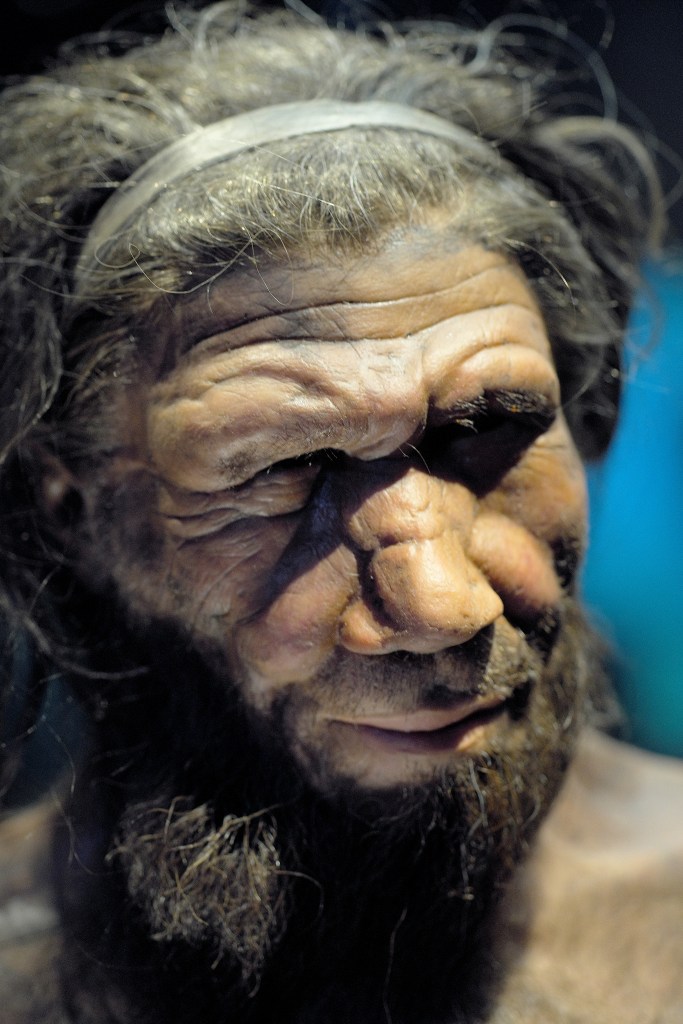
Photo of a reconstruction of a Neanderthal man | Neanderthals Never Lived in Africa
Reconstruction of a Neanderthal by Natural History Museum. Werner Ustorf, CC BY-SA 2.0 <https://creativecommons.org/licenses/by-sa/2.0&gt;, via Wikimedia Commons

It is a common belief that humans originated in Africa. That is true but human ancestry is complicated, and in the past, there were many human species and subspecies. Starting with Homo Erectus, it is estimated that they lived between 1.6 million years ago until about 100,000 years ago.

Homo Erectus was the ancestor of Homo Heidelbergensis (between 700,000 and 200,000 years ago) as well as Homo Floresiensis (hobbit people – between 100,000 and 50,000 years ago). Homo Heidelbergensis in turn was the ancestor of (at least) three homo species, Homo Sapiens (between 300,000 until now), Homo Neanderthalensis (between 400,000 to 40,000 years ago),  and Homo Denisova 300,000 to 25,000 years ago.

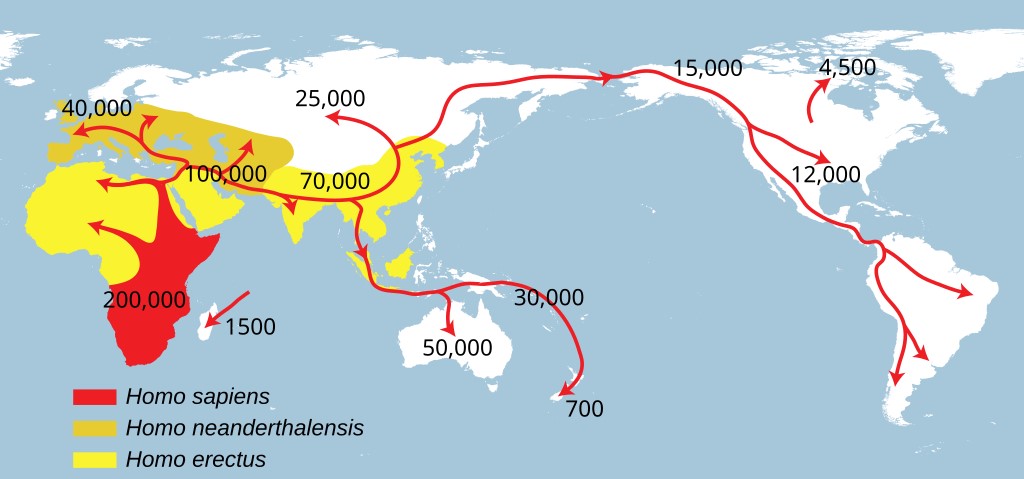
However, note that Homo Neanderthalensis is not an ancestor of Homo Sapiens. Homo Heidelbergensis was an ancestor to both. Homo Neanderthalensis originated in Europe and Asia and stayed there, whilst Homo Sapiens originated in Africa and ventured elsewhere (see picture below).

Homo Neanderthalensis and Homo Sapiens (or Homo Sapiens Sapiens) interbred, and so did Homo Denisova and Homo Sapiens, and Homo Neanderthalensis interbred with Homo Denisova. What a mess! I can add that Homo Neanderthalensis and Homo Sapiens were different species, so it may seem strange that they could interbreed.

However, species is a complex concept and at certain points in history you could consider Homo Neanderthalensis and Homo Sapiens to be different subspecies rather than different species. That is why you sometimes hear the terms Homo Sapiens Neanderthalensis and Homo Sapiens Sapiens. Now when you know how complicated it is, I suggest you take a look at the map below.

A world map showing portions of Africa being yellow and red, and portions of Asia being yellow and dark yellow with red arrows representing migrating Homo Sapiens. The map features several time markers representing the arrival of Homo Sapiens | Neanderthals Never Lived in Africa
The spread of Homo Erectus (yellow), Homo Sapiens (red) and Homo Neanderthalensis (dark yellow). NordNordWest, Public domain, via Wikimedia Commons

I can add that genetic testing can reveal how much Neanderthal DNA you have. I took a test with 23AndMe to find out about my ancestry (it was 98% Scandinavian and Finnish) and to find out about my risk for genetic illnesses. 23AndMe also told me that I was in the 99 percentiles with respect to carrying Neanderthal genes, meaning that I had unusually many Neanderthal genes (but not 99%). However, no one has called me a Neanderthal to my face yet.

The Extent of the Neanderthal Habitat

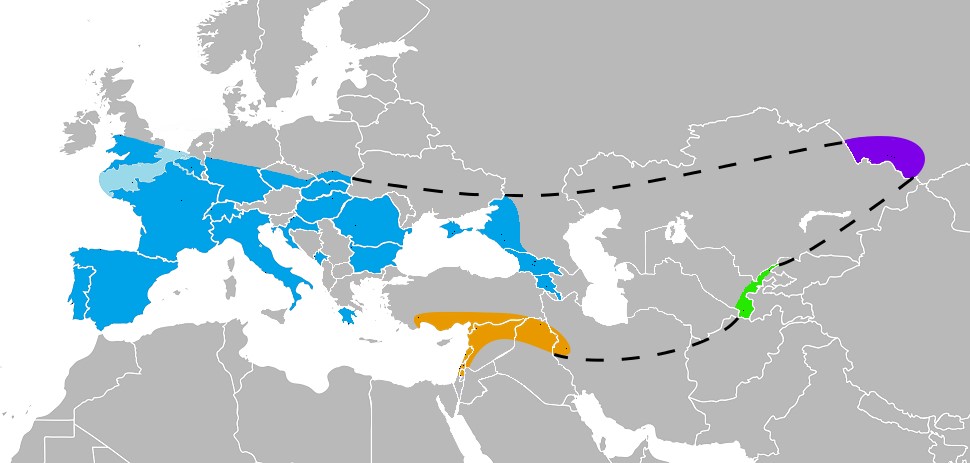
The map below indicates where skeleton remains of Neanderthals had been found as of 2017.

This map of Europe and West Asia shows the region where Neanderthals have been found | Neanderthals Never Lived in Africa
Known Neanderthal range in Europe (blue), Southwest Asia (orange), Uzbekistan (green), and the Altai mountains (violet), as inferred by their skeletal remains (not stone tools). There were 165 such places by 2017. Nilenbert, N. Perrault, auteur du guide complet du canotageI, CC BY-SA 3.0 <http://creativecommons.org/licenses/by-sa/3.0/&gt;, via Wikimedia Commons

Other Neanderthal Facts

There are a lot of other interesting and surprising facts about Neanderthals, such as:

  • They lived in caves, but they also built shelters.
  • They had complex tools and skills, cooked and processed food and created art and jewelry, cooked glue, and had musical instruments (for example a bone flute).
  • Neanderthals not only used fire, they were able to control and maintain fire, and they used it to cook food, make tools, and for warmth and shelter.
  • Neanderthals were stockier and more muscular than modern humans, with broader rib cages and shorter limbs. This helped them conserve heat and survive in the cold environments in Europe and Asia during the ice ages.
  • They might have spoken language.
  • There’s evidence that they were seafaring as far back as 200,000 to 150,000 years ago.
  • Their brains were larger than ours. The braincases of Neanderthal men and women averaged about 1,600 cm3 and 1,300 cm3, respectively, which is considerably larger than the modern human average (1,260 cm3 and 1,130 cm3, respectively).
  • They had medical knowledge. They had knowledge of medicinal plants and well-healed fractures on many bones indicate the setting of splints. They also knew how to treat wounds.
  • They hunted big game.
  • They interbred with modern humans.

The Cause of the Ice Ages

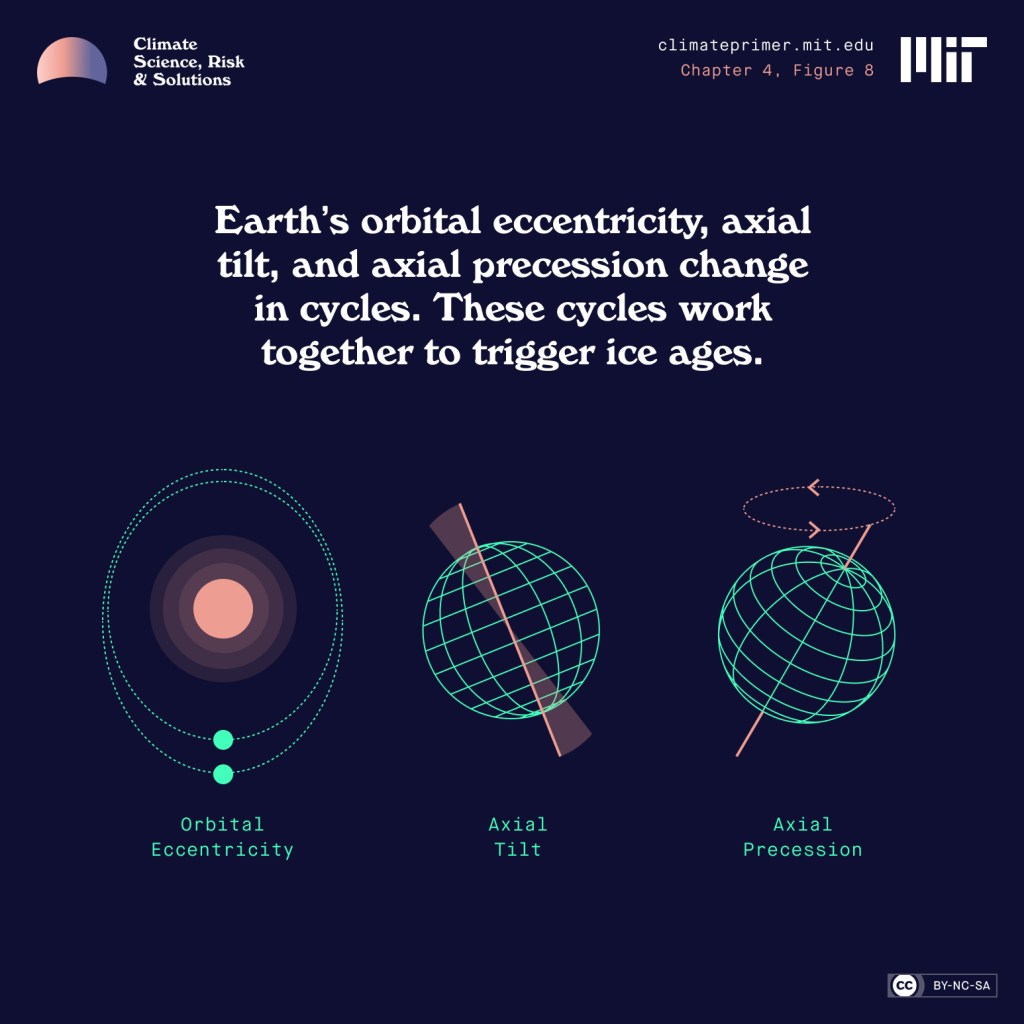
Regarding the Ice Ages, which were a great challenge to Neanderthals, they are caused by earth’s orbital cycles. However, keep in mind that does not mean that orbital cycles are causing the current rapid global warming. NASA keeps track of the orbital cycles, and they should slowly be causing a cool down right now, not a  rapid warming. In addition, if the warming was caused by orbital cycles (or the sun), the upper troposphere would be warming as well as the lower troposphere.

However, what we are seeing is a warming of the lower troposphere and cooling of the upper troposphere consistent with greenhouse gas emissions causing the warming (the blanket effect). To read more about what is causing the current global warming, click here.

Three illustrated orbital cycles. On the left orbital eccentricity, in the middle is the axial tilt and on the right axial precession.
Illustration of Milankovitch cycles from MIT’s Climate Primer.

Above from PBS explanation and overview of earth’s three orbital cycles.

Endangered Species

When I was a teenager, I read a few of Jean M. Auels novels about pre-historic humans.  I loved them and I saw the movie. Now I am reading Jacqui Murray’s novels about pre-historic humans. Jacqui Murray’s books are even more fascinating and very realistic and well researched.

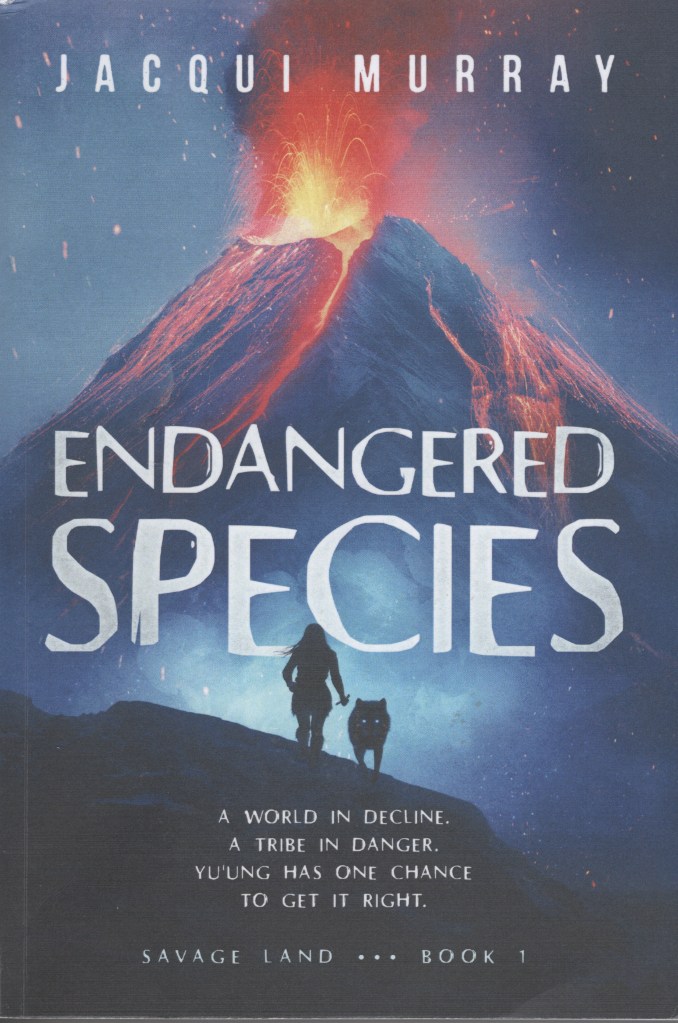
The latest Jacqui Murray book I’ve read is Endangered Species, the first book in her new series Savage Lands. This book is set to take place 75,000 years ago among Neanderthals and ancient Homo sapiens. I love all her books, but especially Endangered Species. I was also happy that she included canines as heroes in the book (Ump, White Streak, etc.) I am a dog lover after all. I can add that at the end of the book there are a lot of interesting Neanderthal Facts.

You can read my Amazon review for Endangered Species by clicking here and you can read my Virtual Book Blast post for Endangered Species (promoting this book) by clicking here. All the Virtual Book Blasts for Endangered Species feature interesting Neanderthal facts. To see a few more Virtual Book Blasts for this book click on the links in the list below.

  • Virtual Book Blast for Endangered Species – Darlene Foster – Click here
  • Virtual Book Blast for Endangered Species – Liz Gauffreau – Click here
  • Virtual Book Blast for Endangered Species – Carol Cooks – Click here
  • Virtual Book Blast for Endangered Species – John Howell – Click here
  • Virtual Book Blast for Endangered Species – Booomcha, Kymber Hawke – Click here
Front cover of Endangered Species by Jacqui Murray
Front cover of Endangered Species. Click on the image to go to the Amazon page for the paperback version of the book.
To see the other Super Facts click here

The Special Theory of Relativity by David Bohm

The goal of this blog is to create a list of what I call super facts. Super facts are important and true facts that are nevertheless highly surprising to many, disputed among the public, or unnecessarily misunderstood. They are special facts that we all can learn something important from. However, I also make posts that are not super facts but feature other interesting information, such as this book review and book recommendation.

The Special Theory of Relativity by David Bohm

David Bohm a close colleague of Albert Einstein was one of the most interesting theoretical physicists of the 20th century. This book “The Special Theory of Relativity” is one of the most interesting and thorough introductory books on the Special Theory of Relativity that I have come across. It is a series of lectures on the topic. It features algebra, equations, and a little bit of differentials but not too much.

You may want to have some math, physics and some relativity under your belt before you tackle this book. In my estimate it is written for those who have taken high school AP physics and AP algebra, maybe calculus as well, or one or two college level physics classes and math classes (or more). It is probably too basic for professional physicists, but it is not written for laymen. I bought the paperback version.

  • Hardback –  Routledge; 1st edition (October 10, 1996), ISBN-10 : 0415148081, ISBN-13 : 978-0415148085, 256 pages, item weight : 13.6 ounces, dimensions : ‎ 5.75 x 0.75 x 9 inches. It is out of stock, and it costs $75.60 – $144.00 on US Amazon. Click here to order it from Amazon.com.
  • Paperback –  Publisher : Routledge; 1st edition (September 4, 2006), ASIN : 0415404258, ISBN-13 : 978-0415404259, 304 pages, item weight : 12 ounces, dimensions : 5.08 x 0.69 x 7.8 inches. It is out of stock, and it costs $12.36 – $17.21 on US Amazon. Click here to order it from Amazon.com.
  • Kindle –  Published : Routledge; 1st edition (September 29, 2015), ASIN : B009W3W6MG, 306 pages, it costs $10.10 – $13.77 on US Amazon. Click here to order it from Amazon.com.
The front cover of “The Special Theory of Relativity by David Bohm.”
Front cover of the paperback version of The Special Theory of Relativity by David Bohm. Click on the image to go to the Amazon page for the paperback version of the book.

Amazon’s Description of the Book

In these inspiring lectures David Bohm explores Albert Einstein’s celebrated Theory of Relativity that transformed forever the way we think about time and space. Yet for Bohm the implications of the theory were far more revolutionary both in scope and impact even than this. Stepping back from dense theoretical and scientific detail in this eye-opening work, Bohm describes how the notion of relativity strikes at the heart of our very conception of the universe, regardless of whether we are physicists or philosophers.

This is my five-star review for The Special Theory of Relativity

Note, I wrote this review in 2014, so it is relatively old, pun intended.

Lorentz Electrodynamics, Special Relativity, and our Perception of Reality

This book is a thorough and well written introduction to the “Special Theory of Relativity”. In addition to the basics of special relativity it covers the history of Special Relativity and it includes 60-pages of Lorentz Electrodynamics. The book also discusses Minkowski Diagrams, the Twin Paradox, relativistic Doppler effects, K-Calculus, and philosophy related to relativity. The book does not discuss General Relativity.

Bohm does not derive many formulas for electrodynamics, optics, quantum physics, thermodynamics, etc., and therefore this book does not resemble a textbook. Bohm’s focus is on a deeper understanding of the special theory of relativity itself, and on time and space.

He discusses perception of reality and includes discussions on child development, psychology and neurology related to perception, the meaning of the relational concepts in relativity, the structure of scientific revolutions (T.S. Kuhn), our perceptions of time and space, philosophy, and other related topics that cannot be classified as physics.

In K Calculus you draw the world lines of light pulses sent at constant intervals between different observers. Then you calculate what is essentially the Doppler factor K and uses it to explain what is going in relativity. In contrast the Lorentz transform is concerned with the space-time coordinates that you measure after taking into account that light have to travel a certain distance and that this takes time. Basically, the “actual time and space coordinates”.

K Calculus on the other hand is including both relativistic effects and the distance and time it takes for light to travel. K Calculus is thus not what you “measure” but what you “observe”. K Calculus makes it very easy to explain special relativity to an audience that is not strong in math and it also adds a new understanding to the special theory of relativity.

However, I see an inherent risk with K-Calculus in that it can end up fooling the student into believing that he understands relativity, for example, if a student incorrectly comes to believe that time dilation is some form of Doppler Effect.

Except for the fact that some of the mathematical derivations were unnecessarily complex I thought this book presented relativity lucidly, the philosophical discussions were insightful, and it added to my understanding of the topic. It should probably not be your first book on Special Relativity but it is a very good second book. I highly recommend it for those who want to think through the concepts of relativity a little deeper.

The back cover of "The Special Theory of Relativity by David Bohm"
Back cover of the paperback version of The Special Theory of Relativity by David Bohm. Click on the image to go to the Amazon page for the kindle version of the book.

To see the Super Facts click here

The Great Sun and Moon Spectacle

We are all in our places with sunshiny faces  ready to experience the astronomical event of the century, a spectacle that Mr. Sun, Sun, Golden Mr. Sun and the moon provided for us.

This is a submission for Kevin’s No Theme Thursday

The Great Sun and Moon Spectacle
Image by Kevin from The Beginning at Last

For us in Dallas, Texas, 2024 was the year when the sun and the moon put up an unforgettable spectacle for all of us to see. On April 8, 2024, the sun and the moon and earth lined up perfectly so that the moon fully covered the sun. We had a total solar eclipse, and we were lucky with the weather. I can add that experiencing a total solar eclipse is quite different from experiencing a partial or annular solar eclipse. I’ve experienced a partial solar eclipse as well and I can attest to the difference.

Unlike a partial eclipse, it gets dark during a total solar eclipse, the stars come out if the sky is clear like it was. The birds and the insects become quiet. It happens very suddenly, in just a few seconds. The total solar eclipse lasted four minutes.

The Motion of the Sun and the Moon

To understand what a solar eclipse is, the video below might help. What you see is the moon and the earth as seen from the sun’s viewpoint. We see earth all lit up by the sun, like a full moon, and we also see the moon lit up by the sun. 

In this situation, when the people on earth look up in the sky, they see the sun, but they don’t see the moon, even though it is there. It is a new moon, or a black moon if it happens twice in the same month. As the moon begins to partially cover the sun the shadows on the ground start looking different and if you use solar eclipse glasses you can see the sun disappearing and looking like a bright crescent, but it is still daylight and looking at the sun without eclipse glasses would just hurt your eyes.

Well, this is true until the sun is fully covered by the moon. When that happens, the light turns off and at that point it is safe to look at the sun without glasses. What you’ll see is a pitch-black circle in the sky surrounded by wispy faint lights. Those wispy faint lights are the sun’s corona.

Below is a youTube video showing an animation composed of actual satellite photos by NASA.


Solar Eclipse Preparation

I drank a very special beer for the occasion, a Trappist Belgian Strong Ale, or Quadruple, called Westvleteren 12 from Brouwerij Westvleteren (Sint-Sixtusabdij van Westvleteren).

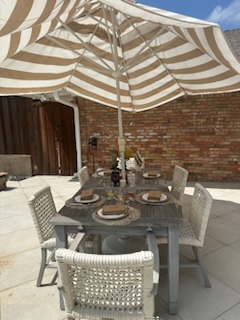
A table set for five with a large parasol | The Great Sun and Moon Spectacle
Our patio table. The little brown packages contain AAS / ISO certified solar eclipse glasses.
My daughter holding a Westvleteren 12 glass with a bow. Grandpa and grandma sitting on chairs in the background | The Great Sun and Moon Spectacle
Our daughter holding a Westvleteren 12 glass with a bow. Grandpa and grandma in the background.
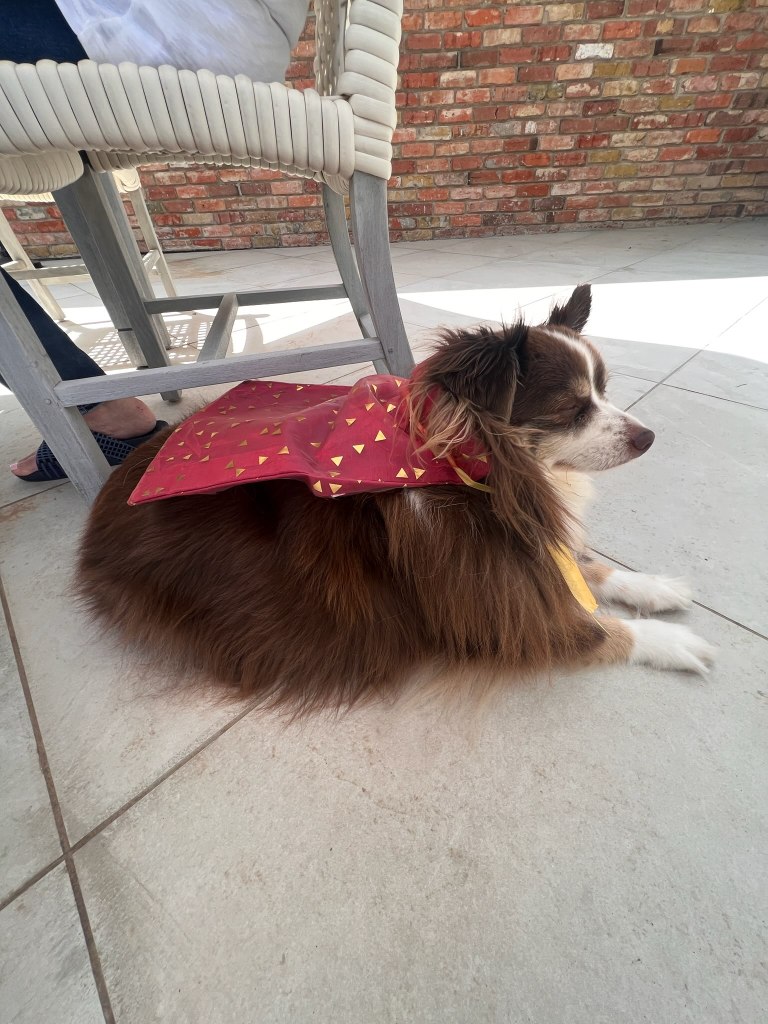
A mini-Australian Shepherd sitting on the patio floor | The Great Sun and Moon Spectacle
Rollo our mini-Australian Shepherd on the patio.

The Partial Eclipse Phase

It was partially cloudy during the partial eclipse, but we were able to get a good look at the eclipse as it progressed. As mentioned, to see the partial eclipse, you have to use good solar eclipse glasses. It is primarily for safety reasons, but it is also pointless to look at the sun during a partial eclipse. You won’t see the eclipse crescent because the powerful light from the sun overwhelms your view.

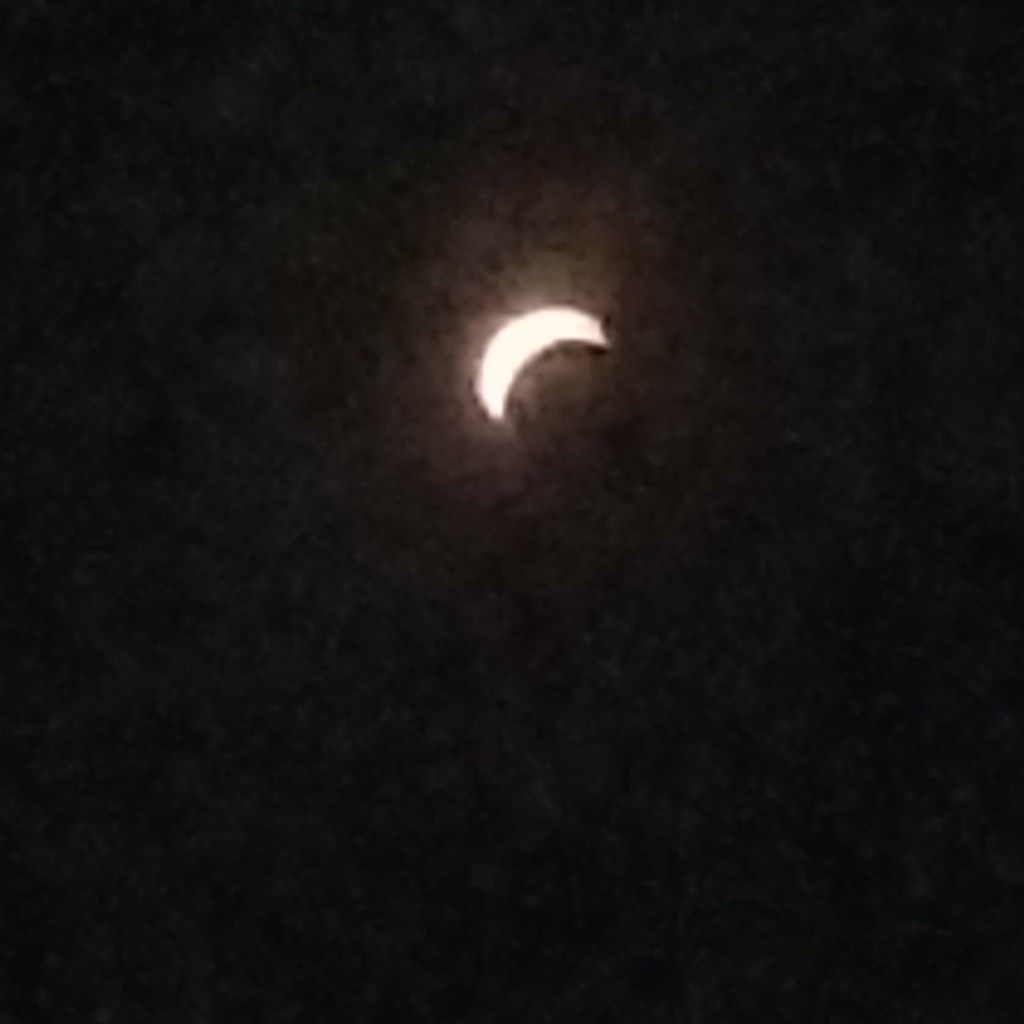
I had a little filter that was placed in front of my phone camera as I took a few pictures. Admittedly they were pretty bad. I have an old Samsung Galaxy S8+ but even using newer phones it is difficult to get decent photos of something like this.

The photo shows a shiny crescent on black background | The Great Sun and Moon Spectacle
Partial eclipse photo taken with my old Samsung Galaxy phone and a filter.

The Total Eclipse

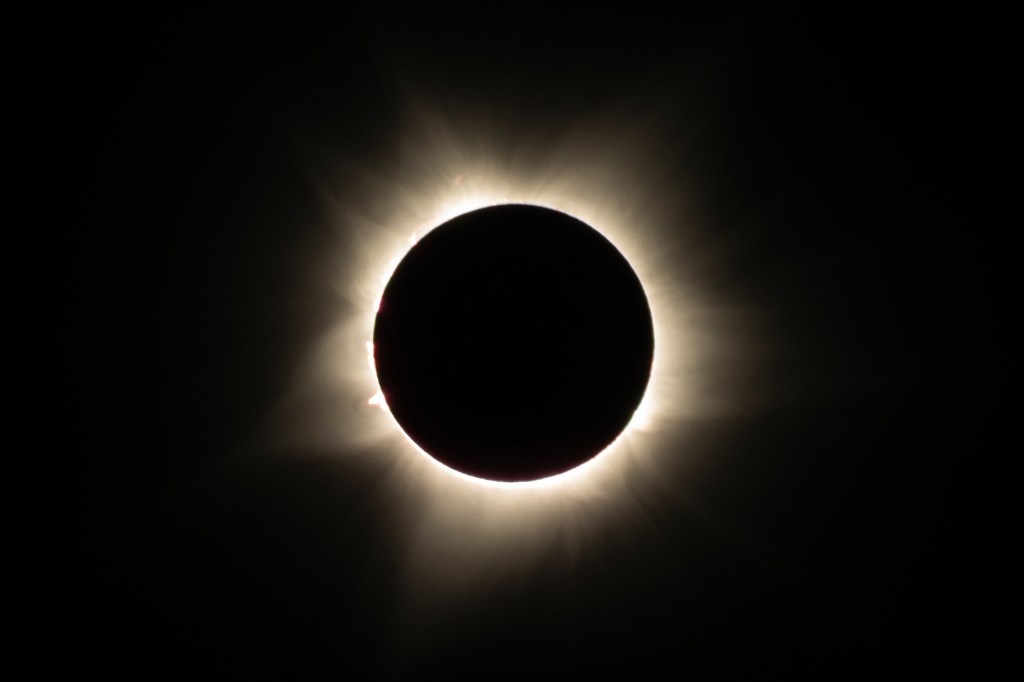
At 1:40PM Dallas time the total solar eclipse happened and luckily it was not covered by clouds. At this point it suddenly got dark and it was safe to look straight at the sun without using the eclipse glasses. The total eclipse lasted four minutes. I have included a shutter stock photo below which closely represents what we actually saw. We saw a black circle and around the black circle was a wispy white fog like light. This was the sun’s corona and it shone with about the same power as the full moon. It kind of looked like a black hole.

Black circle surrounded by a wispy white fog like light. That’s the sun’s corona | The Great Sun and Moon Spectacle
Except for the black background this looks like what we saw with our eyes. The sky we had was dark, like twilight, but not black. Solar Eclipse Stock Photo ID: 2344355767 by aeonWAVE

The Stars and the Planet Venus

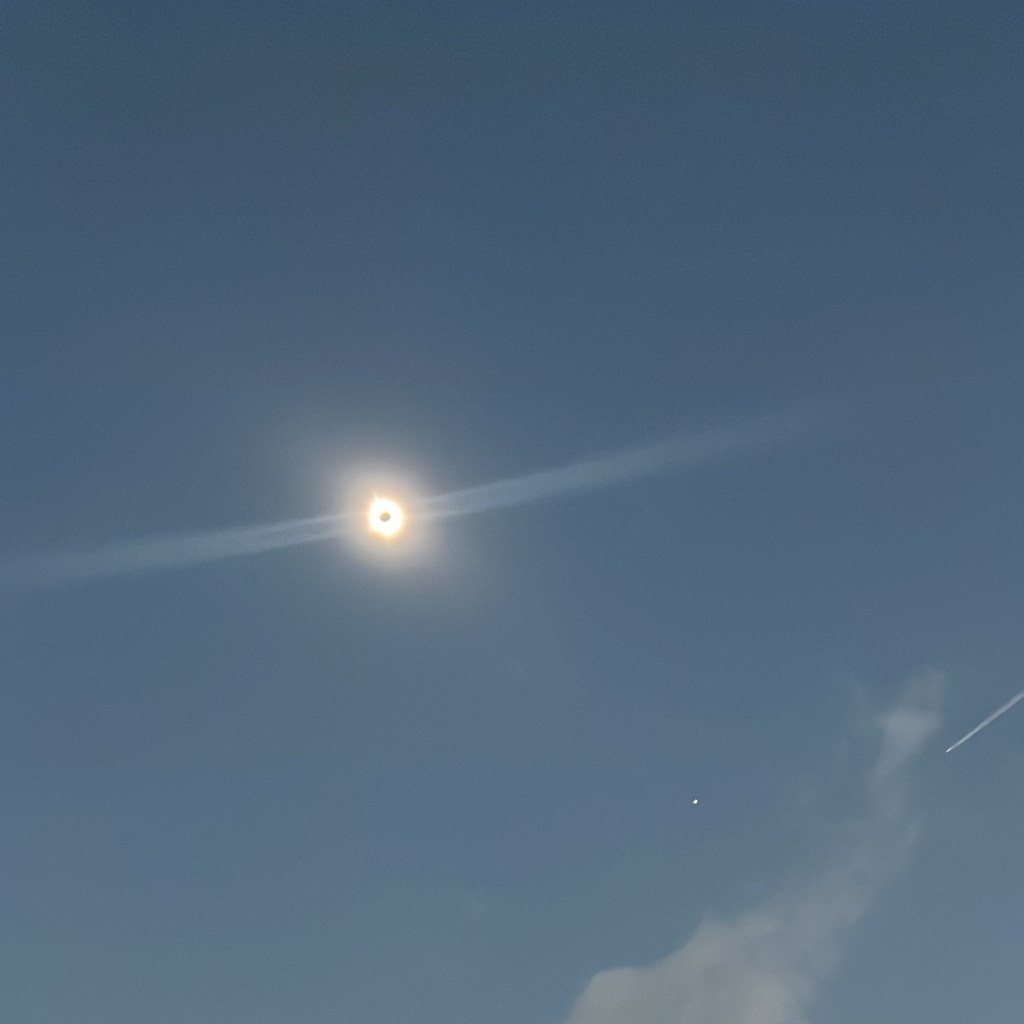
The photo shows the sun totally covered by the moon. It is very small in the photo. There is star like object, that’s Venus, a cloud and airplane contrail | The Great Sun and Moon Spectacle
Total solar eclipse photo that my daughter took. Can you find Venus?

Total Eclipse Photos

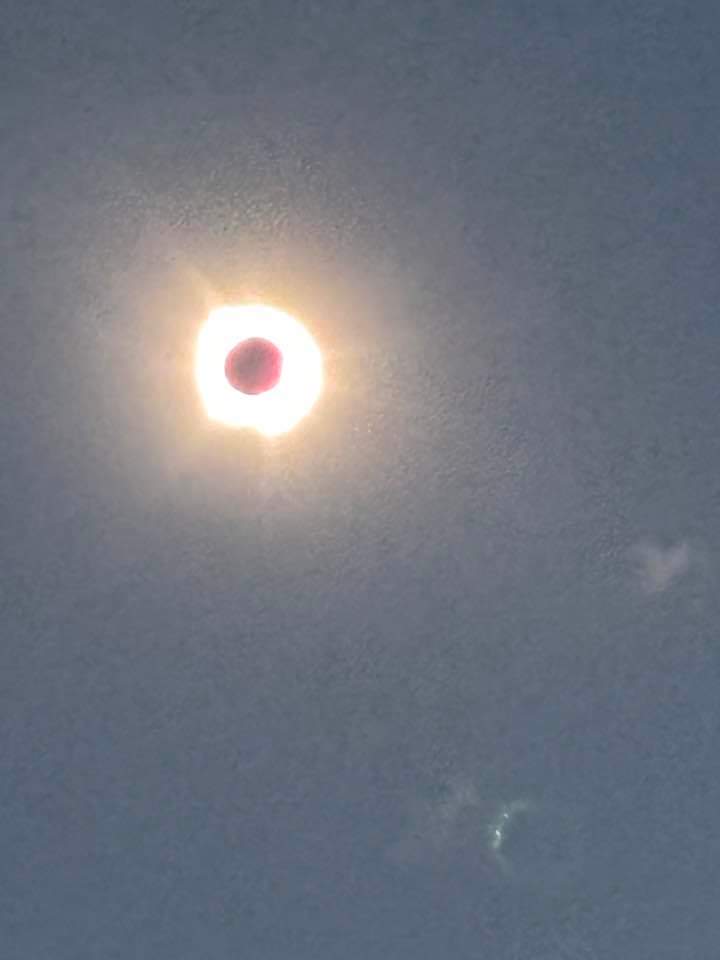
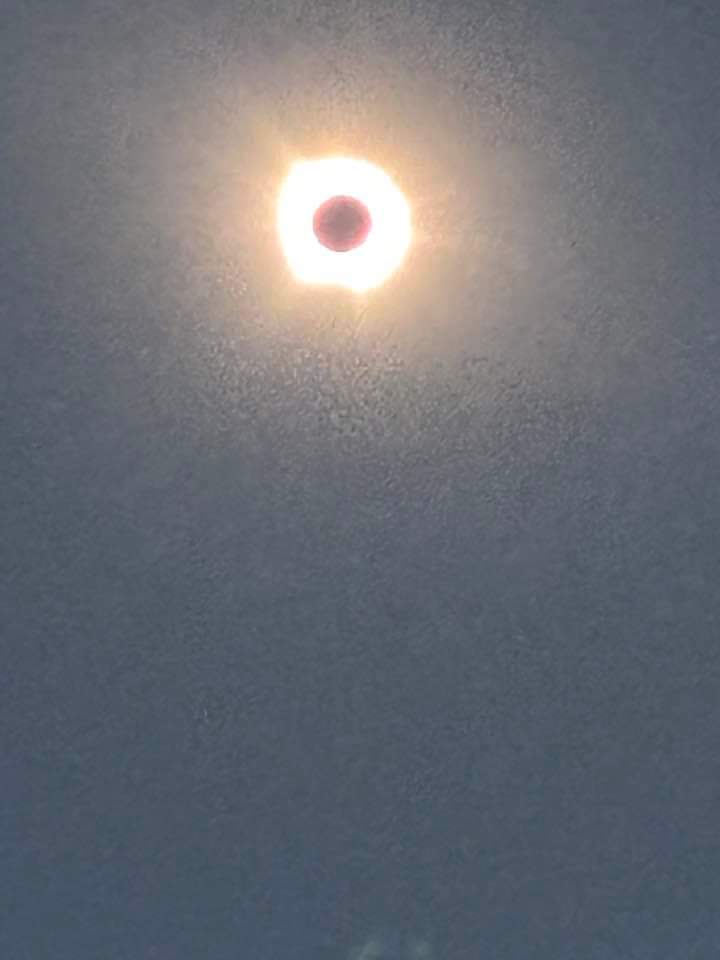
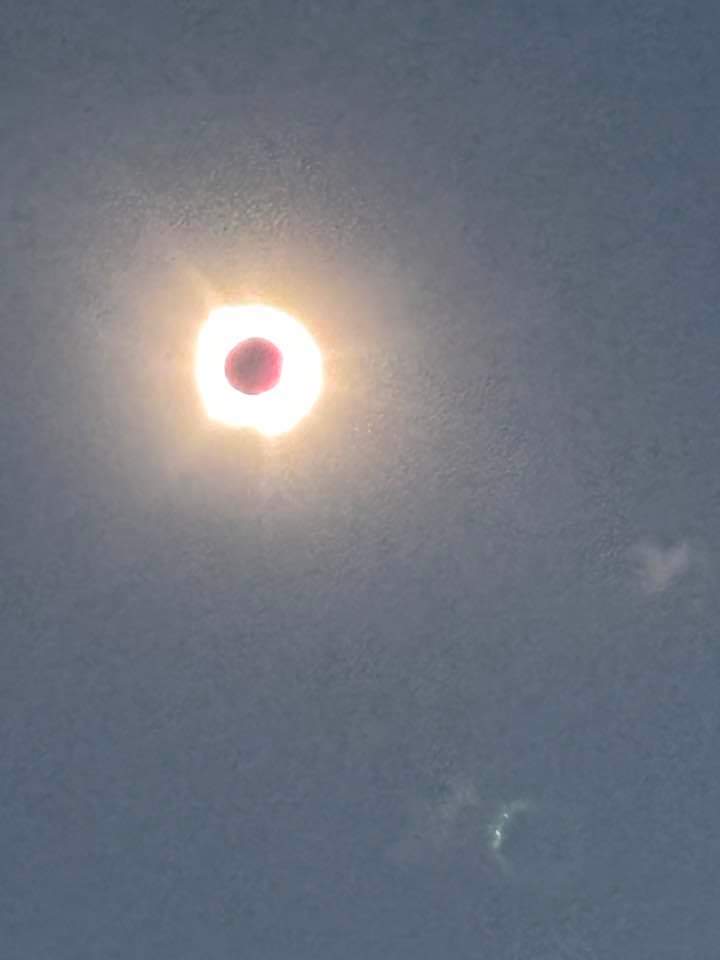
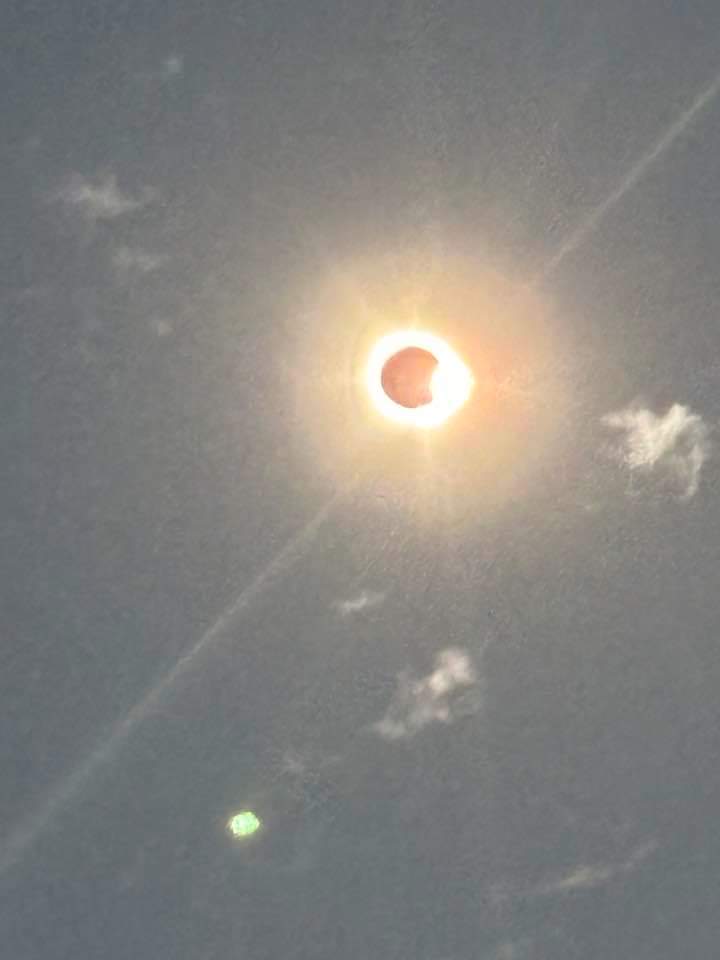
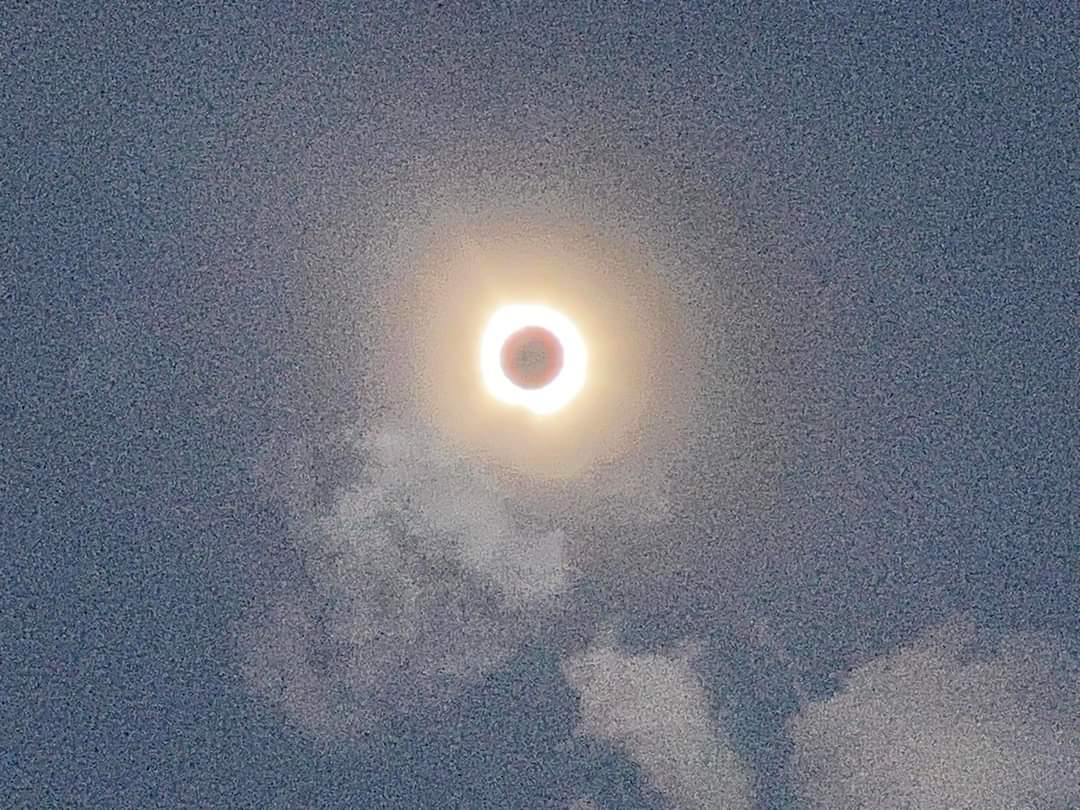
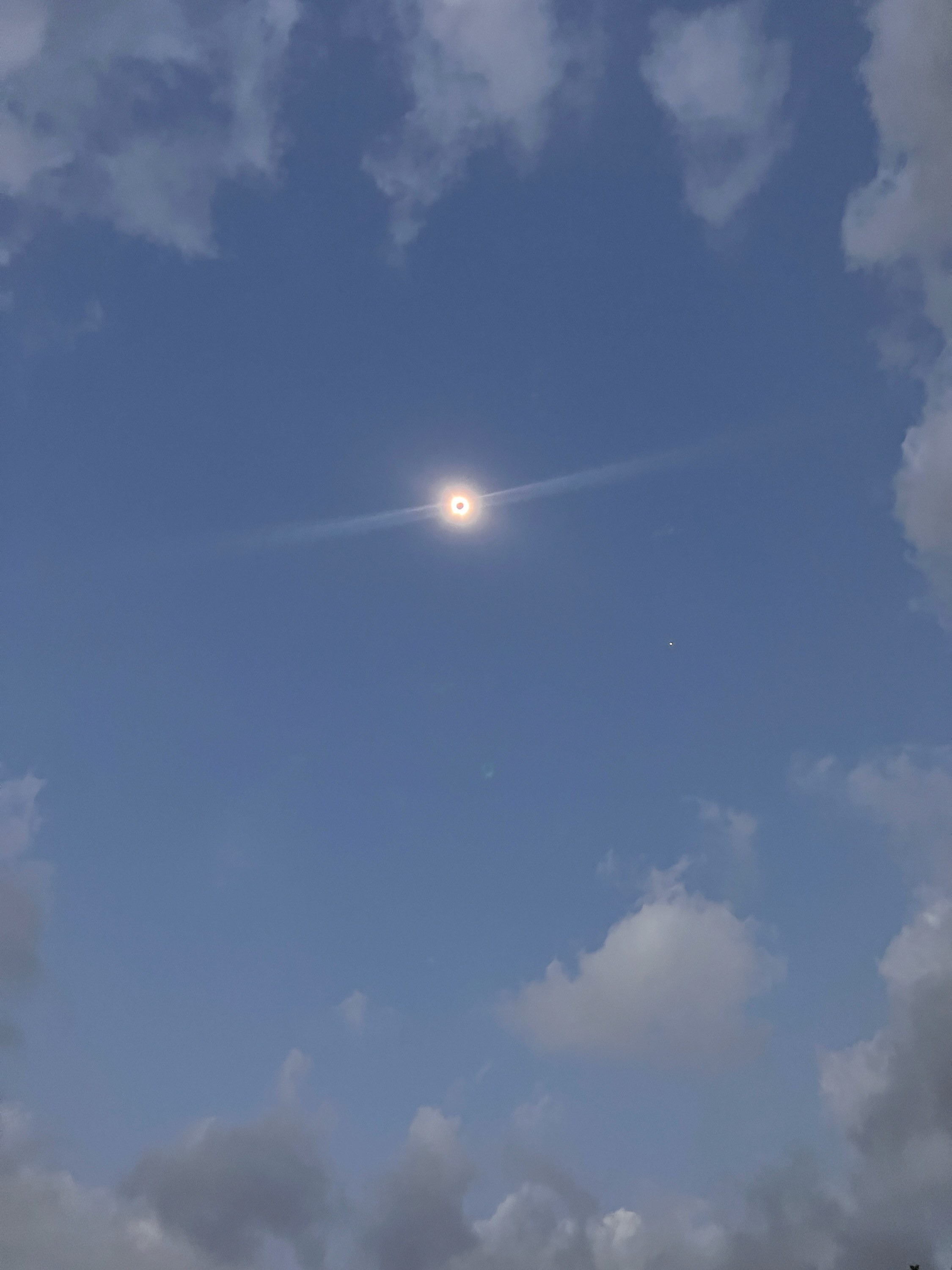
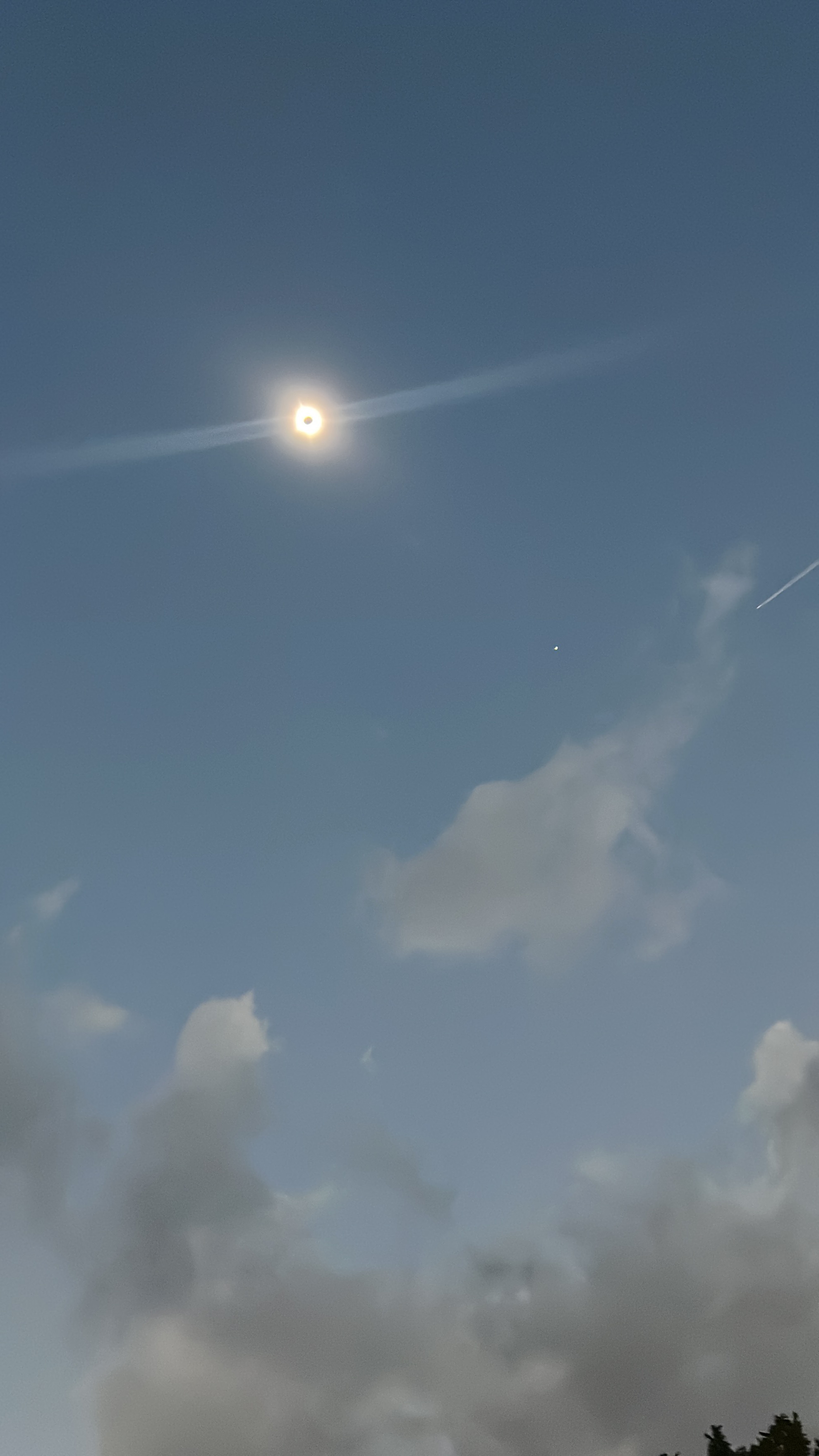
These eight pictures were taken with cell phones by my daughter Rachel, Denise Mosier-Wanken, and Margaret Weiss Bloebaum.

Did you see the total solar eclipse?


To see the Super Facts click here


Black Moon

Today, December 30, 2024, we are having what is called a Black Moon. In Europe it will be December 31.  This is not a super-fact post. Just some lighthearted information about the Black Moon phenomenon.

What is a Black Moon?

The most common definition is that it is the second new moon in a single calendar month. That’s what we are having now. During a new moon the moon is located between the sun and earth, which means that the night side of the moon is directed towards us. At night it is usually below the horizon and during the day you can’t see it.

However, there is one exception to that and that is when you are having a solar eclipse. In that case the moon is directly in front of the sun. It is an unusually well-placed new moon if you will. Here in Dallas, we had a total solar eclipse on April 8 this year. It was a remarkable experience. It turned daker, cooler, some stars and planets came out, including Venus, and the birds and insects stopped singing. I have included some photos from that event below. What you see is the dark side of the moon with the sun hiding behind it.

The sun is shaped like a moon crescent but bright.
I took this photo with my old Samsung 8+ phone before we had totality. Since the sun was still partially visible and bright I used a filter / a pair of glasses that I held in front of the phone.
There’s a black circle in the middle with a light around it, and an especially bright light on the right side | Black Moon
A friend Denise Mosier-Wanken took this photo with her phone. The sun is almost gone. The fuzzy fog like light around the black circle is the sun’s corona.
There’s a black circle in the middle with a light around it.
My daughter Rachel took this photo with her iPhone.
A professional solar eclipse photo with filter. Black Moon.
A professional solar eclipse photo with filter. What we saw with our eyes was something in between this photo and the photos we took. The corona in our photos is too big. This one is too small. Stock Photo ID: 2344355767 by aeonWAVE.

Alternative Definitions of a Black Moon

As mentioned, the most common definition of a black moon is that it is the second new moon in a single calendar month. However, there are other definitions:

  • A month with no full moon
  • A month with no new moon
  • The third new moon in a season with four new moons. A season is defined as the period between a solstice and an equinox and is roughly three months.

A New Moon is a Star Gazing Opportunity

Since there is no moon in the sky the night is a little bit darker. This makes a significant difference in places that are very dark and very far away from city lights. There is so much light pollution here in Dallas, so it doesn’t matter here. However, I still took out my little telescope and observed easy objects, such as Venus, Mars, Jupiter and its four Galilean moons.

Jupiter in the middle. It is a greenish speck with lines. It is surrounded by three white dots.
The three little dots are three of the four Galilean Moons. I roughly saw this in my telescope a couple of hours ago, but it is not my photo. Photo by Raoni Aldrich Dorim on Pexels.com

The Near Side and the Far Side of the Moon

The moon is always showing us the same side, the so-called near side. The far side, or the back side, you can only see from spacecrafts. Look at the photo below. The near side is on the left whilst the far side is on the right. During a new moon the near side (left) is dark, and the far side (right) is lit up by the sun. But again, you cannot see the far side (right), which is turned away from us.

During a full moon the near side (left) is lit up by the sun, and the far side (right) is dark. One interesting fact about the moon is that the near side (left) and the far side (right) are very different. The far side (right) not only looks different, it has a crust that is much thicker compared to the near side, and it is also densely cratered compared to the near side.

On the left is the near side of the moon and on the right the far side of the moon | Black Moon
The near side of the Moon and the far side of the Moon. Comparison between the two hemispheres of the Moon. Elements of this image were furnished by NASA. Stock Photo ID: 2157518223 by Claudio Caridi.

Below is a youTube video showing an animation composed of actual satellite photos by NASA.

In this video the near side of the moon is dark. It is a new moon and the people on earth don’t see the moon. The sun is behind us and lights up both earth and the far side of the moon (the side people on earth do not see), so that is what the space craft see.

Happy New Year

Finally, a Happy New Year to all of you from Rollo and me. He may not look that happy but that is because I am leaving over the New Years. We have a dog sitter though. For the same reason I will not be on-line tomorrow.

Our mini-Australian Shepherd is looking into the camera. He is looking a tad sad.
Happy New Year from Rollo

To see the Super Facts click here